![]()
1
Introduction to 60 GHz1
Su-Khiong (SK) Yong
1.1 What is 60 GHz?
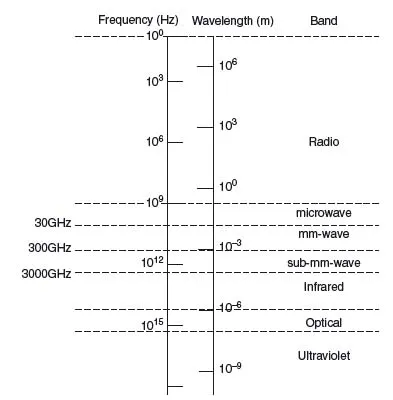
Since the first wireless transatlantic radio wave transmission demonstration by Marconi from Cornwall, England, to Newfoundland, Canada, in 1901 (based on long wave), wireless communications have undergone tremendous growth. They were first used mainly by military and shipping companies and later quickly expanded into commercial use such as commercial broadcasting services (such as shortwave, AM and FM radio, terrestrial TV), cellular telephony, and global positioning service (GPS), wireless local area network (WLAN), and wireless personal area network (WPAN) technologies. Today, these wireless communications systems have become an integral part of daily life and continue to evolve in providing better quality and user experience. One of the recent emerging wireless technologies is millimeter-wave (mm-wave) technology. It is important to note that mm-wave technology has been known for many decades, but has mainly been deployed for military applications. Over the past 5–6 years, advances in process technologies and low cost integration solutions have made mm-wave a technology to watch and begun to attract a great deal of interest from academia, industry and standardization bodies. In very broad terms, mm-wave technology is concerned with that part of the electromagnetic spectrum between 30 and 300 GHz, corresponding to wavelengths from 10 mm to 1 mm [1], as shown in Figure 1.1. In this book, however, we will focus specifically on 60 GHz radio2 which enables many new applications that are difficult if not impossible to offer by wireless systems at lower frequencies, as discussed in Section 1.3.
1.2 Comparison with other Unlicensed Systems
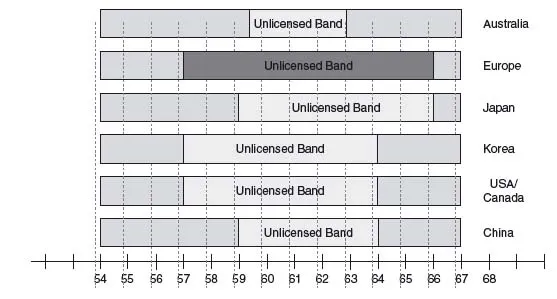
60 GHz technology offers various advantages over current or existing communications systems [2]. One major reason for the recent interest in 60 GHz technology is the huge unlicensed bandwidth. As shown in Figure 1.2, at least 5 GHz of continuous bandwidth is available in many countries worldwide. While this is comparable to the unlicensed bandwidth allocated for ultra-wideband (UWB) purposes [3], the 60 GHz bandwidth is continuous and less restricted in terms of power limits. This is due to the fact that UWB system is an overlay system and thus subject to very strict and different regulations [4]. The large bandwidth at 60 GHz is one of the largest unlicensed bandwidths ever to be allocated. This huge bandwidth represents great potential in terms of capacity and flexibility, making 60 GHz technology particularly attractive for gigabit wireless applications (see Section 1.3).
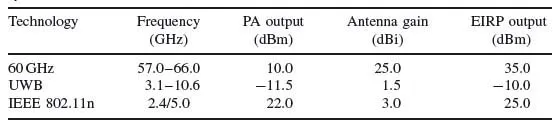
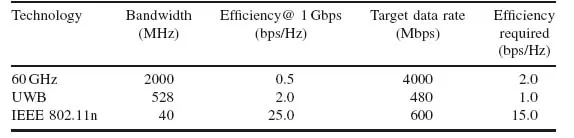
Furthermore, 60 GHz regulation allows much higher transmit power – equivalent isotropic radiated power (EIRP) – compared to other existing WLAN and WPAN systems. Table 1.1 shows examples of typical 60 GHz, UWB and IEEE 802.11 systems that operate near the US Federal Communications Commission (FCC) regulatory limit.
The output power of a power amplifier for 60 GHz is typically limited to 10 dBm because the implementation of efficient power amplifiers at this frequency is very challenging (see Chapter 3 for more discussion) though FCC regulations allow up to 27 dBm. However, the huge antenna gain up to 40 dBi has significantly boosted the allowable EIRP limits. On the other hand, UWB systems which are required to meet the strict power spectrum mask of –41.3 dBm/MHz based on FCC regulations, thus offer only very limited EIRP of the order of –10 dBm. This makes the UWB system a very short-range and low-power device. In contrast, the design of power amplifiers for 2.4/5.0GHz is simpler and can deliver much higher power than the 60 GHz system. However, the EIRP limit is typically confined to 30 dBm due to the crowded Industrial, Scientific and Medical band. It can be seen from Table 1.1 that the EIRP of the 60 GHz system is approximately 10 times larger than the IEEE 802.1 1n and 30000 times larger than the UWB system.
The higher transmit power is necessary to overcome the higher path loss at 60 GHz. While the high path loss seems to be a disadvantage at 60 GHz, it confines the 60 GHz operation to within a room in an indoor environment. Hence, the effective interference levels for 60 GHz are less severe than those systems located in the congested 2.0–2.5 GHz and 5.0–5.8 GHz regions.
The huge bandwidth available for 60 GHz and UWB systems also simplifies the system design of these technologies. A system with much lower spectral efficiency can be designed to deliver a Gbps transmission to provide low cost and simple implementation. Table 1.2 shows the spectral efficiency required by the 60 GHz, UWB and IEEE 802.11 systems to achieve 1 Gbps transmission as well as spectral efficiency of the actual deployment of such systems. A typical 60 GHz system requires only 0.4bps/Hz to achieve 1 Gbps, making it an ideal candidate to support very high data rate applications using simple modulation. Though the UWB system only requires 2bps/Hz to achieve 1 Gbps, its actual deployment is limited to 400Mbps at 1 m operating range. IEEE 802.1 1n-alike systems will require 25 bps/Hz in order to achieve 1 Gbps, making the extension of such system to beyond 1 Gbps unappealing in terms of cost and implementation. A more detailed discussion on the modulation choice for 60 GHz is presented in Chapter 4.
In addition, the huge path loss at 60 GHz enables higher-frequency reuse in each indoor environment, thus allowing a very high-throughput network. The compact size of 60 GHz radio also permits multiple-antenna solutions at the user terminal that are otherwise difficult if not impossible at lower frequencies. Compared to 5 GHz systems, the form factor of 60 GHz systems is approximately 140 times smaller and thus can be conveniently integrated into consumer electronic products.
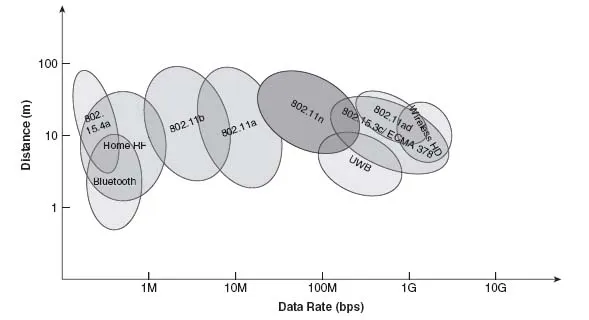
Despite of the various advantages offered, 60 GHz based communications suffer a number of critical problems that must be solved. Figure 1.3 shows the data rates and range requirements for a number of WLAN and WPAN systems.
Since there is a need to distinguish between different standards for broader market exploitation, the 60 GHz related standards are positioned to provide gigabit rates and longer operating range than the UWB systems but shorter than that of IEEE 802.1 1n systems. Typically, 60 GHz systems are designed to provide multi-gigabit data rates with operating range below 20 m to support various applications as described in Section 1.3. At such rate and range, it will be a non-trivial task for 60 GHz systems to provide sufficient power margin to ensure a reliable communication link. Furthermore, the delay spread of the channel under study is another limiting factor for high-speed transmissions. Large delay spread values can easily increase the complexity of the system beyond the practical limit for equalization (see Chapter 2 for more discussion on the impact of channel on the 60 GHz design as well as choice of modulation in Chapter 5).
1.3 Potential Applications
With the allocated bandwidth of 7 GHz in most countries, 60 GHz radio has become the technology enabler for many gigabit transmission applications that are technically constrained at lower frequency. A number of indoor applications are envisioned, such as:
(i) cable replacement or uncompressed high definition (HD) video streaming that enables users to wirelessly display content to a remote screen with wired equivalent quality/experience;
(ii) ‘synch and go’ file transfer that enables gigabytes of file transfer in a few seconds;
(iii) wireless docking stations that allow multiple peripherals (including an external monitor) to be connected without the need for frequent plugging and unplugging;
(iv) wireless gigabit Ethernet that permits bidirectional multi-gigabit Ethernet traffic;
(v) wireless gaming that ensures high-quality performance and low latency for exceptional user experience.
All these applications have been discussed in various standards and industry alliances [5–9]. Uncompressed video streaming is emerging as one of the most attractive applications and related products based on the WirelessHD specification are currently available on the market from companies such as Panasonic, LG Electronics and Toshiba [5, 10]. In the following, we will briefly describe the technical requirements for proper uncompressed video streaming operation.
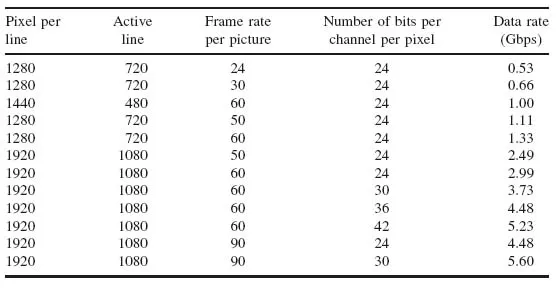
Depending on the progressive scan resolution and number of pixels per line, the data rate required varies from several hundred Mbps to a few Gbps. The latest commercially available high-definition television (HDTV) resolution is 1920 × 1080, with a refresh rate of 60 Hz. Considering RGB video formats with 8 bits per channel per pixel, the required data rate turns out to be approximately 3 Gbps, which is currently supported by the HDMI 1.1 specification. In the future, higher numbers of bits per channel (10 and 12 bits per color) as well as higher refresh rates (90 Hz, 120 Hz) are expected to improve the quality of next-generation HDTV. This easily scales the data rate to well beyond 5 Gbps. Table 1.3 summarizes data rate requirements for some current and future HDTV specifications. Furthermore, uncompressed HD streaming is an asymmetric transmission with significantly different data flow in both uplink and downlink directions. This application also requires very low latency of tens of microseconds and very low bit error probability (down to 10−12) to ensure high-quality video.
1.4 Worldwide Regulation and Frequency Allocation
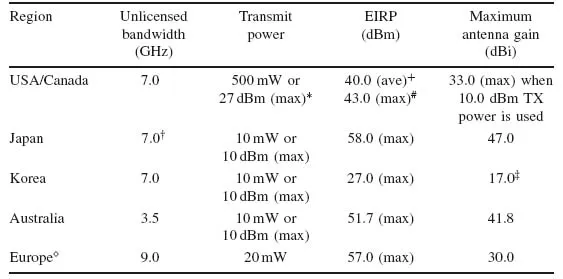
This section discusses the current status of worldwide regulation and standardization efforts for the 60 GHz band. The regulatory bodies in the United States, Japan, Canada and Australia have already set frequency bands and regulations for 60 GHz operation, while in Korea and Europe intense efforts are currently under way. A summary of the issued and proposed frequency allocations and main specifications for radio regulation in a number of countries is given in Table 1.4. It is important to note that even though a maximum transmit power of 27 dBm is allowed in the USA, the actual transmit power may be limited by the capability of power amplifiers (PAs), especially in the case of single antennas. Typically, the maximum output of the 60 GHz PA is limited to around 10 dBm.
1.4.1 North America
In 2001, the FCC allocated 7 GHz in the 54–66 GHz band for unlicensed use [11]. In terms of the power limits, FCC rules allow emission with average power density of 9 μW/cm2 at 3 meters and maximum power density of 18 μW/cm2 at 3 meters, from the radiating source. These values translate to average EIRP and maximum EIRP of 40 dBm and 43 dBm, respectively. The FCC also specified the total maximum transmit power of 500 mW for an emission bandwidth greater than 100 MHz. Devices must also comply with the radio frequency (RF) radiation exposure requirements specified in §1.307(b), §2.1091 and §2.1093 of [11]. After taking RF safety issues into account, the maximum transmit power is limited to 10 dBm. Furthermore, each transmitter must transmit transmitter identification at least once, within 1 second interval of the signal transmission. It is important to note that 60 GHz regulations in Canada, enforced by Industry Canada Spectrum Management and Telecommunications (IC-SMT) [12], are harmonized with those of the USA.
1.4.2 Japan
In 2000, the Ministry of Public Management, Home Affairs, Posts and Telecommunications (MPHPT) of Japan issued 60 GHz radio regulations for unlicensed utilization in the 59–66GHz band [13]. The 54.25–59GHz band is allocated for licensed use. The maximum transmit power for unlicensed use is limited to 10 dBm [14] with maximum allowable antenna gain of 47 dBi [15]. Unlike in North America, Japanese regulations specify that the maximum transmission bandwidth must not exceed 2.5 GHz. There is no specification for RF radiation exposure and transmitter identification requirements. For further information and latest regulation updates in Japan, interested readers are referred to [16].
1.4.3 Australia
Following the released of regulations in Japan and North America, the Australian Communications and Media Authority (ACMA) took similar steps to regulate the 60GHz band in 2005 [17]. However, only 3.5 GHz bandwidth (59.4–62.9 GHz) is allocated for unlicensed use. The maximum transmit power and maximum EIRP are limited to 10 dBm and 51.7 dBm, respectively. The data communication transmitters that operate in this frequency band are limited to land and maritime deployments. For further information and latest regulation updates in Australia, interested readers are referred to [18].
1.4.4 Korea
In June 2005, the Millimeter-wave Frequency Study Group (MFSG) was formed under the auspices of the Korean Radio Promotion Association [19]. The MFSG has recommended a 7 GHz unlicensed spectrum (57–64 GHz) without limitations on the types of application to be used. For indoor applications, the maximum transmit power is 10 dBm, the same as in Japan and Australia, while the maximum allowable antenna gain is 17dBi. For outdoor applications, the transmitted power is limited to –20 dBm and 10 dBm for frequency bands 57–58 GHz and 58–64 GHz, respectively, while the maximum antenna gain is 47 dBi [20]. In addition, any device using frequencies in the 57–64 GHz band shall transmit the transmitter identification code per se, to enable other devices to fully detect and protect against malfunctions from occurring, with the exception of any fixed point-to-point system. For further information and latest regulation updates in Korea, interested readers are referred to [21].
1.4.5 Europe
The European Telecommunications Standards Institute (ETSI) and European Conference of Postal and Telecommunications Administrations (CEPT) have been working closely to establish a legal framework for the deployment of unlicensed 60 GHz devices. In general, the 59–66 GHz band has been allocated for mobile services without specific decisions having been made as to the regulations. The CEPT Recommendation T/R 22-03 provisionally allocated (and later withdrew) the 54.25–66 GHz band for terrestrial and fixed mobile systems [22].
In 2004, the European Radiocommunications Committee (ERC) considered the used of the 57–59 GHz band for fixed services without requiring frequency planning [23]. Later, the Electronic Communications Committee (ECC) within CEPT recommended the use of point-to-point fixed services in the 64–66 GHz band [24]. Later, ETSI proposed 60 GHz regulation...