eBook - ePub
Rate Constant Calculation for Thermal Reactions
Methods and Applications
- English
- ePUB (mobile friendly)
- Available on iOS & Android
eBook - ePub
Rate Constant Calculation for Thermal Reactions
Methods and Applications
About this book
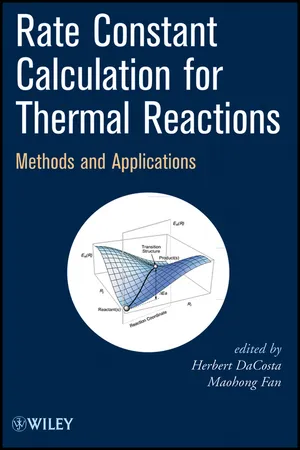
Providing an overview of the latest computational approaches to estimate rate constants for thermal reactions, this book addresses the theories behind various first-principle and approximation methods that have emerged in the last twenty years with validation examples. It presents in-depth applications of those theories to a wide range of basic and applied research areas. When doing modeling and simulation of chemical reactions (as in many other cases), one often has to compromise between higher-accuracy/higher-precision approaches (which are usually time-consuming) and approximate/lower-precision approaches (which often has the advantage of speed in providing results). This book covers both approaches. It is augmented by a wide-range of applications of the above methods to fuel combustion, unimolecular and bimolecular reactions, isomerization, polymerization, and to emission control of nitrogen oxides. An excellent resource for academics and industry members in physical chemistry, chemical engineering, and related fields.
Information
Part I
Methods
Chapter 1
Overview of Thermochemistry and Its Application to Reaction Kinetics
1.1 History of Thermochemistry
Thermochemistry deals with energy and enthalpy changes accompanying chemical reactions and phase transformations and gives a first estimate of whether a given reaction can occur. To our knowledge, the field of thermochemistry started with the experiments done by Malhard and Le Chatelier 1 with gunpowder and explosives. The first of their two papers of 1883 starts with the sentence: “All combustion is accompanied by the release of heat that increases the temperature of the burned bodies.” In 1897, Berthelot [2], who also experimented with explosives, published his two-volume monograph Thermochimie in which he summed up 40 years of calorimetric studies.
The first textbook, to our knowledge, that clearly explained the principles of thermochemical properties was authored by Lewis and Randall [3] in 1923.
Thermochemical data, actually heats of formation, were gathered, evaluated, and published for the first time in the seven-volume book International Critical Tables of Numerical Data, Physics, Chemistry and Technology [4] during 1926–1930 (and the additional index in 1933).
In 1932, the American Chemical Society (ACS) monograph No. 60 The Free Energy of Some Organic Compounds [5] appeared.
In 1936 was published The Thermochemistry of the Chemical Substances [6] where the authors Bichowsky and Rossini attempted to standardize the available data and published them at a common temperature of 18°C (291K) and pressure of 1 atm.
In 1940, Josef Mayer and Nobel Prize winner Maria Mayer published their monograph Statistical Mechanics [7], in which the method of calculating thermochemical properties from spectroscopic data was explained in detail.
In 1947, Rossini et al. published their Selected Values of Properties of Hydrocarbons [8], which was followed by the famous NBS Circular 500 (1952) [9] that focuses on the thermochemistry of inorganic and organic species and lists not only the enthalpies of formation but also heat capacities (Cp), enthalpies (HT − H0), entropies (S), and equilibrium constants (Kc) as a function of temperature. Within the data, thermodynamic relations (e.g., through Hess's Law) between the same property of different substances or between different properties of the same substance were satisfied. During the 1950s, the loose leaf compendium of the Thermodynamic Research Center (TRC) [10] at A&M University in Texas appeared as a continuation of API Project 44. In this compendium, thermochemistry as a function of temperature is only a small part of their data that also include melting and boiling points, vapor pressures, IR spectra, and so on. Although their values are technically reliable, a very serious drawback is the lack of documentation of the data sources and the calculation methods.
In 1960, the first loose leaf edition of the Joint Army–Navy–Air Force (JANAF) thermodynamic tables appeared, but was restricted solely to U.S. government agencies. It is devoted to chemical species involving many elements; however, it contains only a very limited number of organic species. The publication, which became very famous when published as bound second edition in 1971 11, set the standard temperature reference at 298.15K and published the enthalpy increments (also known as integrated heat capacities) as (HT − H298) instead of (HT − H0). This edition of the JANAF tables, with Stull as the main editor, for the first time described in detail methods of calculating thermochemical properties mainly based on the monograph of Mayer and Mayer [7]. It also set the upper temperature range limit of the tables up to 6000K in order to assist the needs and requests of the space research institutions and industry. Further editions published afterward 11 kept the many errors and wrong calculation results instead of correcting or improving them to include better available values.
Published in 1960, the report “Thermodynamic Data for Combustion Products” [12] by Gordon focused on high-performance solid rocket propellants.
In 1961, Duff and Bauer wrote a Los Alamos report [13], which was summarized in 1962 in the Journal of Chemical Physics [14], in which for the first time thermochemical properties of organic molecules, that are, enthalpies and free energies, were given as polynomials.
In 1963, McBride et al. published the “Thermodynamic Properties to 6000K for 210 Substances Involving the First 18 Elements,” NASA Report SP-3001 [15]. This publication revealed for the first time to the public world the methods of calculating thermochemical data for monoatomic, diatomic, and polyatomic species. At that time, JANAF tables were accessible to only a very restricted number of people. The NASA publication lists, also for the first time, the thermochemical properties not only in table format but also as seven-coefficient polynomials. The NASA program to calculate thermochemical properties and these seven-term polynomials was published by McBride ...
Table of contents
- Cover
- Title Page
- Copyright
- Preface
- Contributors
- Part I: Methods
- Part II: Minireviews and Applications
- Index
Trusted by 375,005 students
Access to over 1.5 million titles for a fair monthly price.
Study more efficiently using our study tools.
Frequently asked questions
Yes, you can cancel anytime from the Subscription tab in your account settings on the Perlego website. Your subscription will stay active until the end of your current billing period. Learn how to cancel your subscription
No, books cannot be downloaded as external files, such as PDFs, for use outside of Perlego. However, you can download books within the Perlego app for offline reading on mobile or tablet. Learn how to download books offline
Perlego offers two plans: Essential and Complete
- Essential is ideal for learners and professionals who enjoy exploring a wide range of subjects. Access the Essential Library with 800,000+ trusted titles and best-sellers across business, personal growth, and the humanities. Includes unlimited reading time and Standard Read Aloud voice.
- Complete: Perfect for advanced learners and researchers needing full, unrestricted access. Unlock 1.5M+ books across hundreds of subjects, including academic and specialized titles. The Complete Plan also includes advanced features like Premium Read Aloud and Research Assistant.
We are an online textbook subscription service, where you can get access to an entire online library for less than the price of a single book per month. With over 1.5 million books across 990+ topics, we’ve got you covered! Learn about our mission
Look out for the read-aloud symbol on your next book to see if you can listen to it. The read-aloud tool reads text aloud for you, highlighting the text as it is being read. You can pause it, speed it up and slow it down. Learn more about Read Aloud
Yes! You can use the Perlego app on both iOS and Android devices to read anytime, anywhere — even offline. Perfect for commutes or when you’re on the go.
Please note we cannot support devices running on iOS 13 and Android 7 or earlier. Learn more about using the app
Please note we cannot support devices running on iOS 13 and Android 7 or earlier. Learn more about using the app
Yes, you can access Rate Constant Calculation for Thermal Reactions by Herbert DaCosta, Maohong Fan, Herbert DaCosta,Maohong Fan in PDF and/or ePUB format, as well as other popular books in Biological Sciences & Biochemistry. We have over 1.5 million books available in our catalogue for you to explore.