Crystallization is an important technique for separation and purification of substances as well as for product design in chemical, pharmaceutical and biotechnological process industries.
This ready reference and handbook draws on research work and industrial practice of a large group of experts in the various areas of industrial crystallization processes, capturing the essence of current trends, the markets, design tools and technologies in this key field. Along the way, it outlines trouble free production, provides laboratory controls, analyses case studies and discusses new challenges.
First the instrumentation and techniques used to measure the crystal size distribution, the nucleation and solubility points, and the chemical composition of the solid and liquid phase are outlined. Then the main techniques adopted to control industrial crystallizers, starting from fundamental approaches to the most advanced ones, including the multivariable predictive control are described. An overview of the main crystallizer types is given with details of the main control schemes adopted in industry as well as the more suitable sensors and actuators.
Crystalline population coming out from a crystallizer is characterized by its size distribution, which can be expressed in different ways. The crystal size distribution (“CSD”) may, in fact, be referred to the number of crystals, the volume or the mass of crystals with reference to a specific size range, or the cumulative values of number, volume or mass of crystals up to a fixed crystal size. The first approach refers to a density distribution, whereas the second one to a cumulative size distribution.
However, it is also useful to represent the CSD by means of a lumped parameter as an average size, the coefficient of variation, or other statistical parameters which may be adopted for the evaluation of a given commercial product.
In this section the more usual ways to represent both the whole CSD and the lumped CSD parameters are presented.
1.2 Particle Size Distribution
The particle size distribution may be referred to the density distribution or cumulative distribution. Each distribution may be expressed in number, volume, or mass of crystals.
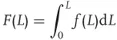
The cumulative variable, F(L), expresses number, volume, or mass of crystals per unit slurry volume between zero size and the size L, whereas the density distribution function, f(L), refers to number, mass, or volume of crystals per unit slurry volume in a size range, whose average size is L.
The relationship between the cumulative size variable and the density distribution size one is as follows:
1.1
or in the reverse form:
1.2
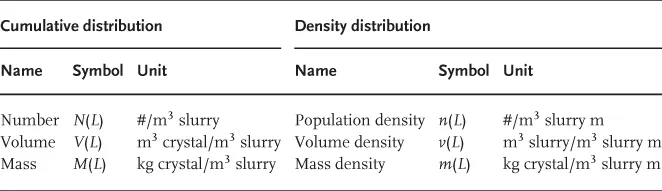
In Table 1.1 the expression of cumulative and density function variables referred to the number, volume, or mass of crystals is reported.
Table 1.1 Cumulative and density variables.
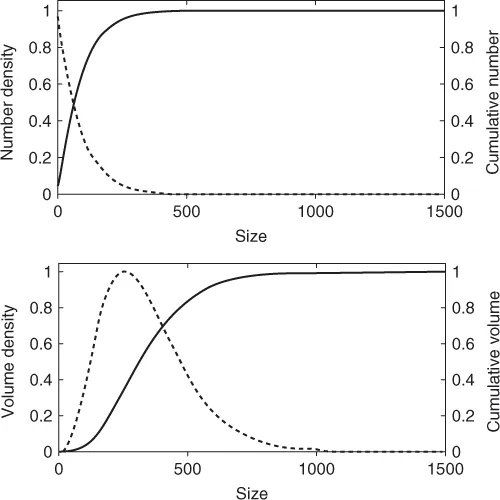
Examples of number and volume distributions are reported in Figure 1.1.
Figure 1.1 Cumulative and volume crystal size distributions (continuous line for the cumulative distribution and dotted lines for the density distribution).
In spite of the three geometric dimensions of crystals, the CSD is usually referred to just one dimension, the so-called characteristic one, which is related to the adopted measurement technique. In the case of crystal size measurement by sieving the characteristic dimension is the second one, corresponding to the wire mesh length. Otherwise, if a laser diffraction-based analyzer is used, the characteristic dimension is the length given by the instrument, falling between the first and the second crystal dimension.
The most used density distribution variable is the crystal population density, n(L). It can be used to estimate the total number, NT, the total ...
Table of contents
Cover
Related Titles
Title Page
Copyright
Preface
Scope of the Book
List of Contributors
Chapter 1: Characterization of Crystal Size Distribution
Chapter 2: Forward Light Scattering
Chapter 3: Focused Beam Reflectance Measurement
Chapter 4: Turbidimetry for the Estimation of Crystal Average Size
Chapter 5: Imaging
Chapter 6: Turbidimetry and Nephelometry
Chapter 7: Speed of Sound
Chapter 8: In-Line Process Refractometer for Concentration Measurement in Sugar Crystallizers
Chapter 9: ATR-FTIR Spectroscopy
Chapter 10: Raman Spectroscopy
Chapter 11: Basic Recipe Control
Chapter 12: Seeding Technique in Batch Crystallization
Chapter 13: Advanced Recipe Control
Chapter 14: Advanced Model-Based Recipe Control
Chapter 15: Fines Removal
Chapter 16: Model Predictive Control
Chapter 17: Industrial Crystallizers Design and Control
Index
Trusted by 375,005 students
Access to over 1.5 million titles for a fair monthly price.
Study more efficiently using our study tools.
Frequently asked questions
Yes, you can cancel anytime from the Subscription tab in your account settings on the Perlego website. Your subscription will stay active until the end of your current billing period. Learn how to cancel your subscription
No, books cannot be downloaded as external files, such as PDFs, for use outside of Perlego. However, you can download books within the Perlego app for offline reading on mobile or tablet. Learn how to download books offline
Perlego offers two plans: Essential and Complete
Essential is ideal for learners and professionals who enjoy exploring a wide range of subjects. Access the Essential Library with 800,000+ trusted titles and best-sellers across business, personal growth, and the humanities. Includes unlimited reading time and Standard Read Aloud voice.
Complete: Perfect for advanced learners and researchers needing full, unrestricted access. Unlock 1.5M+ books across hundreds of subjects, including academic and specialized titles. The Complete Plan also includes advanced features like Premium Read Aloud and Research Assistant.
Both plans are available with monthly, semester, or annual billing cycles.
We are an online textbook subscription service, where you can get access to an entire online library for less than the price of a single book per month. With over 1.5 million books across 990+ topics, we’ve got you covered! Learn about our mission
Look out for the read-aloud symbol on your next book to see if you can listen to it. The read-aloud tool reads text aloud for you, highlighting the text as it is being read. You can pause it, speed it up and slow it down. Learn more about Read Aloud
Yes! You can use the Perlego app on both iOS and Android devices to read anytime, anywhere — even offline. Perfect for commutes or when you’re on the go. Please note we cannot support devices running on iOS 13 and Android 7 or earlier. Learn more about using the app
Yes, you can access Industrial Crystallization Process Monitoring and Control by Angelo Chianese,Herman J. Kramer in PDF and/or ePUB format, as well as other popular books in Physical Sciences & Industrial & Technical Chemistry. We have over 1.5 million books available in our catalogue for you to explore.