The book aims at providing to master and PhD students the basic knowledge in fluid mechanics for chemical engineers. Applications to mixing and reaction and to mechanical separation processes are addressed.
The first part of the book presents the principles of fluid mechanics used by chemical engineers, with a focus on global theorems for describing the behavior of hydraulic systems. The second part deals with turbulence and its application for stirring, mixing and chemical reaction. The third part addresses mechanical separation processes by considering the dynamics of particles in a flow and the processes of filtration, fluidization and centrifugation. The mechanics of granular media is finally discussed.
In this chapter, to begin with, we recall the Navier–Stokes equations that govern the flow of a Newtonian fluid. These equations explain the behavior of common fluids such as water or air. For a given force field and boundary conditions, the solution of Navier–Stokes equations controls both the flow velocity and pressure at any point and at any time in the domain under consideration. The Navier–Stokes equations are the most commonly used equations in fluid mechanics; they provide the knowledge of the flow of Newtonian fluids at the local level.
The solutions to Navier–Stokes equations are typically very difficult to arrive at. This fact is attested to by the extraordinary development of numerical computation in fluid mechanics. Only a few exact analytical solutions are known for Navier– Stokes equations. We present in this chapter some laminar flow solutions whose interpretation per se is essential in this regard. We then introduce the boundary layer concept. We conclude the chapter with a discussion on the uniqueness of solutions to Navier–Stokes equations, with special reference to the phenomenon of turbulence.
This being the introductory chapter, we have not included a prolonged discussion on continuum mechanics. The derivation of Navier–Stokes equations is available in other continuum mechanics or fluid mechanics books.1 We have consciously avoided concentrating on the derivational aspects of Navier–Stokes equations as we are convinced that it is far more important to understand the meaning of the different terms of these equations and to hence interpret the way they are applied in the study of fluid mechanics in general. In addition, we limit ourselves to introducing the only classical concept from continuum mechanics to be used in this book, namely, the ability to calculate the force acting through a surface passing through a point that lies inside a continuum, using the stress tensor. Hence, Chapter 1 partly serves as a collection of formulae, while proper physical principles are discussed in the remainder of this book. The reader might wish to read this chapter without pondering on it for long, and then may refer to it later, if necessary, for it may be insightful in such a case.
1.1. Forces, stress tensor, and pressure
Consider a domain, V, containing a fluid. The fluid’s flow is controlled by various forces acting on it. The laws of mechanics help us to distinguish two types of forces:
– Body forces, which are exerted at every point in a domain. Weight is the most common body force.
– Forces that are transferred from one particle to another, at the boundary of and within the domain. These forces are expressed using the stress tensor. This is where the continuum concept intervenes.
The force at a point M in the continuum is associated with surface element ds whose orientation is given by the unit normal vector
(Figure 1.1). The force
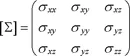
, which is proportional to the surface ds, varies when the orientation of the surface changes. It is determined at the point M using the stress tensor [Σ], which is a symmetric,2 3 × 3 matrix:
[1.1]
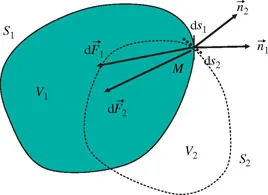
Figure 1.1.Forces
and
exerted at a point M through two surface elements ds1and ds2, whose orientations are given by normals
and
. Both ds1and ds2are elements of closed surfaces S1(solid line) and S2(dashed line), respectively, surrounding volumes V1and V2
The force through the surface element ds whose normal is
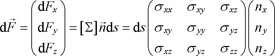
is written as:
[1.2]
The force applied to a closed surface S surrounding an arbitrary volume V in the continuum (Figure 1.1) can be derived using the surface integral:
[1.3]
The concept of the stress tensor is inseparable from the mechanical principle of action and reaction. The normal vector
is oriented toward the exterior of the domain on which the force is applied. The direction of the force is reversed if one considers the force exerted by the domain V on the exterior. Therefore, the domain under consideration should always be specified. The force is exerted by the external environment through the surface of separation.
In equation [1.1] and [1.2], the stress tensor is expressed in a Cartesian coordinate system (O, x, y, z). In this coordinate system, the single-column matrices define the normal vector
and force
. We only have to multiply matrix [Σ] by
to calculate the force.
The stress tensor embodies two notions: pressure and friction forces. For a Newtonian fluid, pressure is introduced by adding together the diagonal terms of the stress tensor:
[1.4]
We also introduce the stress deviator tensor [Σ′].
[1.5]
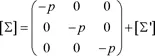
such that σ′xx + σ′yy + σ′zz = 0. The stress deviator is associated with friction forces, whereas the pressure produces a force that is perpendicular to the surface element under consideration. Alternatively, the stress tensor can be expressed as:
[1.6]
Figure 1.1 depicts two volumes V1 and V2 surrounded by closed surfaces S1 and S2. At a point M belonging to both surfaces, the normals are different, and therefore the forces exerted on the surface elements, ds1 and ds2, are also different. The orientation of the force vectors shown in Figure 1.1 satisfies two properties. The forces are not perpendicular to the two surfaces onto which they are applied, if friction forces exist. However, they are not far from being perpendicular to the surfaces, and they are oriented toward the interior of the domain; this i...
Table of contents
Cover
Title Page
Copyright
Preface
Part I: Elements in Fluid Mechanics
Part II: Mixing and Chemical Reactions
Part III: Mechanical Separation
Physical Properties of Common Fluids
Index
Trusted by 375,005 students
Access to over 1.5 million titles for a fair monthly price.
Study more efficiently using our study tools.
Frequently asked questions
Yes, you can cancel anytime from the Subscription tab in your account settings on the Perlego website. Your subscription will stay active until the end of your current billing period. Learn how to cancel your subscription
No, books cannot be downloaded as external files, such as PDFs, for use outside of Perlego. However, you can download books within the Perlego app for offline reading on mobile or tablet. Learn how to download books offline
Perlego offers two plans: Essential and Complete
Essential is ideal for learners and professionals who enjoy exploring a wide range of subjects. Access the Essential Library with 800,000+ trusted titles and best-sellers across business, personal growth, and the humanities. Includes unlimited reading time and Standard Read Aloud voice.
Complete: Perfect for advanced learners and researchers needing full, unrestricted access. Unlock 1.5M+ books across hundreds of subjects, including academic and specialized titles. The Complete Plan also includes advanced features like Premium Read Aloud and Research Assistant.
Both plans are available with monthly, semester, or annual billing cycles.
We are an online textbook subscription service, where you can get access to an entire online library for less than the price of a single book per month. With over 1.5 million books across 990+ topics, we’ve got you covered! Learn about our mission
Look out for the read-aloud symbol on your next book to see if you can listen to it. The read-aloud tool reads text aloud for you, highlighting the text as it is being read. You can pause it, speed it up and slow it down. Learn more about Read Aloud
Yes! You can use the Perlego app on both iOS and Android devices to read anytime, anywhere — even offline. Perfect for commutes or when you’re on the go. Please note we cannot support devices running on iOS 13 and Android 7 or earlier. Learn more about using the app
Yes, you can access Fluid Mechanics for Chemical Engineering by Mathieu Mory in PDF and/or ePUB format, as well as other popular books in Physical Sciences & Mechanics. We have over 1.5 million books available in our catalogue for you to explore.