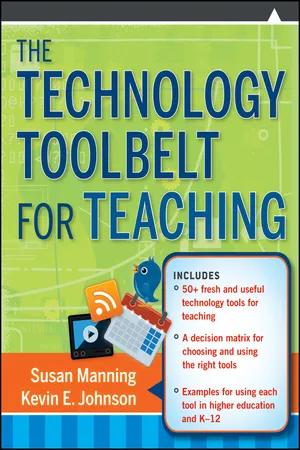
The Technology Toolbelt for Teaching
eBook - ePub

The Technology Toolbelt for Teaching

  1. English
  2. ePUB (mobile friendly)
  3. Available on iOS & Android
eBook - ePub

The Technology Toolbelt for Teaching

About this book

Instructors are under pressure to integrate technology into their traditional or online instruction, but often they aren't sure what to do or why they should do it. The Technology Toolbelt for Teaching offers instructors a down-to-earth guide to common technologies, explains the pedagogical purposes they serve, and shows how they can be used effectively in online or face-to-face classrooms.

Designed to be easy to use, the book includes a decision-making matrix for each technology tool: a series of questions that teachers can use to decide whether these tools support their teaching goals.

This comprehensive resource contains an array of useful tools that address problems of organization such as a time management calendar, aids for scheduling meetings, and mind-mapping or graphic organizers. The authors also include a variety of online tools for communication and collaboration, and tools to present content, help establish presence, and assess learning.

Praise for The Technology Toolbelt for Teaching

"Feeling overwhelmed and even afraid of integrating technology into your course? Fear no more! Susan Manning and Kevin Johnson have provided the ultimate guide that explains not only the various technology tools that can support faculty work and enhance coursework but also provides sound advice to help faculty choose the right tool for the job. This is a must-read for all faculty regardless of their experience with technology."—Rena M. Palloff and Keith Pratt, managing partners, Crossroads Consulting Group, and authors, Building Online Learning Communities and Collaborating Online

"The Technology Toolbelt for Teaching delivers exactly what it promises: a concrete overview of a wide variety of tools, complete with examples specific to practitioners in both K–12 and higher education. Authors Susan Manning and Kevin Johnson provide practical applications rather than philosophy, and solutions rather than platitudes. This is a must for any teacher working with—or wanting to start working with—technology."—Jane Bozarth, author, Social Media for Trainers; eLearning coordinator, State of North Carolina

"Creating compelling learning experiences for students is fraught with decision points. Add one or more technology options to the equation, and the number of directions to take learners seems to grow limitlessly, and can either paralyze the instructional design process or cause us to take on too much. Enter The Technology Toolbelt for Teaching. Manning and Johnson's handy guide – and the decision-making matrix that frames each of the tools it demystifies – is an essential resource for choosing paths wisely."—Jonathan Finkelstein, author, Learning in Real Time; founder and executive producer, LearningTimes

Includes

  • 50+ fresh and useful technology tools for teaching

  • A decision matrix for choosing and using the right tools

  • Examples for using each tool in higher education and K–12

Frequently asked questions

Yes, you can cancel anytime from the Subscription tab in your account settings on the Perlego website. Your subscription will stay active until the end of your current billing period. Learn how to cancel your subscription.
At the moment all of our mobile-responsive ePub books are available to download via the app. Most of our PDFs are also available to download and we're working on making the final remaining ones downloadable now. Learn more here.
Perlego offers two plans: Essential and Complete
  • Essential is ideal for learners and professionals who enjoy exploring a wide range of subjects. Access the Essential Library with 800,000+ trusted titles and best-sellers across business, personal growth, and the humanities. Includes unlimited reading time and Standard Read Aloud voice.
  • Complete: Perfect for advanced learners and researchers needing full, unrestricted access. Unlock 1.4M+ books across hundreds of subjects, including academic and specialized titles. The Complete Plan also includes advanced features like Premium Read Aloud and Research Assistant.
Both plans are available with monthly, semester, or annual billing cycles.
We are an online textbook subscription service, where you can get access to an entire online library for less than the price of a single book per month. With over 1 million books across 1000+ topics, we’ve got you covered! Learn more here.
Look out for the read-aloud symbol on your next book to see if you can listen to it. The read-aloud tool reads text aloud for you, highlighting the text as it is being read. You can pause it, speed it up and slow it down. Learn more here.
Yes! You can use the Perlego app on both iOS or Android devices to read anytime, anywhere — even offline. Perfect for commutes or when you’re on the go.
Please note we cannot support devices running on iOS 13 and Android 7 or earlier. Learn more about using the app.
Yes, you can access The Technology Toolbelt for Teaching by Susan Manning,Kevin E. Johnson in PDF and/or ePUB format, as well as other popular books in Education & Education Teaching Methods. We have over one million books available in our catalogue for you to explore.

Information

Publisher
Jossey-Bass
Year
2011
Print ISBN
9780470634240
eBook ISBN
9781118005200

PART ONE
INTRODUCTION

In our opening chapters we lay the foundation for using tools in the context of instructional design. We begin in Chapter One with an overview of instructional technology and sort through the definitions of technology and educational technology. We then review the development of the Internet as most of us recall it, considering such popular concepts as Web 2.0. What distinguished Web 2.0 from Web 1.0 largely had to do with the ability to interact with and change content, to share and subscribe (for example, to Really Simple Syndication [RSS] feeds), and the granular nature of content. For example, an English instructor could share a learning object on correct APA citation styles, which could be dropped into a variety of science courses to address that one point. What we do in the future will depend on how the Web continues to develop.
In Chapter Two we introduce several models of instructional design and tie these to the selection process for technology tools. Herein we assert that technology tools must be used in the context of instructional design. We therefore offer a Decision-Making Matrix and resource that suggests more questions teachers should ask as they examine technology tools and deliberately consider whether these tools support their pedagogy. We explain the nuances of these questions and their implications as you move forward in the book.

CHAPTER ONE
Why Web-Based Tools?

For generations, wise old sages have enjoyed telling youngsters about life before the latest innovation, invention, or technology. Teachers are no different. First we told stories about life before the printing press when knowledge was only transmitted orally, then about how students had to write their own notes because we did not have copy machines to reproduce the latest handout, and now we pass on stories about life before the Internet when no one could “Google.” And with every invention of new technology and tools, in true teacher fashion, we scratch our heads and wonder where this is leading. In what ways do the latest innovations enhance learning and assist teachers in doing so?
That is the fundamental purpose of this book. We are going to explore a variety of technology tools available to teachers with an eye to instructional design and delivery. It is not enough to know that gizmos and gadgets exist—we must also consider how tools might be used to address instructional problems.

Defining Technology

Before we get too far into the text, we should first define technology, instructional or educational technology, and technology tools. We will address these definitions again in Chapter Two when we relate these to instructional design.
Science and technology are sometimes mentioned in the same breath, but there are notable differences. Science often deals with outcomes that are directly observable through the senses (Arms & Camp, 1998); teaching and learning do not. A better way to look at technology is to consider the International Network for Small and Medium Enterprises' definition of technology as “human innovation in action that involves the generation of knowledge and processes to develop systems that solve problems and extend human capabilities” (2010, p. 1). There may be a science behind how the technology works (such as computer science), and the application to solve problems may be systematic, but the results are not always so neatly observable as to be classified according to our senses.
Employing instructional or educational technology, therefore, is the process by which we use tools to address an instructional problem. This is not new science. As Saettler (2004) reminds us, instructional technology dates far back. Today's examples of technology include communication through e-mail and Voice over Internet Protocol, streaming video and content presentations, and synchronous Web conferencing, to name a few. All of these technologies can support learning as they address instructional problems. Further, if technology is a process, then the specific tools are the instruments we use to implement that process. Skype, YouTube, and Elluminate are specific tools that demonstrate the implementation of the previous examples.
The technology we examine in this book falls into the realm of educational technology in that we will discuss processes by which specific tools are applied to instructional problems. This is increasingly relevant in higher education as more and more courses become “distributed,” either as fully online courses or blended courses. Information from the Sloan Consortium reports that “over 4.6 million students were taking at least one online course during the fall 2008” (Allen and Seaman, 2010, p. 1). An article in Campus Technology shared research conducted by Ambient Insight, reporting that there are currently more than twelve million college students engaged in some form of online learning, with projections expecting this number to grow to more than twenty-two million postsecondary students by the year 2014 (Nagel, 2009). If even a fraction of those projections come true, faculty in higher education are going to have to become much more familiar with what technology is available to them and how they might use it to their instructional advantage.
For those of you not currently teaching online or in blended classroom environments, this book serves as a way of enhancing your onground classroom organization and instruction. The advantage of introducing these tools in onground classrooms, even pre-K through grade 12, is that you and your students will be better equipped to handle the learning curve when teaching or taking more tool-driven courses.

The First Webs

What Web are we on (and who cares)? No discussion of educational technology seems to get by without mention of Web 2.0. What difference does the number make in the process of teaching and learning? This is where our old stories come back into play.
The faculty who first began to interact with the Internet were the leading scientists and engineers of the 196...

Table of contents

  1. COVER
  2. CONTENTS
  3. TITLE PAGE
  4. COPYRIGHT
  5. SERIES
  6. DEDICATION
  7. PREFACE
  8. ACKNOWLEDGMENTS
  9. ABOUT THE AUTHORS
  10. PART ONE: INTRODUCTION
  11. PART TWO: TOOLS TO HELP YOU STAY ORGANIZED
  12. PART THREE: TOOLS TO COMMUNICATE AND COLLABORATE
  13. PART FOUR: TOOLS TO PRESENT CONTENT
  14. PART FIVE: TOOLS TO HELP YOU ASSESS LEARNING
  15. PART SIX: TOOLS TO HELP YOU TRANSFORM YOUR IDENTITY
  16. REFERENCES
  17. INDEX
  18. END USER LICENSE AGREEMENT