Digital Spectral Analysis
eBook - ePub

Digital Spectral Analysis

Parametric, Non-Parametric and Advanced Methods

  1. English
  2. ePUB (mobile friendly)
  3. Available on iOS & Android
eBook - ePub

Digital Spectral Analysis

Parametric, Non-Parametric and Advanced Methods

About this book

Digital Spectral Analysis provides a single source that offers complete coverage of the spectral analysis domain. This self-contained work includes details on advanced topics that are usually presented in scattered sources throughout the literature.

The theoretical principles necessary for the understanding of spectral analysis are discussed in the first four chapters: fundamentals, digital signal processing, estimation in spectral analysis, and time-series models.

An entire chapter is devoted to the non-parametric methods most widely used in industry.

High resolution methods are detailed in a further four chapters: spectral analysis by stationary time series modeling, minimum variance, and subspace-based estimators.

Finally, advanced concepts are the core of the last four chapters: spectral analysis of non-stationary random signals, space time adaptive processing: irregularly sampled data processing, particle filtering and tracking of varying sinusoids.

Suitable for students, engineers working in industry, and academics at any level, this book provides a rare complete overview of the spectral analysis domain.
Frequently asked questions

Yes, you can cancel anytime from the Subscription tab in your account settings on the Perlego website. Your subscription will stay active until the end of your current billing period. Learn how to cancel your subscription.
At the moment all of our mobile-responsive ePub books are available to download via the app. Most of our PDFs are also available to download and we're working on making the final remaining ones downloadable now. Learn more here.
Perlego offers two plans: Essential and Complete
  • Essential is ideal for learners and professionals who enjoy exploring a wide range of subjects. Access the Essential Library with 800,000+ trusted titles and best-sellers across business, personal growth, and the humanities. Includes unlimited reading time and Standard Read Aloud voice.
  • Complete: Perfect for advanced learners and researchers needing full, unrestricted access. Unlock 1.4M+ books across hundreds of subjects, including academic and specialized titles. The Complete Plan also includes advanced features like Premium Read Aloud and Research Assistant.
Both plans are available with monthly, semester, or annual billing cycles.
We are an online textbook subscription service, where you can get access to an entire online library for less than the price of a single book per month. With over 1 million books across 1000+ topics, we’ve got you covered! Learn more here.
Look out for the read-aloud symbol on your next book to see if you can listen to it. The read-aloud tool reads text aloud for you, highlighting the text as it is being read. You can pause it, speed it up and slow it down. Learn more here.
Yes! You can use the Perlego app on both iOS or Android devices to read anytime, anywhere — even offline. Perfect for commutes or when you’re on the go.
Please note we cannot support devices running on iOS 13 and Android 7 or earlier. Learn more about using the app.
Yes, you can access Digital Spectral Analysis by Francis Castanié in PDF and/or ePUB format, as well as other popular books in Mathematics & Probability & Statistics. We have over one million books available in our catalogue for you to explore.

Information

Publisher
Wiley-ISTE
Year
2013
Print ISBN
9781848212770
eBook ISBN
9781118601839
PART 1

Tools and Spectral Analysis

Chapter 1

Fundamentals 1

1.1. Classes of signals

Every signal-processing tool is designed to be adapted to one or more signal classes and presents a degraded or even deceptive performance if applied outside this group of classes. Spectral analysis too does not escape this problem, and the various tools and methods for spectral analysis will be more or less adapted, depending on the class of signals to which they are applied.
We see that the choice of classifying properties is fundamental, because the definition of classes itself will affect the design of processing tools.
Traditionally, the first classifying property is the deterministic or non-deterministic nature of the signal.

1.1.1. Deterministic signals

The definitions of determinism are varied, but the simplest is the one that consists of calling any signal that is reproducible in the mathematical sense of the term as a deterministic signal, i.e. any new experiment for the generation of a continuous time signal x(t) (or discrete time x(k)) produces a mathematically identical signal. Another subtler definition, resulting from the theory of random signals, is based on the exactly predictive nature of x(t) tt0 from the moment that it is known for t < t0 (singular term of the Wold decomposition, e.g. see Chapter 4 and [LAC 00]). Here, we discuss only the definition based on the reproducibility of x(t), as it induces a specific strategy on the processing tools: as all information of the signal is contained in the function itself, any bijective transformation of x(t) will also contain all this information. Representations may thus be imagined, which, without loss of information, will demonstrate the characteristics of the signal better than the direct representation of the function x(t) itself.
The deterministic signals are usually separated into classes, representing integral properties of x(t), strongly linked to some quantities known by physicists.
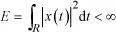
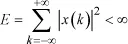
Finite energy signals verify the integral properties in equations [1.1] and [1.2] with continuous or discrete time:
[1.1]
images
[1.2]
images
We recognize the membership of x(t) to standard function spaces (noted as L2 or l2), as well as the fact that this integral, to within some dimensional constant (an impedance in general), represents the energy E of the signal.
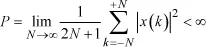
Signals of finite average power verify:
[1.3]
images
[1.4]
images
If we accept the idea that the sums of equation [1.1] or [1.2] represent “energies”, those of equation [1.3] or [1.4] then represent powers.
It is clear that these integral properties correspond to mathematical characteristics whose morphological behavior along the time axis is very different: the ...

Table of contents

  1. Cover
  2. Dedication
  3. Title Page
  4. Copyright
  5. Preface
  6. Part 1: Tools and Spectral Analysis
  7. Part 2: Non-Parametric Methods
  8. Part 3: Parametric Methods
  9. Part 4: Advanced Concepts
  10. List of Authors
  11. Index