eBook - ePub
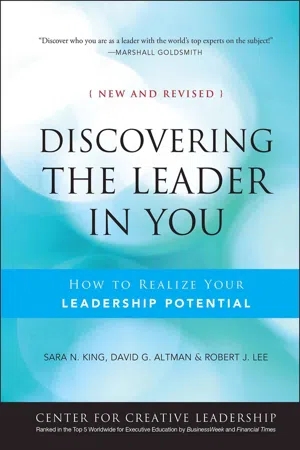
Discovering the Leader in You
How to realize Your Leadership Potential
- English
- ePUB (mobile friendly)
- Available on iOS & Android
eBook - ePub
Discovering the Leader in You
How to realize Your Leadership Potential
About this book
From the Center for Creative Leadership's most popular and best known leadership program Leadership Development Program comes a book for anyone who wants to have a competitive edge in today's complex marketplace. Discovering the Leader in You shows what it looks like to fit in a leadership role and provides a system of self-discovery that allows for exploration into the roles within an organization. The book includes illustrative cases examples and puts the spotlight on the transition from "the decision to lead" to "how to implement the decision to lead."
Information
Chapter One
Where Does Leadership Fit in Your Life?
As counselors and trainers of executives and as advocates for improving the human condition through leadership development, we've noticed in recent years that increasingly more clients seem less sure about their path of leadership. Despite having had high levels of achievement and an unwavering dedication to work and career, they admit, when pressed, that something just doesn't feel right. They're uncertain about whether they're spending their best years doing what they really want to do and whether, at the end of the day, the leadership path they have chosen will ultimately be fulfilling.
This concerns us because we believe that the need for effective leadership has grown. We need strong leaders not only at the top of formal organizations (corporations, nonprofit organizations, and government agencies, for example) but also at all levels in organizations and in our communities and families. Each of us has multiple opportunities to lead every day if we choose to do so. Our hope is that in reading this book, you will find clarity about the role of leadership in your life so that you can lead more effectively in whatever situation you face.
Leadership is a hot topic, as shown by the flood of journals, books, Web sites, blogs, and training programs that now discuss what it is and how it's best practiced. Search the Web using the word leadership, and you will generate well over 100,000 hits. Search university offerings, and you will see classes and degrees in leadership. Pick up any newspaper or news magazine, and leadership is a prominent topic covered.
Leadership can certainly be read about, studied, and taught, but individuals rarely think about leadership as a vocation, even though acquiring its skills demands the same kind of conscious decisions as acquiring a technical specialty or pursuing an educational degree. At some moment early in your life, someone may have urged you to select and develop an area of technical knowledge. But has anyone ever asked you to consider specifically how leadership would fit into your life or urge you to select and develop it as a special skill?
We wrote this book to encourage you to make more conscious choices about why, when, how, and where you lead. We think it's critical that you connect your leadership to those things you find most essential in life. Leadership is not just about developing a brilliant strategy or executing a task perfectly. We believe that the most effective leaders are those who commit themselves to getting better day by day and week by week and then apply their skills to improving the lives of other people in the organizations in which they work or their communities.
This chapter explores questions and issues that leaders like you are raising and explains how the rest of this book can help you resolve them on a personal level through structured introspection, discussion, purposeful questions, and short cases of leaders who have experienced, as television sports journalist Jim McKay used to say, “the thrill of victory and the agony of defeat.” In essence, this book addresses these questions:
- Why do you want to lead?
- Who are you as a leader?
- Are your personal goals, values, needs, and resources such that your work in leadership can be both personally rewarding and outwardly fruitful?
- If you now find yourself in a leadership position or hope to be in a leadership role in the future, do you have a vision of what you'd like your leadership work to accomplish for you personally as well as for your organization or community?
- Are you clear about when and where you are most effective as a leader?
The Challenges Today
Leaders must be able to cope effectively with uncertainty and continuous change. The stress, sacrifices, criticism, responsibility, and accountability that leaders face can cause us to question our roles as leaders. Some leaders we work with each week will admit that at times, they are tired, overwhelmed, stuck, lost, bored, or feeling devalued. Others aren't feeling much of anything and don't want to be noticed. Don't get us wrong: there are plenty of leaders who are optimistic and energized. But our sense is that leaders today are finding the road a bit tougher to navigate than leaders did in the past.
Leaders' New Questions
The three of us together have nearly a century of experience in assisting leaders in the development of their talents and careers. As the world becomes more interdependent and more complex, leaders with whom we work frequently come to us with questions, and sometimes concerns, about their place in the world as leaders and the place of leadership in their lives. The tenor of their questions has changed recently. Questions about strengths and developmental needs, becoming a more effective agent of change, confronting structural problems, organizational politics and difficult coworkers, and minimizing the tremendous stress of executive roles continue to surface, but they are being augmented and sometimes even replaced by a different inquiry. Contemporary leaders ask about personal and professional fulfillment, service to others, balancing the demands of work with life's other responsibilities. We hear about job dissatisfaction. We hear about job insecurity, even among the most senior leaders in organizations. Highly rated performers are not immune from having reservations about what they experience as a lack of sufficient control over both the professional and personal aspects of their careers. One corporate executive captures the confusion quite well: “It seems there have been times in your life when the options before you have seemed clouded and the trail behind you so cluttered that you can't seem to clear your feet to move ahead.”
We wonder why such issues seem increasingly common. The global economic crisis that began in 2008 will no doubt affect people's perceptions of the future and their career aspirations for some time to come. Certainly the tasks of leadership in a more interdependent global world have changed from what they used to be. Advances in technology fundamentally affect the way that individuals and groups interact. When you consider how some organizations expect to have access to their leadership around the clock, getting away from work becomes quite challenging. We also wonder whether the human potential movement of the 1960s shifted people's concepts of what constitutes a happy life. Do the attitudes and expectations of the millennial generation (born between 1980 and 2000) create different expectations of leaders? When leaders demand more personal meaning in their work lives, are they responding to changes in career patterns or family relationships? In the pages that follow, we explore these and other questions leaders today are asking themselves and others.
The Problem of Drift
Some people go through life with complete clarity about their goals as a leader, but most leaders, at one point or another, express doubts about their capabilities, have questions about how best to leverage their talents, or are simply confused about the leader within them. We call this the problem of drift. Drift can feel as if you are going through the motions but not actually moving forward. It can be short-lived (for instance, after a challenging meeting or a tough week, you may begin to wonder whether you can handle the expectations of your team) or it can be chronic (for example, after five years in a job, you realize that unless you make a change, some of your life's goals are not going to be met). Think of drift as being opposite to being “in the zone,” or in a place in life in which you are making conscious choices and taking action with a clear sense of purpose and connection to your core values and goals.
We work with leaders in all kinds of organizations, from multinational to grassroots and from public to private sector. Drift is an equal opportunity employer that at some point affects leaders from all walks of life. Whether underqualified, underchallenged, overwhelmed, burned out, or in some other way miscast, it's not uncommon for leaders to feel out of place in their current roles, unprepared for the demands of leadership, misaligned with their responsibilities, unaware of the unknown factors inherent in a leadership role, or unsure about how to seize the potential for change and get back on the right track. One goal of this book is to help you address issues you may have about drift and about your sense of focus, purpose, effectiveness, and drive as a leader. We will help you move from feeling a sense of drift to a place where you reach your full potential as a leader by delineating a process of discovering the leader in you.
Drift can occur for a number of reasons. Consider these situations, and see if any are familiar to you:
- You are overwhelmed. Your organization let go of 15 percent of its workforce. You are now covering the leadership responsibilities for three departments. How can you be effective with so much responsibility?
- You are skeptical. Your organization has undergone the third major restructuring in three years. Change is the name of the game, but to what end isn't clear. You are responsible for motivating your team and getting them on board with the changes. How can you do that when you don't believe in the change yourself?
- You are stuck. You have been doing the same job for the past four years. Because of your organization's outsourcing to overseas locations, moving to a new position would require you to move abroad. You see little opportunity for advancement given your desire to stay rooted in your community. Your work is critical to the organization's success, but the fire in your belly is not as strong as it once was. How do you get excited again?
- You are lost. Your boss and three other senior leaders have left the organization. You are being asked to fill in on some of their key projects, while others in the organization conduct a search to fill these positions. You didn't want more responsibility, but others are looking to you for answers. How do you step up to the plate when you're not sure you can swing the bat, let alone hit the pitch?
- You are in denial. You have had six bosses in three years. Change keeps coming, but you don't know what is going to ultimately stick. Perhaps if you ignore the newest change, hunker down, and pretend to be onboard, this too shall pass. How long can you wait?
- You are angry. Your spouse lost her job, and the job market in your area is horrendous. You have decided to move, but you love your organization, your role, and your colleagues. How will you find the right next leadership role?
- You are unhappy. You have often made leadership and career decisions based on the expectations of others. You chose your field because of your father's encouragement. You said yes to each organizational opportunity because your boss, mentor, or spouse said it was the right thing to do. But now you realize you aren't doing what you want to do. How do you break the cycle and find a job that is more connected to your core values?
- You are pressured. In order to put your three children through college, maintain your financial commitments to nonprofit organizations you care about, and contribute to your own retirement account, you feel pressure to serve in a high-level, well-paying position where the perks and financial rewards are plentiful. How do you find respite from the demands of the role?
- You are underchallenged. You are twenty-seven years old and new to the organization. You believe that you have a lot to give, and yet your boss continues to ask you to work on routine tasks you mastered several years ago. You see many opportunities to lead, but your boss seems threatened by giving you too much exposure. How do you convince her that you are ready for more?
- You are worried. You have been asked to volunteer your time on a major cross-functional taskforce with high visibility. You have just had your first child and learning how to manage the role of parent, spouse, and employee. You are already finding it difficult to keep up with all of the demands in your life. How can you add still more work to your plate?
- You are thrilled. You have just landed the marketing job you always wanted: leading a project team for one of your firm's major accounts. But this is your first real leadership role, and you are unsure of how to best organize, lead, and motivate your team. Is there a map to help guide your next steps?
- You are nervous. You are the first expatriate for the company and are moving your entire family to Hong Kong. You will be charting new territory by opening the first office in Asia and leading a culturally diverse workforce. You are not sure what to do next. Instead of taking action, you feel stuck in place, almost paralyzed. What do you do first?
These situations describe the multitude of questions that leaders at all levels are asking. Given the pace of change in organizations, individuals who are in a pretty good place can suddenly find themselves thrust into situations they didn't foresee or don't know how to handle. These situations have both a professional and personal impact on them.
We have had many conversations with clients who faced one or more of these issues. Our conversations revealed that many leaders find themselves in the middle of situations and don't have a systematic way to navigate to a better place. All in all, they haven't conducted much of a conscious, guided evaluation of themselves as leaders. Intrigued by drift, we probed further by asking, Have you thought about the role that leadership plays in your life? Has leadership been a conscious decision? In a few cases, the answers were a resounding yes; the individuals had indeed given much thought to who they were as leaders and the skills they wanted to develop in the future. These individuals came across as self-assured. Some planned to move up to the next level, and a few were content to end their careers in the jobs they held. In either case, they stood on solid ground. But most of the leaders we talked with hadn't been very thoughtful about assuming a leadership position. One leader described “falling into” his position. Another said, “I don't even give it a second thought. You know, it's like you just try to get through each day and do the best you can.”
These conversations, no matter the amount of change or circumstances, confirm our belief that too few individuals actively think about leadership or are truly comfortable with their identities as leaders. We are struck by how seldom people in leadership positions consider to any great extent their work as leaders. We are well acquainted with people who are so keen on assuming leadership responsibilities that they have pursued that goal without paying enough attention to the meaning of the work or the fact that developing others was a critical skill for being a successful leader. Not only are individuals uncomfortable with their identities as leaders, more are walking the halls of organizations disillusioned, dissatisfied, and disconnected. Rather than being active in tackling the issues before them, they hide out in their offices, work from home, disassociate themselves from mistakes, and hunker down hoping that this too shall pass. The main question they ask is, “Is taking this leadership role worth the effort?”
The bad news is that the problem of drift has impact beyond individual discomfort. Since leadership is about having responsibility for others, drift has consequences that can be challenging and frustrating for colleagues and families as well. Leading by rote wastes good talent and energy, dilutes the talent and energy that others muster to create results, and creates drag on company resources. Perhaps worse, while in the grip of drift, you can experience a malaise that stands in the way of full commitment and fulfillment. This malaise can be contagious and infect other members of your team or work group.
If you feel this way, be comforted by the fact that many others do as well. Do you want help moving out of the drift cycle? If you do, you will benefit by stepping back, asking yourself some fundamental questions, and then figuring out how to get back in the driver's seat. The process can help you gain traction for moving yourself to a place of fulfillment, commitment, and motivation.
Reflect on the following questions, and write down responses that immediately come to mind:
- How much of your life today involves being a leader? (Don't limit your answer to just your work life.)
- Are you currently in a leadership role? How did you get there?
- Do you see yourself as a leader? Are you a leader all of the time?
- How comfortable are you with your identity as a leader?
- Did you choose to become a leader, or did it somehow choose you?
By answering thes...
Table of contents
- Cover
- Praise for Discovering the Leader in You
- Title Page
- Copyright
- Dedication
- Preface
- Chapter One: Where Does Leadership Fit in Your Life?
- Chapter Two: Organizational Realities, Demands, and Expectations
- Chapter Three: Your Leadership Vision
- Chapter Four: Your Leadership Motivation and Values
- Chapter Five: Your Leadership Profile
- Chapter Six: Personal Realities, Demands, and Expectations
- Chapter Seven: The Leader in You
- References
- About the Authors
- Index
- About the Center for Creative Leadership
Trusted by 375,005 students
Access to over 1.5 million titles for a fair monthly price.
Study more efficiently using our study tools.
Frequently asked questions
Yes, you can cancel anytime from the Subscription tab in your account settings on the Perlego website. Your subscription will stay active until the end of your current billing period. Learn how to cancel your subscription
No, books cannot be downloaded as external files, such as PDFs, for use outside of Perlego. However, you can download books within the Perlego app for offline reading on mobile or tablet. Learn how to download books offline
Perlego offers two plans: Essential and Complete
- Essential is ideal for learners and professionals who enjoy exploring a wide range of subjects. Access the Essential Library with 800,000+ trusted titles and best-sellers across business, personal growth, and the humanities. Includes unlimited reading time and Standard Read Aloud voice.
- Complete: Perfect for advanced learners and researchers needing full, unrestricted access. Unlock 1.5M+ books across hundreds of subjects, including academic and specialized titles. The Complete Plan also includes advanced features like Premium Read Aloud and Research Assistant.
We are an online textbook subscription service, where you can get access to an entire online library for less than the price of a single book per month. With over 1.5 million books across 990+ topics, we’ve got you covered! Learn about our mission
Look out for the read-aloud symbol on your next book to see if you can listen to it. The read-aloud tool reads text aloud for you, highlighting the text as it is being read. You can pause it, speed it up and slow it down. Learn more about Read Aloud
Yes! You can use the Perlego app on both iOS and Android devices to read anytime, anywhere — even offline. Perfect for commutes or when you’re on the go.
Please note we cannot support devices running on iOS 13 and Android 7 or earlier. Learn more about using the app
Please note we cannot support devices running on iOS 13 and Android 7 or earlier. Learn more about using the app
Yes, you can access Discovering the Leader in You by Sara N. King,David Altman,Robert J. Lee in PDF and/or ePUB format, as well as other popular books in Business & Leadership. We have over 1.5 million books available in our catalogue for you to explore.