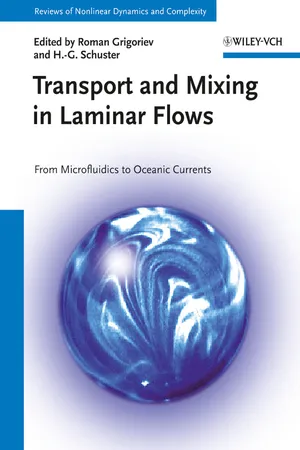
This book provides readers from academia and industry with an up-to-date overview of important advances in the field, dealing with such fundamental fluid mechanics problems as nonlinear transport phenomena and optimal control of mixing at the micro- and nanoscale.
The editors provide both in-depth knowledge of the topic as well as vast experience in guiding an expert team of authors. The review style articles offer a coherent view of the micromixing methods, resulting in a much-needed synopsis of the theoretical models needed to direct experimental research and establish engineering principles for future applications.
Since these processes are governed by nonlinear phenomena, this book will appeal to readers from both communities: fluid mechanics and nonlinear dynamics.
eBook - ePub
Transport and Mixing in Laminar Flows
From Microfluidics to Oceanic Currents
- English
- ePUB (mobile friendly)
- Available on iOS & Android
eBook - ePub
Transport and Mixing in Laminar Flows
From Microfluidics to Oceanic Currents
About this book
Information
Chapter 1
Resonances and Mixing in Near-Integrable Volume-Preserving Systems
1.1 Introduction
Many laminar flows are often characterized by a high degree of symmetry due to the confining effect of surface tension (for free-surface flows, e.g., in microdroplets) and/or device geometry (e.g., for flows in microchannels). Designing a flow with good mixing properties is particularly difficult in the presence of symmetries. Symmetry leads to the existence of (flow) invariants [1, 2], which are functions of coordinates that are constant along streamlines of the flow. The level sets of one invariant define surfaces on which the (three-dimensional) flow is effectively two-dimensional. An additional invariant further reduces the flow dimensionality: a flow with two invariants is effectively one-dimensional. Since the flow cannot cross invariant surfaces, the existence of invariants is highly undesirable in the mixing problem as their presence inhibits complete stirring of the full fluid volume by advection. Neither is chaotic advection per se sufficient for good mixing, as time-dependent flows [3, 4] can have chaotic streamlines restricted to two-dimensional surfaces in the presence of an invariant. Thus, the key to achieving effective chaotic mixing in any laminar flow is to ensure that all flow invariants are destroyed.
In this section we will focus on the class of laminar flows characterized by small deviations from exact symmetries. Not only are such flows common in various applications of microfluidics, this is the only class of flows that generically affords a quantitative analytical treatment. The description of the weakly perturbed flow in terms of the action and angle variables allows quantitative analytical treatment using perturbation theory. Indeed, if the symmetries are broken weakly, the invariants (or actions) of the unperturbed flow become slowly varying functions of time (start to drift, in the more technical language) for the perturbed flow, while the angle variable remains quickly varying. Such perturbed flows are referred to as near-integrable, in contrast to the flows with exact symmetries which are integrable, that is, possess an exact analytical solution. Near-integrable systems play a prominent role in many areas of science. Often they arise naturally when there is a large separation of scale...
Table of contents
- Cover
- Related Titles
- Title Page
- Copyright
- List of Contributors
- Mixing in Laminar Fluid Flows: From Microfluidics to Oceanic Currents
- Chapter 1: Resonances and Mixing in Near-Integrable Volume-Preserving Systems
- Chapter 2: Fluid Stirring in a Tilted Rotating Tank
- Chapter 3: Lagrangian Coherent Structures
- Chapter 4: Interfacial Transfer from Stirred Laminar Flows
- Chapter 5: The Effects of Laminar Mixing on Reaction Fronts and Patterns
- Chapter 6: Microfluidic Flows of Viscoelastic Fluids
- Index
Trusted by 375,005 students
Access to over 1.5 million titles for a fair monthly price.
Study more efficiently using our study tools.
Frequently asked questions
Yes, you can cancel anytime from the Subscription tab in your account settings on the Perlego website. Your subscription will stay active until the end of your current billing period. Learn how to cancel your subscription
No, books cannot be downloaded as external files, such as PDFs, for use outside of Perlego. However, you can download books within the Perlego app for offline reading on mobile or tablet. Learn how to download books offline
Perlego offers two plans: Essential and Complete
- Essential is ideal for learners and professionals who enjoy exploring a wide range of subjects. Access the Essential Library with 800,000+ trusted titles and best-sellers across business, personal growth, and the humanities. Includes unlimited reading time and Standard Read Aloud voice.
- Complete: Perfect for advanced learners and researchers needing full, unrestricted access. Unlock 1.5M+ books across hundreds of subjects, including academic and specialized titles. The Complete Plan also includes advanced features like Premium Read Aloud and Research Assistant.
We are an online textbook subscription service, where you can get access to an entire online library for less than the price of a single book per month. With over 1.5 million books across 990+ topics, we’ve got you covered! Learn about our mission
Look out for the read-aloud symbol on your next book to see if you can listen to it. The read-aloud tool reads text aloud for you, highlighting the text as it is being read. You can pause it, speed it up and slow it down. Learn more about Read Aloud
Yes! You can use the Perlego app on both iOS and Android devices to read anytime, anywhere — even offline. Perfect for commutes or when you’re on the go.
Please note we cannot support devices running on iOS 13 and Android 7 or earlier. Learn more about using the app
Please note we cannot support devices running on iOS 13 and Android 7 or earlier. Learn more about using the app
Yes, you can access Transport and Mixing in Laminar Flows by Roman Grigoriev, Heinz Georg Schuster in PDF and/or ePUB format, as well as other popular books in Technology & Engineering & Microelectronics. We have over 1.5 million books available in our catalogue for you to explore.