Chapter 1: An introduction to trading
How to succeed? Try hard enough.
Malcolm Forbes (1919 – 1990)
In a nutshell
• All consistently profitable traders have a trading plan that they follow.
• There is nothing stopping you achieving trading success, except yourself.
• Develop a passion for trading and commit yourself to it.
• Put in the required effort and don’t look back.
Trading
In simple terms, trading is the process whereby we regularly buy financial products, primarily in a market (more officially referred to as an exchange), and then sell them later for a higher price. This simple concept makes a lot of sense and is probably the main reason why people generally think that trading is easy money.
The financial product that we buy and sell may be stock in a company, a commodity like gold or silver, a futures contract or even a foreign currency, for example. Many people don’t know that many markets offer the opportunity to take advantage of and financially benefit from a falling price as well. This is often referred to as trading ‘short’, as opposed to the aforementioned and more commonly known ‘long’ trading.
If you were to ask most people to describe their ideal or perfect job, many would suggest the following:
• Self-employment — being your own boss and reporting to no-one.
• Geographical freedom — being able to perform your necessary tasks from anywhere.
• Unlimited potential for profit — achieving financial freedom and independence.
Trading meets all of these three criteria and is why many consider it to be a great profession. It can be a very exciting and worthwhile endeavour and there are several other attractions and advantages for most people (not including ‘making money’, which is obvious).
Some of the other advantages of trading include:
• Minimal capital outlay — compare this with purchasing a franchise or establishing a new retail store in your nearest shopping complex.
• Flexibility with time — you choose when you trade and when you don’t.
• Almost anyone can do it — if you are old enough (usually 18 or 21 years of age), you can open a trading account and begin.
There are, of course, some disadvantages, which include:
• No guaranteed success — many people don’t make money trading.
• Can be stressful and emotional — when you are ‘playing’ with your own money, this is almost inevitable.
• Solitary existence — trading can be a very lonely profession.
• Takes time — like many endeavours, consistently profitable trading takes time. I list this as a disadvantage because I believe many newcomers don’t recognise this, nor do they fully appreciate what is required to develop the skills and attributes for successful trading.
I should add here that I personally have struggled at times with the solitary nature of trading. I used to work in a very large organisation and was an integral part of a team, and going from that environment to one of solitude was a significant culture shock. I think this affects people in different ways but it is certainly worth being aware of.
Another thing to consider is the contribution that traders make to society. I have been challenged on a number of occasions with the comment that traders don’t contribute anything to the orderly function of a society, whereas almost every other profession or job, including anything from being a pilot or a postie to working in a grocery store or being a teacher, does. What about traders? They are individuals who probably sit at home and use a trading plan to consistently make money from financial markets. Apart from providing some liquidity, what else do they contribute to society? What function do they perform?
This may not sit well with you.
One final thing you need to be aware of: trading has a greater potential for reward than investing, but with that extra potential for reward is greater risk. Those who trade well have been well educated and prepared. Very seldom does somebody start trading and make money from day one. Often you will hear the saying: ‘Only educated traders survive’.
Develop a trading plan
If you learn only one thing from this book, I would like it to be this: if you want to trade successfully, you need to develop and then follow a written trading plan that is right for you. All consistently profitable traders have a plan that they follow, as successful traders understand the importance of having a plan to guide them in their trading actions.
I believe that many people approach the market with a sense of confidence, yet with little idea of why or how they are going to trade on it successfully. There is a well-known phrase that says: ‘If you fail to plan, you are planning to fail!’
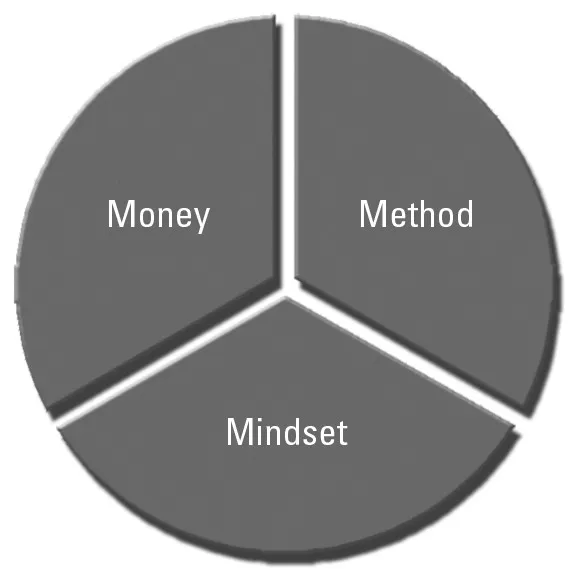
The trading plan model I always use is shown in figure 1.1 (overleaf ).
Some people will use terms other than those that appear in this model (for example, Trading Psychology for Mindset, Risk or Money Management for Money, Trading System for Method); however, I like these terms as they are easier to remember — the three Ms!
Throughout this book, I will explore these three areas further. But before I do, I want to touch upon which one is most important. Most, including myself, will declare the mindset as the most important; however, there are numerous other trains of thought on this. Some would suggest that it doesn’t matter how disciplined or confident you are; if you don’t have a robust and simple method, you won’t be successful.
Figure 1.1: trading plan model
Likewise, if you don’t manage your money by cutting losses and protecting your capital, it doesn’t matter how good your method is.
From this I conclude that all three are important in their own way, yet I will not change my opinion on the mindset being by far the most important ingredient in your success. Yes, you need a simple and sound method and you most definitely need to manage your money, but it is your mindset that makes it all happen and ensures you do things the right way.
By developing a written trading plan, you can clearly define and articulate the rules you will follow, your money management approach and all the various components of your trading method.
Developing a good trading plan requires commitment and discipline. Just the thought of discipline may scare a lot of potential traders. This is because many people like to break rules, even ones they set themselves. You need to realise how important it is that you demand of yourself the highest level of discipline, in order to implement the requirements of your trading plan ruthlessly. We will discuss discipline in greater detail in chapter 10 when we tackle the important character attributes.
Based on my own personal study of successful traders, I believe that you must also develop a trading plan that is right for you — that suits your personality. If you are not comfortable with the way you approach the market, then you will be more likely to drift away from your plan and fall into bad habits.
Trading is not new. Many traders have come and gone before you, and many of them have made mistakes from which you can learn. Even those who are highly successful have done some stupid things and broken rules along the way to success. Enlisting the assistance and support of a mentor can be invaluable when you are starting to trade. This can be particularly helpful in areas such as personal psychology. Some of the greatest sports people in the world have coaches to finetune and guide them in order to achieve optimum performance. Interestingly, they are the type of people you may assume would be beyond requiring assistance from a coach or mentor. Instead, they realise how valuable it is.
You should consider trading like running a business, and anyone who has run a business successfully will tell you that irrational emotions should have little place in decision-making. In essence, trading is all about decision-making — although, because our natural instincts come to the fore when dealing with money, many people cannot remove certain emotions from their trading actions sufficiently.
To develop a trading plan and then follow it requires certain character traits that lead to success in any endeavour. These include commitment, desire, discipline and patience. It takes time and a lot of introspection to trade properly. If you want to trade seriously, you must develop a plan and there is only one thing stopping you doing that: you.
Commit to it
Anybody can achieve anything they put their mind to. I’m sure you’ve heard this before, and I firmly believe it.
However, I also believe that not many people can set their mind to something.
Have you ever broken one of your New Year’s resolutions? Why? It was because of your mind. Honestly, you were not really committed to making that particular change in your life. It is quite simple: if your mind is not set to something, then there is little chance of it actually happening.
I am sure you can think of many highly successful people that you have either known or heard about, whether they are sportspeople, businesspeople or in some other occupation. Each person who has achieved great things in his or her life would have done so in large part by displaying passion, desire, commitment and discipline, and they would each have overcome obstacles and adversity along the way. There is no easy way for any of these people.
With regards to achieving success in life, I have several beliefs. First, I believe that anything in life that is worth achieving takes time. Trading is no exception. I believe that successful people always give 100 per cent in their ventures. Always!
I also believe that generally there are three types of people in this world. Those who make things happen, those who watch what happens, and those who wonder, ‘What happened?’ If you want to achieve anything in life, including being the best trader you can be, you must be a member of the first group.
Why do people think that trading should be any different from any other endeavour in life? If you want success, you will need to commit yourself, develop a plan, have discipline and develop a passion for it. Otherwise, the chances of your succeeding are fair at best.
Your own mind drives everything you do and you need to control it. If you want to trade, and therefore need to develop a trading plan and follow it, you must convince yourself that trading is something you really want to do. Once you have achieved this goal, there is nothing to stop you developing a robust plan that will, over the long run, be profitable. On the other hand, if you cannot convince yourself, then you will cut corners and fail to follow your rules or to develop a plan that is right for you. Here, chances are, you will lose money.
Markets around the world are full of people who are losing money and most are doing so because they have no plan and little discipline. The fact that you ha...