![]()
PART I
How to Use This Book
Organizations use training to build skills and change behavior in individuals. Without change there can be no impact. The way to ensure that training has an impact is to have participants experience the content by working with it. This book gives you activities that provide participants with hands-on experience with content.
Which Activities Are Applicable to Which Topics?
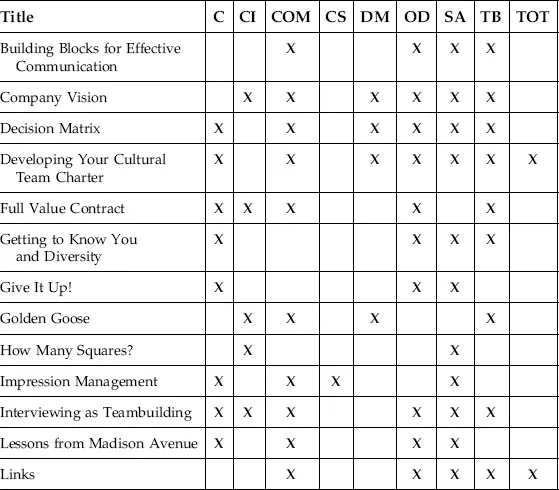
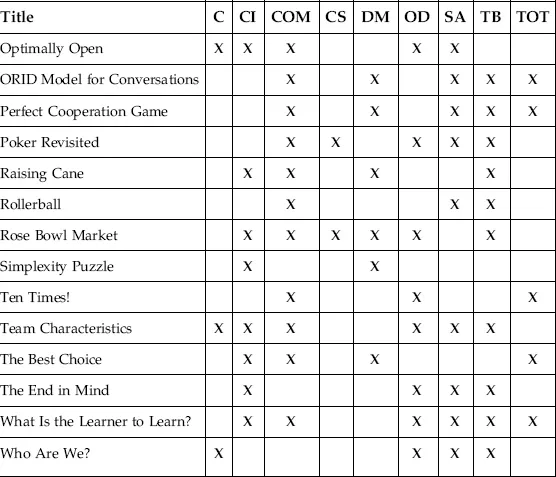
Each author describes the purpose of the activity and suggested audiences. Sometimes the variations contain suggestions on how to use the activity with other audiences or for other purposes. In addition, the editors have suggested other purposes or settings for which the activities seem suitable. All of the activities are cross-referenced in the Cross-Reference Matrix below. You may find activities that you like and can suitably adapt for your training purpose. That’s the reason we encourage you to read them all.
CROSS-REFERENCED PURPOSES OR SETTINGS
- Cultural/cross-cultural training (C)
- Creativity and innovation (CI)
- Communication (COM)
- Customer service (CS)
- Decision making/problem solving (DM)
- Organization development (OD)
- Self-awareness/personal growth (SA)
- Team building (TB)
- Training of trainers (TOT)
Modification Issues
As you read the activities, you may find that, while you like a given activity, it may not be exactly right for your audience or circumstances. Be creative. If you like the activity but it does not exactly fit your situation, identify what needs to be modified with the use of the What if . . .? questions below.
What if . . .?
- There is not enough time in the session? There is lots more time than the activity will take?
- I have too few people? I have too many people?
- I don’t have sufficient supplies or funds for the supplies/equipment?
- I don’t have time to do all the required preparation?
- The competition in the activity distracts from my purpose.
- Participants will be reluctant to engage because of peers, supervisors in the group? No one volunteers?
- Different participants will know more/less about the topic? Participants work at very different rates when doing the activities? No one in the group has the skill to assist with required modeling?
- Participants don’t come up with ideas? Participants give strange/wrong examples, answers? People feel left out because their ideas were not asked for/used? Some participants never participate in discussions?
- I am not a subject matter expert?
- The topic is controversial? Participants biased?
- The topic is complex?
- I want to do some/all of it online?
Adapted from Thiagaragan, 2005.
Identifying the issues is the first step. Thinking creatively how to modify the activity to address the issues is the second. Maybe just a kernel of the activity will inspire you to build a different activity. Don’t forget to try your modified activities with practice audiences before heading into the training room.
Cultural Issues
All simulations and games, and many activities, have cultural elements. Most training groups have people of different cultural backgrounds, as cultural differences are not only based on nationality or ethnic group, but they may also be based on cultural subgroups, age, gender, status, or occupation. For example, accountants may not react in the same way as graphics designers or writers, even if the group is “mono-cultural.” If you are not purposefully focusing on cultural differences, check the activity for any of the following that might affect whether participants understand or how they may react (Blohm & Bradley, 1991).
CONCEPTS
- Confidentiality
- Decision-making styles
- Fairness
- Feedback
- Leadership
- Power
- Punishment
- Rewards
- Rules
- Success
- Winning
KNOWLEDGE
- One’s culture’s historical concepts, heroes, anecdotes, proverbs
- One’s culture’s daily “tools” (money, transportation, housing)
- Rituals
TRAINING/LEARNING ENVIRONMENT
- Beliefs about how learning takes place
- Expectations of role of a teacher, trainer, facilitator
- Formality of workspace, classroom, training room
- Learning style preferences
ORIENTATION TOWARD VALUES
- Absolute versus relative values (right/wrong)
- Competition, cooperation
- Group versus individual orientation
- Respect
- Status
- Time
LANGUAGE AND COMMUNICATION STYLES
- Acceptable terminology (slang, acronyms, jargon)
- Direct/indirect styles
- First and second languages
- High/low context
- Linear/circular patterns
- Nonverbals
- Symbols
“CULTURAL” ADVANTAGE
- Expected outcomes of the game may exclude a particular group
- Rules of game/activity may favor one culture’s problem-solving style
After you identify which of these issues are present, consider your training or workshop participants. Which issues might affect their understanding of or interactions with others? Can you substitute something more universally understood? Do you need to provide definitions or explanations? Do you need to establish a mutually agreeable definition for the purpose of the activity with the participants? The point is to not be blindsided by something that could have been predicted with a little more thought.
Where to Place a Training Activity in a Session
Where in a training session might you use an activity? The answer to this can be as varied as those who train. Activities can motivate or be used to introduce, practice, review, or apply content. They can also be used to assess participant learning. For example, activities in this book are used in the following ways:
- Links and How Many Squares expand participants’ vision of what they can do.
- Decision Matrix and The End in Mind are intended to introduce participants to the content they will be working with.
- Team Characteristics encourages teams to consider the unique features of their teams, while Developing Your Cultural Team Charter helps new teams (local or virtual) develop their ground rules for functioning.
- Poker Revisited gives salespeople a chance to analyze their performance in individual contacts at the beginning of a workshop.
- ORID Model for Conversations introduces a structure for understanding conversations and applies it to the workshop itself.
- Interviewing as Team Building develops awareness and skills through a sequence of activities and debriefings.
- Give It Up! simulates an experience in the future.
- What Is the Learner to Learn? has the activity as the culmination of the session.
As you read the activities in the book, you will see that each has two variations to help you think about how you might adapt the activity for your specific use. In some variations, there are changes in audience or in how parts of the activity can be conducted. Some variations show how an activity might be used in a different place in a training design.
When designing your training, determining where experiential activities may best fit can be the most daunting task. Consider the following questions when looking at your complete session design.
- How engaged are the senses?
- Are kinesthetic and cognitive combined?
- Are participants asked to interact or move around?
- Can participants decide their level of engagement?
- How well is the content explained/demonstrated?
- Can participants practice and apply it?
- Can participants experience ‘ah-ha’ moments?
- How easily is the experience applied to real-world situations?
- Is the experience a model or metaphor of their reality?
- Does the debriefing move participants to real-world applications?
- How connected is the experience to the goal?
- Can participants reconstruct the experience when needed?
- Can future applications with the same group be utilized?
Sample Activity
So let’s practice what we preach. Play This Book provides an engaging way for participants to learn what’s in this book and how to modify what they find. Take a moment and read it. Then answer these questions:
- What is your impression of the activity to help participants acclimate to the book? Did it help you to imagine how you might use the book?
- What did you like about the activity?
- Could you think of ways to make the activity more useful to you?
- Can you imagine when and how you could use it (or a modification of it) in your training?
We trust you will find many useful ideas in this book and wish you luck in designing your training!
Play This Book
By Thiagi
My father was fond of quoting Francis Bacon: “Some books are to be tasted, others to be swallowed, and some few to be chewed and digested.”
This book is to be played. And here’s a game to help you do that. The game comes in two parts.
Part 1. Rapid Retrieval
Purpose
- To rapidly retrieve (and use) appropriate content from this book
Group Size
- Minimum: four
- Maximum: thirty
- Best: ten to twenty
Duration
Materials and Equipment
- A copy of this book for each participant
- Index cards (see Part 1, Step 3, and Part 2, Step 2)
- Flip chart
Facilitator Preparation
Flip through the book and create a series of content-based questions taken from different pages and sect...