This book presents tools and algorithms required to compress/uncompress signals such as speech and music. These algorithms are largely used in mobile phones, DVD players, HDTV sets, etc.
In a first rather theoretical part, this book presents the standard tools used in compression systems: scalar and vector quantization, predictive quantization, transform quantization, entropy coding. In particular we show the consistency between these different tools. The second part explains how these tools are used in the latest speech and audio coders. The third part gives Matlab programs simulating these coders.
Let us consider a discrete-time signal x(n) with values in the range [−A, +A]. Defining a scalar quantization with a resolution of b bits per sample requires three operations:
– partitioning the range [−A, +A] into L = 2b non-overlapping intervals {Θ1 … ΘL} of length {Δ1 … ΔL},
– numbering the partitioned intervals {i1 … iL},
– selecting the reproduction value for each interval, the set of these reproduction values forms a dictionary (codebook)1
.
Encoding (in the transmitter) consists of deciding which interval x(n) belongs to and then associating it with the corresponding number i(n) ∈ {1 … L = 2b}. It is the number of the chosen interval, the symbol, which is transmitted or stored. The decoding procedure (at the receiver) involves associating the corresponding reproduction value
from the set of reproduction values
with the number i(n). More formally, we observe that quantization is a non-bijective mapping to [−A, +A] in a finite set C with an assignment rule:
The process is irreversible and involves loss of information, a quantization error which is defined as
. The definition of a distortion measure
is required. We use the simplest distortion measure, quadratic error:
This measures the error in each sample. For a more global distortion measure, we use the mean squared error (MSE):
This error is simply denoted as the quantization error power. We use the notation
for the MSE.
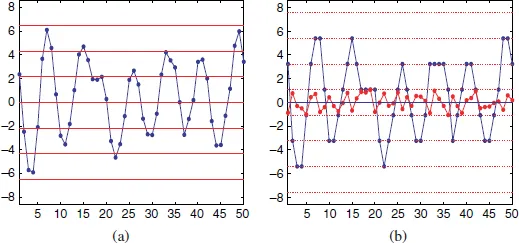
Figure 1.1(a) shows, on the left, the signal before quantization and the partition of the range [−A, +A] where 6 = 3, and Figure 1.1(b) shows the reproduction values, the reconstructed signal and the quantization error. The bitstream between the transmitter and the receiver is not shown.
Figure 1.1.(a) The signal before quantization and the partition of the range [−A, +A] and (b) the set of reproduction values, reconstructed signal, and quantization error
The problem now consists of defining the optimal quantization, that is, in defining the intervals {Θ1 … ΘL} and the set of reproduction values
to minimize
.
1.2. Optimum scalar quantization
Assume that x(n) is the realization of a real-valued stationary random process X(n). In scalar quantization, what matters is the distribution of values that the random process X(n) takes at time n. No other direct use of the correlation that exists between the values of the process at different times is possible. It is enough to know the marginal probability density function of X(n), which is written as px(.).
1.2.1. Necessary conditions for optimization
To characterize the optimum scalar quantization, the range partition and reproduction values must be found whic...
Table of contents
Cover
Title Page
Copyright
Introduction
Part 1: Tools for Signal Compression
Part 2: Audio Signal Applications
Part 3: MATLAB® Programs
Bibliography
Index
Trusted by 375,005 students
Access to over 1.5 million titles for a fair monthly price.
Study more efficiently using our study tools.
Frequently asked questions
Yes, you can cancel anytime from the Subscription tab in your account settings on the Perlego website. Your subscription will stay active until the end of your current billing period. Learn how to cancel your subscription
No, books cannot be downloaded as external files, such as PDFs, for use outside of Perlego. However, you can download books within the Perlego app for offline reading on mobile or tablet. Learn how to download books offline
Perlego offers two plans: Essential and Complete
Essential is ideal for learners and professionals who enjoy exploring a wide range of subjects. Access the Essential Library with 800,000+ trusted titles and best-sellers across business, personal growth, and the humanities. Includes unlimited reading time and Standard Read Aloud voice.
Complete: Perfect for advanced learners and researchers needing full, unrestricted access. Unlock 1.5M+ books across hundreds of subjects, including academic and specialized titles. The Complete Plan also includes advanced features like Premium Read Aloud and Research Assistant.
Both plans are available with monthly, semester, or annual billing cycles.
We are an online textbook subscription service, where you can get access to an entire online library for less than the price of a single book per month. With over 1.5 million books across 990+ topics, we’ve got you covered! Learn about our mission
Look out for the read-aloud symbol on your next book to see if you can listen to it. The read-aloud tool reads text aloud for you, highlighting the text as it is being read. You can pause it, speed it up and slow it down. Learn more about Read Aloud
Yes! You can use the Perlego app on both iOS and Android devices to read anytime, anywhere — even offline. Perfect for commutes or when you’re on the go. Please note we cannot support devices running on iOS 13 and Android 7 or earlier. Learn more about using the app
Yes, you can access Tools for Signal Compression by Nicolas Moreau in PDF and/or ePUB format, as well as other popular books in Technology & Engineering & Signals & Signal Processing. We have over 1.5 million books available in our catalogue for you to explore.