The Maudsley Prescribing Guidelines in Psychiatry
eBook - ePub

The Maudsley Prescribing Guidelines in Psychiatry

  1. English
  2. ePUB (mobile friendly)
  3. Available on iOS & Android
eBook - ePub

The Maudsley Prescribing Guidelines in Psychiatry

About this book

Helps with complex prescribing needs

The evidence base for drug treatments in psychiatry ranges from meta-analyses and randomised controlled clinical trials to single case reports, and from NICE guidelines to individual SPCs.  Where do you look for information when transferring a patient from one drug to another?  Where do you find a clear overview when dealing with a complex patient (e.g, with co-morbid epilepsy or liver disease or HIV infection)?   Where can you seek advice on prescribing psychotropics during pregnancy?  The Maudsley Prescribing Guidelines in Psychiatry! The leading clinical reference for handling prescribing problems as encountered in daily practice and for formulating prescribing policy. 

Evidence-based and written by experts

This book is the essential guide for anyone responsible for prescribing, dispensing or administering drugs for patients with mental health disorders.  All the evidence has been reviewed and summarized succinctly by an expert team of psychiatrists and pharmacists. 

New content and improved format

This new edition makes greater use of tables and boxes to facilitate quick reference and includes new sections on cytochrome-mediated interactions and psychiatric side effects of non-psychotropic drugs.

Clinically relevant

Chapters address plasma monitoring, schizophrenia, bipolar disorder, depression and anxiety, children and adolescents, substance abuse and special patient groups.  Each section has a full reference list.  The book covers prescribing drugs outside their licensed indications and their interaction with substances such as alcohol, nicotine and caffeine.

Useful for all levels of experience

Trainees will gain important information regarding the rational, safe and effective use of medications for patients with mental illness.  Experienced clinicians will find excellent guidance regarding more complex issues that they may not encounter regularly. 

Why the Maudsley Prescribing Guidelines in Psychiatry?

Long recognized as an international trailblazer in mental health care, the Maudsley Hospital earned its reputation for excellence in both in-patient and community care.  It is highly regarded for its research, and pioneered the use of clinical neuroscience. You can trust The Maudsley Prescribing Guidelines in Psychiatry to be scientifically sound and clinically effective.
Frequently asked questions

Yes, you can cancel anytime from the Subscription tab in your account settings on the Perlego website. Your subscription will stay active until the end of your current billing period. Learn how to cancel your subscription.
No, books cannot be downloaded as external files, such as PDFs, for use outside of Perlego. However, you can download books within the Perlego app for offline reading on mobile or tablet. Learn more here.
Perlego offers two plans: Essential and Complete
  • Essential is ideal for learners and professionals who enjoy exploring a wide range of subjects. Access the Essential Library with 800,000+ trusted titles and best-sellers across business, personal growth, and the humanities. Includes unlimited reading time and Standard Read Aloud voice.
  • Complete: Perfect for advanced learners and researchers needing full, unrestricted access. Unlock 1.4M+ books across hundreds of subjects, including academic and specialized titles. The Complete Plan also includes advanced features like Premium Read Aloud and Research Assistant.
Both plans are available with monthly, semester, or annual billing cycles.
We are an online textbook subscription service, where you can get access to an entire online library for less than the price of a single book per month. With over 1 million books across 1000+ topics, we’ve got you covered! Learn more here.
Look out for the read-aloud symbol on your next book to see if you can listen to it. The read-aloud tool reads text aloud for you, highlighting the text as it is being read. You can pause it, speed it up and slow it down. Learn more here.
Yes! You can use the Perlego app on both iOS or Android devices to read anytime, anywhere — even offline. Perfect for commutes or when you’re on the go.
Please note we cannot support devices running on iOS 13 and Android 7 or earlier. Learn more about using the app.
Yes, you can access The Maudsley Prescribing Guidelines in Psychiatry by David M. Taylor, Carol Paton, Shitij Kapur, David M. Taylor,Carol Paton,Shitij Kapur in PDF and/or ePUB format, as well as other popular books in Medicine & Anatomy. We have over one million books available in our catalogue for you to explore.

Information

Year
2012
Print ISBN
9780470979488
eBook ISBN
9781118323250
Edition
11
Subtopic
Anatomy
Chapter 1
Plasma level monitoring of psychotropic drugs and anticonvulsants
Plasma drug concentration or plasma ‘level’ monitoring is a process surrounded by some confusion and misunderstanding. Drug level monitoring, when appropriately used, is of considerable help in optimising treatment and assuring adherence. However, in psychiatry, as in other areas of medicine, plasma level determinations are frequently undertaken without good cause and results acted upon inappropriately.1 Conversely, in other instances, plasma concentrations are underused.
Before taking a blood sample for plasma level assay, check the following.
  • Is there a clinically useful assay method available? Only a minority of drugs have available assays. The assay must be clinically validated and results available within a clinically useful timescale.
  • Is the drug at ‘steady state’? Plasma levels are usually meaningful only when samples are taken after steady-state levels have been achieved. This takes 4–5 drug half-lives.
  • Is the timing of the sample correct? Sampling time is vitally important for many but not all drugs. If the recommended sampling time is, say, 12 h post dose, then the sample should be taken 11–13 h post dose if possible; 10–14 h post dose, if absolutely necessary. For trough or ‘predose’ samples, take the blood sample immediately before the next dose is due. Do not, under any circumstances, withhold the next dose for more than 1 or (possibly) 2 h until a sample is taken. Withholding for longer than this will inevitably give a misleading result (it will give a lower result than ever seen in the usual, regular dosing), which may lead to an inappropriate dose increase. Sampling time is less critical with drugs with a long half-life (e.g. olanzapine) but, as an absolute minimum, prescribers should always record the time of sampling and time of last dose.
    If a sample is not taken within 1–2 h of the required time, it has the potential to mislead rather than inform. The only exception to this is if toxicity is suspected – sampling at the time of suspected toxicity is obviously appropriate.
  • Will the level have any inherent meaning? Is there a target range of plasma levels? If so, then plasma levels (from samples taken at the right time) will usefully guide dosing. If there is not an accepted target range, plasma levels can only indicate adherence or potential toxicity. If the sample is being used to check compliance, bear in mind that a plasma level of zero indicates only that the drug has not been taken in the past several days. Plasma levels above zero may indicate erratic compliance, full compliance or even long-standing non-compliance disguised by recent taking of prescribed doses. Note also that target ranges have their limitations: patients may respond to lower levels than the quoted range and tolerate levels above the range; also, ranges quoted by different laboratories sometimes vary widely without explanation.
  • Is there a clear reason for plasma level determination? Only the following reasons are valid:
    • to confirm compliance (but see above)
    • if toxicity is suspected
    • if a pharmacokinetic drug interaction is suspected
    • if clinical response is difficult to assess directly (and where a target range of plasma levels has been established)
    • if the drug has a narrow therapeutic index and toxicity concerns are considerable.
Interpreting sample results
The basic rule for sample level interpretation is to act upon assay results in conjunction with reliable clinical observation (‘treat the patient, not the level’). For example, if a patient is responding adequately to a drug but has a plasma level below the accepted target range, then the dose should not normally be increased. If a patient has intolerable adverse effects but a plasma level within the target range, then a dose decrease may be appropriate.
Where a plasma level result is substantially different from previous results, a repeat sample is usually advised. Check dose, timing of dose and recent compliance but ensure, in particular, the correct timing of the sample. Many anomalous results are the consequence of changes in sample timing.
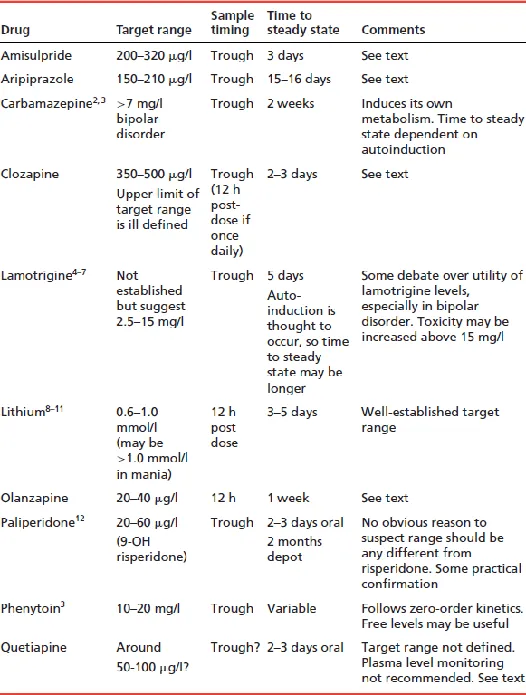
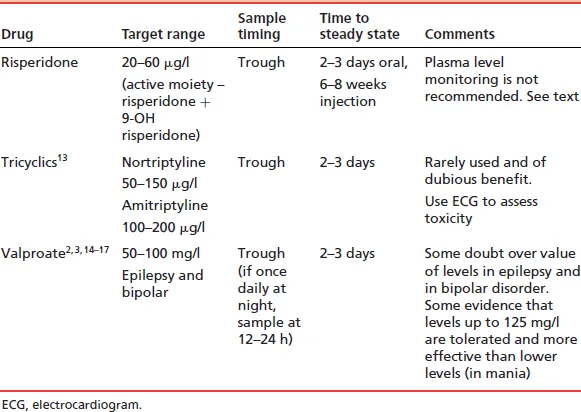
Table 1.1 shows the target ranges for some commonly prescribed psychotropic drugs.
Table 1.1 Interpreting plasma concentration sample results for psychotropic drugs
Table 1-1
Table 1-1
Amisulpride
Amisulpride plasma levels are closely related to dose with insufficient variation to recommend routine plasma level monitoring. Higher levels observed in women18–20 and older patients18,20 seem to have little significant clinical implication for either therapeutic response or adverse effects. A (trough) threshold for clinical response has been suggested to be approximately 100 μg/l;21 mean levels of 367 μg/l20 have been noted in responders in individual studies. Adverse effects (notably extrapyramidal side-effects [EPS]) have been observed at mean levels of 336 μg/l,18 377 μg/l21 and 395 μg/l.19 A plasma level threshold of below 320 μg/l has been found to predict avoidance of EPS.21 A review of the current literature22 has suggested an approximate range of 200–320 μg/l for optimal clinical response and avoidance of adverse effects.
In practice, amisulpride plasma level monitoring is rarely undertaken and few laboratories offer amisulpride assays. The dose–response relationship is sufficiently robust to obviate the need for plasma sampling within the licensed dose range; adverse effects are well managed by dose adjustment alone. Plasma level monitoring is best reserved for those in whom clinical response is poor, adherence is questioned and in whom drug interactions or physical illness may make adverse effects more likely.
Aripiprazole
Plasma level monitoring of aripiprazole is rarely carried out in practice. The dose–response relationship of aripiprazole is well established, with a plateau in clinical response and D2 dopamine occupancy seen at doses above approximately 10 mg/day.23 Plasma levels of aripiprazole, its metabolite and the total moiety (parent plus metabolite) strongly relate linearly to dose, making it possible to predict, with some certainty, an approximate plasma level for a given dose.24 Target plasma level ranges for optimal clinical response have been suggested as 146–254 μg/l25 and 150–300 μg/l,26 with adverse effects observed above 210 μg/l.26 Interindividual variation in aripiprazole plasma levels has been observed but not fully investigated, although gender appears to have little influence.27,28 Age, metabolic enzyme genotype and interacting medications seem likely causes of variation26–29 but there are too few reports regarding their clinical implication to recommend specific monitoring in respect to factors. A putative range of 150–210 μg/l24 has been suggested as a target for patients taking aripiprazole who are showing little or no clinical response or who have intolerable EPS. For reasons described here, plasma level monitoring is not advised in routine practice.
Clozapine
Clozapine plasma levels are broadly related to daily dose30 but there is sufficient vari...

Table of contents

  1. Cover
  2. Frontpiece
  3. Title Page
  4. Copyright
  5. Preface
  6. Acknowledgements
  7. Notes on using The Maudsley Prescribing Guidelines
  8. Notes on inclusion of drugs
  9. List of abbreviations
  10. Chapter 1: Plasma level monitoring of psychotropic drugs and anticonvulsants
  11. Chapter 2: Schizophrenia
  12. Chapter 3: Bipolar disorder
  13. Chapter 4: Depression and anxiety
  14. Chapter 5: Children and adolescents
  15. Chapter 6: Substance misuse
  16. Chapter 7: Use of psychotropic drugs in special patient groups
  17. Chapter 8: Miscellaneous conditions and substances
  18. Index