![]()
Chapter 1
Applications and Practices of Modelling, Risk and Uncertainty
This chapter reviews classical practice in various domains involving modelling in the context of risk and uncertainty and illustrates its common and distinguishing features. In particular, the distinct model formulations, probabilistic settings and decisional treatments encountered are reviewed in association with the typical regulatory requirements in the areas of natural risk, industrial design, reliability, risk analysis, metrology, environmental emissions and economic forecasting. This will help to introduce the notation and concepts that will be assembled within the generic modelling framework developed in Chapter 2. It will also lead to a review of the associated challenges discussed in other chapters. Although unnecessary to an understanding of the rest of the book, Chapter 1 can thus be read as an overview of the areas motivating the book's applications and as an analysis of the corresponding state of the art.
In order to facilitate reading, the following sections group the review of methods and practices under subsections that refer to given classes. Obviously, some of the methods introduced in association with one field are in fact used elsewhere, but this would not be the dominant practice. Industrial risk denotes risks affecting industrial facilities as the consequence of internal initiators such as reservoir failure, pipe break and so on; on the other hand, natural risk covers risks triggered by natural aggressions (e.g. seism, flood, . . .) and impacting on either industrial facilities or domestic installations. At the crossroads lies the so-called natech risk amongst which the Fukushima/Sendai event is a recent example.
1.1 Protection Against Natural Risk
Natural risk, an important concern for industrial or domestic facilities, has triggered an extensive field of risk research for which the ultimate goal is generally the design of protection for infrastructures or the reduction of the level of vulnerability in existing installations. Probabilistic approaches have permeated to a various extent both regulation and engineering practice, for example with regard to nuclear or hydro power facilities. Here are some notable examples of natural risk addressed:
- flood protection,
- maritime aggressions, such as waves or storm surges coupled with extreme tides,
- extreme winds,
- low flows or high temperatures (threatening the cooling of energy facilities),
- extremely cold temperatures, or associated phenomena (ice blocking, . . .),
- seism.
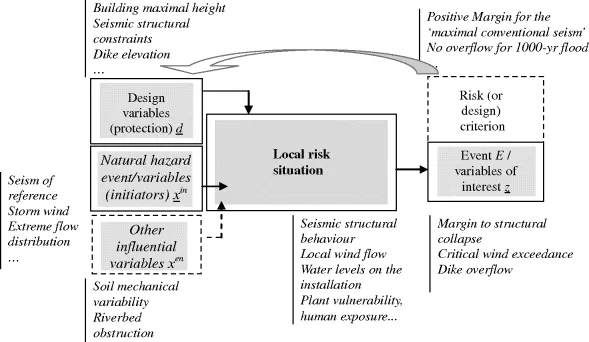
The typical situation is depicted in Figure 1.1. The box called ‘local risk situation’ summarises all phenomena according to which a flood, seism, cold wave or any type of aggression may impact locally on the installation and generate undesired consequences. It is determined both by:
- the natural hazard events (flood, seism, wind series . . .) that constitute initiators of the risk phenomenon;
- the local configuration of the installation, that is its vulnerability depending on the local mechanics of the natural event and its consequences depending on the assets of all kinds that are at stake (plant operation, integrity of equipments, resulting pollution or damage to the environment, potential injuries or fatalities, . . .) and the level of protection insured by the design choices and protection variables (e.g. dike height).
Natural initiators can be generally described by a few variables such as wind speed, seismic acceleration, flood flow and so on: they will be subsequently gathered inside a vector1 xin. Similarly, all protection/design variables will be formally gathered inside a vector d. Additionally, official regulations or design guidelines generally specify risk or design criteria that drive the whole study process. The definition of such criteria combines the following elements:
- A given undesirable event of interest (e.i.) which will be denoted as E. Think of dike overflow caused by flood or marine surge, structural collapse, cooling system failure and so on. Such an event of interest is technically defined on the basis of critical thresholds for one or several variables of interest (v.i.) characterizing the local risk situation: they are represented in Figure 1.1 by vector z. Think of the flood water level, a margin to mechanical failure, a critical local temperature and so on.
- A maximal acceptable level of risk: for instance, the undesired event should not occur up to the 1000-yr flood, or for the seism of reference; or else, structural collapse should occur less than 10−x per year of operation and so on.
The type of structure shown in Figure 1.1, linking variables and risk criteria, is similar to that mentioned in the book's introduction. Beyond natural risk, it will be repeated with limited variations throughout the areas reviewed in this chapter and will receive a detailed mathematical definition in Chapter 2.
1.1.1 The Popular ‘Initiator/Frequency Approach’
A considerable literature has developed on the issues raised by protection against natural risk: this includes advanced probabilistic models, decision theory approaches or even socio-political considerations about the quantification of acceptable risk levels (e.g. Yen and Tung, 1993; Duckstein and Parent, 1994; Apel et al., 2004; Pappenberger and Beven, 2006). The most recent discussions have focused on the cases of major vulnerability, uncertainty about the phenomena, reversibility or the precautionary principle (Dupuy, 2002). Notwithstanding all these research developments, it is useful to start with the state of the practice in regulatory and engineering matters. Most of the time, emphasis appears to be given to a form of ‘initiator/frequency approach’ which consists of attaching the definition of the risk criterion to a reference level prescribed for the initiator, for instance:
- ‘overspill should not occur for the 1000-yr flood’,
- ‘mechanical failure margin should remain positive for the reference seism’.
As will be made clear later, this consists essentially of choosing to focus on a single initiator xin as the dominant alea or source of randomness controlling the hazards and the risk situation. Good examples are the extreme wind speed, the flood flow, the external seismic scenario and so on. Nevertheless, a closer look into the realisation of the undesired event E usually leads to identifying other potentially important sources of uncertainties or risk factors. Yet, those additional uncertain variables (which will be noted xen) may be separated and given an ancillary role if they are mentioned at all. Think of:
- the riverbed elevation which conditions the amount of overspill for a given level of flood flow;
- the soil conditions around the industrial facility that modify the seismic response;
- the vulnerability of the installations, or conversely the conditional efficiency of protection measures.
At most, the two former types of variability would be studied in the context of local sensitivity to the design, if not ignored or packed within an additional informal margin (e.g. add 20 cm to design water level, add 20 % to seismic loading, etc.). The latter type is seldom mentioned and is even less often included in the regulatory framework.
This has a strong impact on the probabilistic formulation of the approach. Consider the undesired event E characterised by the variables of interest z (e.g. flood level, peak temperature, peak wind velocity, mechanical margin to failure). Event E is often schematised as a mathematical set stating that a certain threshold (e.g. dike level, critical temperature, critical wind, zero margin) is exceed...