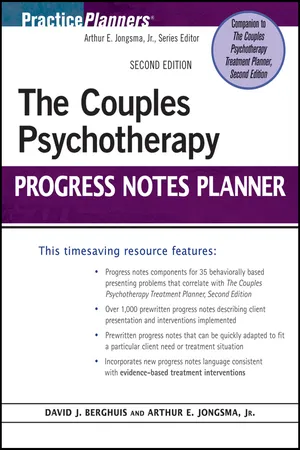
Now in a Second Edition, The Couples Psychotherapy Progress Notes Planner helps mental health practitioners reduce the amount of time spent on paperwork so more time can be spent with clients. The new edition covers an eclectic array of treatment approaches and corresponds with the behavioral problems and the DSM diagnostic categories found in The Couples Psychotherapy Treatment Planner. With new and updated information on the role of evidence-based practice in progress notes writing and the special status of progress notes under HIPAA, this guide provides marriage and family therapists with over 1,000 prewritten progress notes and treatment approaches for working with couples.
eBook - ePub
The Couples Psychotherapy Progress Notes Planner
- English
- ePUB (mobile friendly)
- Available on iOS & Android
eBook - ePub
The Couples Psychotherapy Progress Notes Planner
About this book
Information
Retirement
Client Presentation
1. Emotional Effects of Retirement (1)*
A. The retiring partner reported that he/she has experienced feelings of depression and anxiety subsequent to retirement.
B. The retiring partner acknowledged that his/her emotional struggles with retirement have prompted problematic behaviors.
C. As the retiring partner has displayed improved adjustment to retirement, his/her depression and anxiety have decreased.
D. The retiring partner is no longer experiencing depression and anxiety as a result of adjusting to retirement.
2. Lack of Meaningful Activities (2)
A. The retiring partner has been unable to find meaningful activities to replace his/her time spent in employment.
B. The retiring partner reports that he/she does not find much purpose in his/her current activities.
C. The retiring partner reports little history in activities outside of his/her employment.
D. As treatment has progressed, the retiring partner has developed more meaningful activities that have replaced employment, and feels more purposeful and satisfied in his/her lifestyle.
3. Role Assignment Conflict (3)
A. The partners spend much more time together now that they are in retirement.
B. The partners have experienced confusion regarding role assignments in the household.
C. The partners are in conflict about role assignments in the household.
D. One partner expects the other partner to do much more around the home now that he/she is retired.
E. One partner inserts himself/herself into the other partner's traditional responsibilities now that he/she is retired.
F. As treatment has progressed, the partners have reduced confusion and have decreased their conflict regarding role assignments.
4. Grief (4)
A. The retiring partner grieves the loss of structure that was associated with employment.
B. The retiring partner grieves the recognition that he/she gained with his/her employment.
C. The retiring partner reports emotional upheaval due to his/her grief process regarding the structure and recognition that he/she no longer experiences.
D. As treatment has progressed, the retiring partner has processed his/her grief over loss of structure and recognition, and has resolved this issue.
5. Frequent Arguments (5)
A. The partners report frequent or continual arguing as they spend more time with each other.
B. The arguments have created an environment rife with tension.
C. The frequency of conflict between the partners has diminished.
D. The partners reported a significantly decreased number of arguments due to the implementation of conflict resolution skills.
E. The client reported that his/her relationship with his/her partner has significantly improved and arguing has become very, very infrequent.
6. Difficulty Resolving Interpersonal Problems (6)
A. The couple described that their attempts to solve relationship problems often caused more tension and problems than the original problem.
B. Within the session, the couple displayed increased tension and conflict as they attempted to resolve problems.
C. As the couple has learned to resolve relationship problems, the level of tension and conflict during these discussions has decreased.
7. Frequent Misunderstandings (7)
A. The partners reported frequent patterns of misunderstanding each other during discussions.
B. As the partners have increased the time spent together, they have been more likely to bicker with each other.
C. The retiring partner appears to be compensating for his/her loss of structure and recognition by picking fights with his/her partner.
D. As treatment has progressed, the partners have improved their communication and significantly decreased the misunderstandings between them.
8. Sexual Dysfunction (8)
A. The retiring partner reports a consistently low desire for sexual activity.
B. The retiring partner reports no pleasurable participation in sexual activity.
C. The retiring partner reports a decrease in his/her sexual performance ability.
D. The interest in sexual contact between the partners is gradually increasing.
E. The couple realized an increased desire for sexual contact which is a return to previously established levels.
9. Lack of Physiological Sexual Response (9)
A. The partners report that there is a recurrent lack of physiological response to sexual excitement and arousal.
B. The male partner reports that he is unable to regularly attain or maintain an erection.
C. The female partner reports that she does not regularly experience vaginal lubrication.
D. Instead of an arousal response to sexual contact, the couple reports physiological response to excitement is often not present.
E. The sexually dysfunctional client is gradually regaining the usual physiological response of sexual excitement and arousal.
F. The couple reported that sexual contact resulted in a satisfactory level of physiological response to sexual excitement.
10. Lack of Subjective Enjoyment (10)
A. The sexually dysfunctional client reported a consistent lack of a subjectiv...
Table of contents
- Cover
- PracticePlanners® Series
- Title Page
- Copyright
- Dedications
- PracticePlanners® Series Preface
- Acknowledgments
- Introduction
- Alcohol Abuse
- Anger
- Anxiety
- Blame
- Blended-Family Problems
- Communication
- Dependency
- Depression due to Relationship Problems
- Depression Independent of Relationship Problems
- Disillusionment with Relationship
- Eating Disorders
- Financial Conflict
- Infidelity
- Internet Sexual Use
- Intimate Partner Violence (IPV)—Intimate Terrorism
- Intimate Partner Violence-Situational (Bi-Directional) Couple Violence
- Intolerance
- Jealousy
- Job Stress
- Life-Changing Events
- Loss of Love/Affection
- Midlife Transition Problems
- Only One Partner Willing to Attend Therapy
- Parenting Conflicts—Adolescents
- Parenting Conflicts—Children
- Personality Differences
- Psychological Abuse
- Recreational Activities Dispute
- Religious/Spirituality Differences
- Retirement
- Separation and Divorce
- Sexual Abuse
- Sexual Dysfunction
- Transition to Parenthood Strains
- Work/Home Role Strain
Trusted by 375,005 students
Access to over 1.5 million titles for a fair monthly price.
Study more efficiently using our study tools.
Frequently asked questions
Yes, you can cancel anytime from the Subscription tab in your account settings on the Perlego website. Your subscription will stay active until the end of your current billing period. Learn how to cancel your subscription
No, books cannot be downloaded as external files, such as PDFs, for use outside of Perlego. However, you can download books within the Perlego app for offline reading on mobile or tablet. Learn how to download books offline
Perlego offers two plans: Essential and Complete
- Essential is ideal for learners and professionals who enjoy exploring a wide range of subjects. Access the Essential Library with 800,000+ trusted titles and best-sellers across business, personal growth, and the humanities. Includes unlimited reading time and Standard Read Aloud voice.
- Complete: Perfect for advanced learners and researchers needing full, unrestricted access. Unlock 1.5M+ books across hundreds of subjects, including academic and specialized titles. The Complete Plan also includes advanced features like Premium Read Aloud and Research Assistant.
We are an online textbook subscription service, where you can get access to an entire online library for less than the price of a single book per month. With over 1.5 million books across 990+ topics, we’ve got you covered! Learn about our mission
Look out for the read-aloud symbol on your next book to see if you can listen to it. The read-aloud tool reads text aloud for you, highlighting the text as it is being read. You can pause it, speed it up and slow it down. Learn more about Read Aloud
Yes! You can use the Perlego app on both iOS and Android devices to read anytime, anywhere — even offline. Perfect for commutes or when you’re on the go.
Please note we cannot support devices running on iOS 13 and Android 7 or earlier. Learn more about using the app
Please note we cannot support devices running on iOS 13 and Android 7 or earlier. Learn more about using the app
Yes, you can access The Couples Psychotherapy Progress Notes Planner by David J. Berghuis,Arthur E. Jongsma, Jr. in PDF and/or ePUB format, as well as other popular books in Psychology & Psychotherapy. We have over 1.5 million books available in our catalogue for you to explore.