- English
- ePUB (mobile friendly)
- Available on iOS & Android
eBook - ePub
About this book
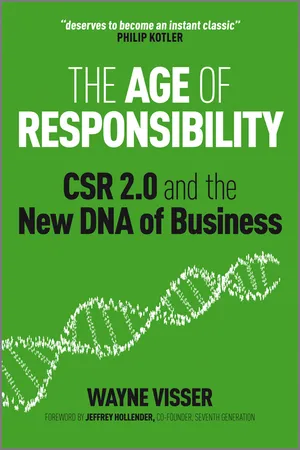
This landmark book shows how the old model of corporate sustainability and responsibility is being replaced by a second generation movement that goes beyond the outmoded approach of CSR as philanthropy or public relations concern to a more authentic, stakeholder-driven model. The author describes the new concept and mission of the new movement and explains its agenda in a succinct guide that will be useful for CSR professionals, including managers, consultants, academics, and non-governmental organizations.
PART I
The call to responsibility
CHAPTER 1
Our ability to respond
We have the Bill of Rights. What we need is a Bill of Responsibilities.—Bill MaherIt is easy to dodge our responsibilities, but we cannot dodge the consequences of dodging our responsibilities.—Josiah Charles StampLet everyone sweep in front of his own door, and the whole world will be clean.—Johann Wolfgang von GoetheIn times like these men should utter nothing for which they would not be willingly responsible through time and in eternity.—Abraham Lincoln
The meaning of responsibility
Do you sigh when you hear the word responsibility? Perhaps responsibility is even a dirty word in your vocabulary. Perhaps you associate it with burdens and restrictions; the opposite of being carefree and without obligations. But responsibility doesn’t have to be a chore, or a cage. It all depends how you think about it.
Responsibility is literally what it says – our ability to respond. It is a choice we make – whether to be attentive to our children’s needs, whether to be mindful of the plight of those less fortunate, whether to be considerate of the impact we have on the earth and others. To be responsible is to be proactive in the world, to be sensitive to the interconnections, and to be willing to do something constructive, as a way of giving back.
Responsibility is the counterbalance to rights. If we enjoy the right to freedom, it is because we accept our responsibility not to harm or harass others. If we expect the right to fair treatment, we have a responsibility to respect the rule of law and honour the principle of reciprocity. If we believe in the right to have our basic needs met, we have the responsibility to respond when poverty denies those rights to others.
Taking responsibility, at home or in the workplace, is an expression of confidence in our own abilities, a chance to test our own limits, to challenge ourselves and to see how far we can go. Responsibility is the gateway to achievement. And achievement is the path to growth. Being responsible for something means that we are entrusted with realizing its potential, turning its promise into reality. We are the magicians of manifestation, ready to prove to ourselves and to others what can happen when we put our minds to it, if we focus our energies and concentrate our efforts.
Being responsible for someone – another person – is an even greater privilege, for it means that we are embracing our role as caregivers, helping others to develop and flourish. This is an awesome responsibility, in the truest sense, one which should be embraced with gratitude, not accepted reluctantly with trepidation. Responsibility asks no more of us than that we try our best, that we act in the highest and truest way we know. Responsibility is not a guarantee of success, but a commitment to trying.
So why is responsibility seen by many as such an onerous burden? Responsibility becomes onerous when choice is removed from the equation, when we do not realize our freedom to act differently, when we forget that we are allowed to say ‘no’. Responsibility becomes pernicious when we take on too much, when we mistakenly think that more is always better, when we take on the guilt and expectations of others. Accepting too many responsibilities is, in fact, irresponsible – for it compromises our ability to respond. Do few things but do them well is the maxim of responsibility.
Being responsible also does not mean doing it all ourselves. Responsibility is a form of sharing, a way of recognizing that we’re all in this together. ‘Sole responsibility’ is an oxymoron.
Taking responsibility is a way of taking ownership in our lives, of acknowledging our own hand in the shaping of destiny. Responsibility is the antidote for victimhood.
When we walk with awareness, we realize the enmeshed nature of reality, we see the subtle strands that make up the web of life, we accept that everything is linked to everything else. Responsibility is being conscious of the oneness of existence.
Responsibility, if we manage it well, should never be like the curse of Sisyphus, eternally rolling a rock uphill, but rather a blessing gratefully received. For what can be more joyous than making a positive contribution in the world, or making a difference in someone else’s life?
Responsibility is the set of prints we leave in the sand, the mark of our passage. What tracks will you leave? Where is the place where you can most freely and effectively respond? The choice, as always, is yours.
I wrote these opening words on responsibility in 2005, and I believe they are more relevant today than they were back then. Responsibility is the choice we make to respond with care. This book, then, is a way of taking stock. What choices have we made – in the way we live our lives, in the way we do our work and in the way we run our businesses? How have we responded to the needs of our day – especially the social, environmental and ethical crises we face? And have our actions been taken with care – have we cared about our impacts on others?
I must admit to being slightly surprised (and a little dismayed) to find myself, 10 years after my first book, Beyond Reasonable Greed, still singing a similar refrain. I am once again arguing that business needs to ‘shapeshift’, to fundamentally rethink the purpose of business and to put into practice a genuinely sustainable and responsible ethos. There are fundamental differences though. Today, many of the problems are worse, more urgent and backed by more solid scientific evidence. In the interim, there has been a geopolitical shift away from the West, with the potential for more questioning of neoliberal economics and shareholder-driven capitalism. There are also more corporate corpses on the slab, allowing us to examine the nature of our greed disease. At the same time, awareness about our public social and environmental crises is much higher, and there are more genuine corporate sustainability and responsibility pioneers that provide living proof of what health and wellbeing could mean for business and society.
The fact is that now we know better what bad corporate magic looks like and the devastating consequences of practicing it. But we also know that magic spells can be broken by revealing the sleight of hand at work. It is my hope that by sharing some of the insights gained from the past 20 years of CSR wonder and trickery, we can move beyond magic to real responsibility – responsibility of the kind that makes a tangible, positive, sustained impact on the lives of the world’s poor and excluded and that visibly turns the tide on our wholesale destruction of ecosystems and species.
The failure of CSR
But I am getting ahead of myself. First let me say what I understand by CSR. I take CSR to stand for Corporate Sustainability and Responsibility, rather than Corporate Social Responsibility, but feel free use whichever proxy label you are most comfortable with. My definition is as follows: CSR is the way in which business consistently creates shared value in society through economic development, good governance, stakeholder responsiveness and environmental improvement. Put another way, CSR is an integrated, systemic approach by business that builds, rather than erodes or destroys, economic, social, human and natural capital. Given this understanding, my usual starting point for any discussion on CSR is to argue that it has failed. I will provide the data and arguments to back up this audacious claim in the paragraphs, pages and chapters that follow. But the logic is simple and compelling. A doctor judges his/her success by whether the patient is getting better (healthier) or worse (sicker). Similarly, we should judge the success of CSR by whether our communities and ecosystems are getting better or worse. And while at the micro level – in terms of specific CSR projects and practices – we can show many improvements, at the macro level almost every indicator of our social, environmental and ethical health is in decline.
I am not alone in my assessment. Indeed, Paul Hawken stated in The Ecology of Commerce in 1993 that ‘If every company on the planet were to adopt the best environmental practice of the “leading” companies, the world would still be moving toward sure degradation and collapse.’ Unfortunately, this is still true nearly 20 years later. Jeffrey Hollender, co-founder and former CEO of Seventh Generation, agrees, saying: ‘I believe that the vast majority of companies fail to be “good” corporate citizens, Seventh Generation included. Most sustainability and corporate responsibility programs are about being less bad rather than good. They are about selective and compartmentalized “programs” rather than holistic and systemic change.’
In fact, there is no shortage of critics of CSR. For example, in 2004, Christian Aid issued a report called ‘Behind the Mask: The Real Face of CSR’, in which they argue that ‘CSR is a completely inadequate response to the sometimes devastating impact that multinational companies can have in an ever-more globalized world – and it is actually used to mask that impact.’ A more recent example is an article in the Wall Street Journal (23 August 2010) called ‘The Case Against Corporate Social Responsibility’, which claims that ‘the idea that companies have a responsibility to act in the public interest and will profit from doing so is fundamentally flawed.’ This is not the place to deconstruct these polemics. Suffice to say that they raise some of the same concerns I have – especially about the limits of voluntary action and the ‘misdirection’ that CSR sometimes represents. But I also disagree with many of their propositions – such as the notion that CSR is always a deliberate strategy to mislead, or that government regulation is the only solution to social and environmental problems.
Be that as it may, there are a number of ways to respond to my assertion that CSR has failed. One is to disagree with the facts and to suggest that things are getting better, not worse, as do the likes of Bjørn Lomborg in his Skeptical Environmentalist (2001). That is his and your prerogative. However, I find the evidence – some of which is presented below and which is widely available from credible sources like the United Nations – both compelling and convincing. Second, you might argue that solving these complex social, environmental and ethical problems is not the mandate of CSR, nor within its capacity to achieve. My response is that while business certainly cannot tackle our global challenges alone, unless CSR is actually about solving the problems and reversing the negative trends, what is the point? CSR then becomes little more than an altruistic conscience-easer at best; a manipulative image-management tool at worst.
My approach – and the essence of this book – is to say that while CSR as it has been practised in the past has failed, that doesn’t mean that a different kind of CSR – one which addresses its limitations and reforms its nature – is destined to fail in the future. Hence, the first part of the book is about where we have gotten to with CSR to date – through the Ages of Greed, Philanthropy, Marketing and Management, using defensive, charitable, promotional and strategic CSR approaches respectively. The second part of the book then goes on to explore what CSR could (and in my view should) be in the Age of Responsibility – namely systemic or radical CSR, which I also call CSR 2.0. Along the way, I cite many best practice case studies, none of which are fully practising systemic CSR, but all of which have pieces of the puzzle that can instruct and inspire.
Our global footprint
Before we get into all that, however, let’s start by putting some facts on the table that back up my claim that many of our global challenges are getting worse, not better – beginning with environmental impacts. According to the Global Footprint Network, humanity’s ecological footprint, driven by the spread of capitalism and Western lifestyles globally, has more than tripled since 1961. Since the late 1980s, we have been in ‘overshoot’ – meaning that the world’s ecological footprint has exceeded the earth’s biocapacity. An ecological footprint analysis shows that while global biocapacity – the area available to produce our resources and capture our emissions – is 2.1 global hectares (ha) per person, the per person footprint is already 2.7 global ha.
The USA and China have the largest national footprints, each in total about 21% of global biocapacity, but US citizens each require an average of 9.4 global ha (or nearly 4.5 Planet Earths if the global population had US consumption patterns), while Chinese citizens use on average 2.1 global ha per person (one Planet Earth). Biocapacity is also unevenly distributed, with eight nations – the United States, Brazil, Russia, C...
Table of contents
- Cover
- Table of Contents
- Praise for The Age of Responsibility
- Title
- Copyright
- Table of Figures
- List of Tables
- Foreword
- Acknowledgements
- About the author
- PART I - The call to responsibility
- PART II - The ages and stages of CSR
- PART III - The principles of CSR 2.0
- PART IV - Our ability to change
- Bibliography
- Index
- Other books by Wayne Visser
- End User License Agreement
Trusted by 375,005 students
Access to over 1.5 million titles for a fair monthly price.
Study more efficiently using our study tools.
Frequently asked questions
Yes, you can cancel anytime from the Subscription tab in your account settings on the Perlego website. Your subscription will stay active until the end of your current billing period. Learn how to cancel your subscription
No, books cannot be downloaded as external files, such as PDFs, for use outside of Perlego. However, you can download books within the Perlego app for offline reading on mobile or tablet. Learn how to download books offline
Perlego offers two plans: Essential and Complete
- Essential is ideal for learners and professionals who enjoy exploring a wide range of subjects. Access the Essential Library with 800,000+ trusted titles and best-sellers across business, personal growth, and the humanities. Includes unlimited reading time and Standard Read Aloud voice.
- Complete: Perfect for advanced learners and researchers needing full, unrestricted access. Unlock 1.5M+ books across hundreds of subjects, including academic and specialized titles. The Complete Plan also includes advanced features like Premium Read Aloud and Research Assistant.
We are an online textbook subscription service, where you can get access to an entire online library for less than the price of a single book per month. With over 1.5 million books across 990+ topics, we’ve got you covered! Learn about our mission
Look out for the read-aloud symbol on your next book to see if you can listen to it. The read-aloud tool reads text aloud for you, highlighting the text as it is being read. You can pause it, speed it up and slow it down. Learn more about Read Aloud
Yes! You can use the Perlego app on both iOS and Android devices to read anytime, anywhere — even offline. Perfect for commutes or when you’re on the go.
Please note we cannot support devices running on iOS 13 and Android 7 or earlier. Learn more about using the app
Please note we cannot support devices running on iOS 13 and Android 7 or earlier. Learn more about using the app
Yes, you can access The Age of Responsibility by Wayne Visser in PDF and/or ePUB format, as well as other popular books in Business & Business Ethics. We have over 1.5 million books available in our catalogue for you to explore.