![]()
PART 1
TROUBLESHOOTING BASICS
![]()
Chapter 1
The Economics of Troubleshooting Polymer Processing Systems
Mark D. Wetzel
E. I. du Pont de Nemours and Company Engineering Research and Technology Wilmington, Delaware, USA
Abstract
Polymer processing is a very cost competitive, but capital intensive endeavor. Most industrial operations consist of a sequence of complex mechanical, electric and thermal components, where ingredients are combined or transformed into higher value products to be sold to customers in the market. The equipment can experience problems that can negatively impact productivity and quality. Proper investments are required in expertise, hardware and software to enable a manufacturing organization to troubleshoot and resolve these problems in order for the business to remain viable in the global marketplace. This chapter examines the economics of key aspects of polymer processing troubleshooting in order to assist the reader in making decisions about how to plan for and make strategic investments in technology and expertise in order to maintain and optimize equipment performance and manufacturing productivity.
Keywords: Extrusion, compounding, economics, troubleshooting, uptime, yield, cost, safety, productivity, facilities, equipment, process, measurement, analysis
1.1 Introduction
The industrial practice of polymer processing has become very cost competitive while requiring a capital intensive set of operations that includes synthesis (polymerization), chemical modification, compounding, and forming or shaping steps. Most systems consist of a sequence of complex mechanical, electric and thermal components, where ingredients are combined or transformed into higher value products to be sold to customers in the market. In order to establish, grow or maintain a profitable business, manufacturing assets must operate at or near peak performance levels that deliver products with consistent properties and high quality. However, polymer processing equipment does experience many problems that can negatively impact productivity and quality. Proper investments are required in expertise, hardware and software to enable a manufacturing organization to troubleshoot and resolve these problems in order for the business to remain viable in the global marketplace.
This chapter examines the economics of polymer processing troubleshooting to assist the reader in making decisions about how to plan for and make strategic investments in technology and expertise in order to maintain and optimize equipment performance and manufacturing productivity. Another objective is to show how it could cost more money or put a business at risk by avoiding the proper commitment to the resources required to identify the causes of processing problems and resolve them in a timely and economically viable way.
1.2 Economic Incentives and Necessities
Competitive industries like plastics processing demand high productivity in order to be profitable. Capital intensive manufacturing operations require high asset utilization. Key metrics can be used to quantify system economic performance and justify or track the costs of troubleshooting investments. The following measures are useful in determining the financial contribution of a process or set of resources allocated to that operation.
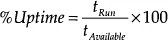
1. Uptime can be defined as the time that an asset is used to make a product that can be sold divided by the time that the asset is available to run:
The time available can include or exclude a number of normal production events. For example, annual plant shutdowns or routine, scheduled equipment overhauls may be excluded from the calculation. It is important that the uptime calculation be consistent over long times, so that performance changes can be compared with benchmarks. Depending on the process, uptime can range from 50 to over 95 percent. For example, a continuous polymerization unit can operate at uptimes from 90-95 percent. A small-lots custom compounding line may have an uptime of 50 to 65 percent. Catastrophic equipment problems, such as extruder screw and shaft breakage or motor drive failures have a serious impact on uptime. Material feed bridging, die hole freeze-off, die drips and plugged vacuum ports are examples of operational problems that also affect uptime.
2. Yield is the material produced that can be sold, divided by the total material processed. First-pass yield is the material that can be sold as a premium product meeting all specifications, divided by the total processed. Product that can be sold as second-grade or scrap may provide income, but first-pass yield is the goal-setting standard. Processes that are unstable or experience frequent upsets can produce significant off-spec products, adversely impacting yield. Uptime and yield are the two most common metrics used to assess manufacturing line productivity.
3. Customer satisfaction and demand is the most important measure of a product’s market value and viability. Poor quality can put a company out of business. Failure to meet demand could constrain growth and prompt a competitor to invest in a new asset to make the same or similar products that take market share.
4. Labor cost includes all resources allocated to a production line. This includes operators, engineers, chemists, mechanics and other skilled trades, contractors, consultants, quality control or analytical laboratory staff, management and other overhead. Processes with frequent equipment failures can experience high labor costs.
5. Energy cost can be used to measure process efficiency. An extrusion line with poor temperature control may cost more to operate than one equipped with a modern computer system and well-tuned closed-loop controllers.
6. Auxiliary or support equipment includes the hardware or systems required to maintain process operations. Computers, software, instrumentation and testing tools may be needed in order to diagnose and resolve problems or prevent upsets or failure that impact uptime and yield.
7. Waste generation and disposal is another economic indicator of asset productivity and sustainability. Processes with frequent upsets or equipment problems can generate more waste that incurs a disposal and potential environmental cost. Excessive edge trim in a film line could increase the waste or material used as “re-work.”
8. Safety, health and environmental events and impacts can be related to process problems and equipment failures. The cost of safety and environmental incidents or near misses can be tracked and correlated to process performance metrics, including uptime and yield. The failure to diagnose and resolve a process problem quickly could result in a serious injury or environmental release that could shut a line down for an indefinite period with potential legal consequences, not to mention the pain and suffering caused to individuals, families or the community.
9. Capital productivity can be calculated using uptime or yield data and the known fixed capital investment and depreciation costs. One may also include labor, energy and feedstock costs.
10. Process capability is a measure of how well an operation performs under the best conditions. It establishes valid uptime, yield and cost metrics to be compared over time. As problems arise, uptime, yield and costs will change and can be tracked over short and long time periods.
11. Financial metrics and conventional accounting methods can be applied to quantify manufacturing performance by combining sales or income with operating costs. Calculations that can be used include RONA (Return on Net Assets), ROI (Return on Investment) and other standard accounting practices that are used to manage costs and determine profitability. These methods will reflect the impact troubleshooting investments have on sales and costs.
These and other measures represent “hard” numbers that quantify process performance from a cost and benefit perspective. While minimizing production cost is critical in a competitive...