This book provides a full representation of Inverse Synthetic Aperture Radar (ISAR) imagery, which is a popular and important radar signal processing tool. The book covers all possible aspects of ISAR imaging. The book offers a fair amount of signal processing techniques and radar basics before introducing the inverse problem of ISAR and the forward problem of Synthetic Aperture Radar (SAR). Important concepts of SAR such as resolution, pulse compression and image formation are given together with associated MATLAB codes.
After providing the fundamentals for ISAR imaging, the book gives the detailed imaging procedures for ISAR imaging with associated MATLAB functions and codes. To enhance the image quality in ISAR imaging, several imaging tricks and fine-tuning procedures such as zero-padding and windowing are also presented. Finally, various real applications of ISAR imagery, like imaging the antenna-platform scattering, are given in a separate chapter. For all these algorithms, MATLAB codes and figures are included. The final chapter considers advanced concepts and trends in ISAR imaging.
Fourier transform (FT) is a common and useful mathematical tool that is utilized in numerous applications in science and technology. FT is quite practical, especially for characterizing nonlinear functions in nonlinear systems, analyzing random signals, and solving linear problems. FT is also a very important tool in radar imaging applications as we shall investigate in the forthcoming chapters of this book. Before starting to deal with the FT and inverse Fourier transform (IFT), a brief history of this useful linear operator and its founders is presented.
1.1.1 Brief History of FT
Jean Baptiste Joseph Fourier, a great mathematician, was born in 1768 in Auxerre, France. His special interest in heat conduction led him to describe a mathematical series of sine and cosine terms that can be used to analyze propagation and diffusion of heat in solid bodies. In 1807, he tried to share his innovative ideas with researchers by preparing an essay entitled “On the Propagation of Heat in Solid Bodies.” The work was examined by Lagrange, Laplace, Monge, and Lacroix. Lagrange’s oppositions caused the rejection of Fourier’s paper. This unfortunate decision caused colleagues to wait for 15 more years to read his remarkable contributions on mathematics, physics, and, especially, signal analysis. Finally, his ideas were published in the book The Analytic Theory of Heat in 1822 [1].
Discrete Fourier transform (DFT) was developed as an effective tool in calculating this transformation. However, computing FT with this tool in the 19th century was taking a long time. In 1903, Carl Runge studied the minimization of the computational time of the transformation operation [2]. In 1942, Danielson and Lanczos utilized the symmetry properties of FT to reduce the number of operations in DFT [3]. Before the advent of digital computing technologies, James W. Cooley and John W. Tukey developed a fast method to reduce the computation time in DFT. In 1965, they published their technique that later on became famous as the fast Fourier transform (FFT) [4].
1.1.2 Forward FT Operation
The FT can be simply defined as a certain linear operator that maps functions or signals defined in one domain to other functions or signals in another domain. The common use of FT in electrical engineering is to transform signals from time domain to frequency domain or vice versa. More precisely, forward FT decomposes a signal into a continuous spectrum of its frequency components such that the time signal is transformed to a frequency-domain signal. In radar applications, these two opposing domains are usually represented as “spatial frequency” (or wave number) and “range” (distance). Such use of FT will be examined and applied throughout this book.
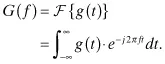
The forward FT of a continuous signal g(t) where −∞ < t < ∞ is described as
(1.1)
To appreciate the meaning of FT, the multiplying function e−j2πft and operators (multiplication and integration) on the right side of Equation 1.1 should be investigated carefully: The term
is a complex phasor representation for a sinusoidal function with the single frequency of fi. This signal oscillates only at the frequency of fi and does not contain any other frequency component. Multiplying the signal in interest, g(t), with the term
provides the similarity between each signal, that is, how much of g(t) has the frequency content of fi. Integrating this multiplication over all time instances from −∞ to ∞ will sum the fi contents of g(t) over all time instants to give G(fi); that is, the amplitude of the signal at the particular frequency of fi. Repeating this process for all the frequencies from −∞ to ∞ will provide the frequency spectrum of the signal; that is, G(f). Therefore, the transformed signal represents the continuous spectrum of frequency components; that is, representation of the signal in “frequency domain.”
1.1.3 IFT
This transformation is the inverse operation of the FT. IFT, therefore, synthesizes a frequency-domain signal from its spectrum of frequency components to its time-domain form. The IFT of a continuous signal G(f) where −∞ < f...
Table of contents
Cover
WILEY SERIES IN MICROWAVE AND OPTICAL ENGINEERING
Title page
Copyright page
Dedication
Preface
Acknowledgments
CHAPTER ONE: Basics of Fourier Analysis
CHAPTER TWO: Radar Fundamentals
CHAPTER THREE: Synthetic Aperture Radar
CHAPTER FOUR: Inverse Synthetic Aperture Radar Imaging and Its Basic Concepts
CHAPTER FIVE: Imaging Issues in Inverse Synthetic Aperture Radar
CHAPTER SEVEN: Scattering Center Representation of Inverse Synthetic Aperture Radar
CHAPTER EIGHT: Motion Compensation for Inverse Synthetic Aperture Radar
CHAPTER NINE: Some Imaging Applications Based on Inverse Synthetic Aperture Radar
Appendix
Index
Trusted by 375,005 students
Access to over 1.5 million titles for a fair monthly price.
Study more efficiently using our study tools.
Frequently asked questions
Yes, you can cancel anytime from the Subscription tab in your account settings on the Perlego website. Your subscription will stay active until the end of your current billing period. Learn how to cancel your subscription
No, books cannot be downloaded as external files, such as PDFs, for use outside of Perlego. However, you can download books within the Perlego app for offline reading on mobile or tablet. Learn how to download books offline
Perlego offers two plans: Essential and Complete
Essential is ideal for learners and professionals who enjoy exploring a wide range of subjects. Access the Essential Library with 800,000+ trusted titles and best-sellers across business, personal growth, and the humanities. Includes unlimited reading time and Standard Read Aloud voice.
Complete: Perfect for advanced learners and researchers needing full, unrestricted access. Unlock 1.5M+ books across hundreds of subjects, including academic and specialized titles. The Complete Plan also includes advanced features like Premium Read Aloud and Research Assistant.
Both plans are available with monthly, semester, or annual billing cycles.
We are an online textbook subscription service, where you can get access to an entire online library for less than the price of a single book per month. With over 1.5 million books across 990+ topics, we’ve got you covered! Learn about our mission
Look out for the read-aloud symbol on your next book to see if you can listen to it. The read-aloud tool reads text aloud for you, highlighting the text as it is being read. You can pause it, speed it up and slow it down. Learn more about Read Aloud
Yes! You can use the Perlego app on both iOS and Android devices to read anytime, anywhere — even offline. Perfect for commutes or when you’re on the go. Please note we cannot support devices running on iOS 13 and Android 7 or earlier. Learn more about using the app
Yes, you can access Inverse Synthetic Aperture Radar Imaging With MATLAB Algorithms by Caner Ozdemir in PDF and/or ePUB format, as well as other popular books in Technology & Engineering & Electrical Engineering & Telecommunications. We have over 1.5 million books available in our catalogue for you to explore.