eBook - ePub
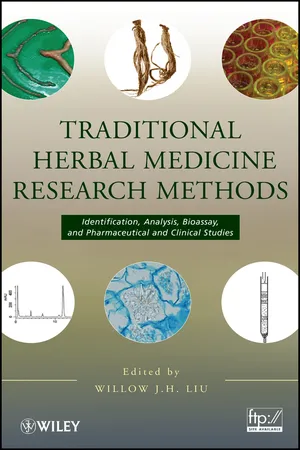
Traditional Herbal Medicine Research Methods
Identification, Analysis, Bioassay, and Pharmaceutical and Clinical Studies
- English
- ePUB (mobile friendly)
- Available on iOS & Android
eBook - ePub
Traditional Herbal Medicine Research Methods
Identification, Analysis, Bioassay, and Pharmaceutical and Clinical Studies
About this book
This book introduces the methodology for collection and identification of herbal materials, extraction and isolation of compounds from herbs, in vitro bioassay, in vivo animal test, toxicology, and clinical trials of herbal research. To fully understand and make the best use of herbal medicines requires the close combination of chemistry, biochemistry, biology, pharmacology, and clinical science. Although there are many books about traditional medicines research, they mostly focus on either chemical or pharmacological study results of certain plants. This book, however, covers the systematic study and analysis of herbal medicines in general – including chemical isolation and identification, bioassay and mechanism study, pharmacological experiment, and quality control of the raw plant material and end products.
Information
Chapter 1
Introduction to Traditional Herbal Medicines and Their Study
1.1 DEFINITION AND TRENDS OF TRADITIONAL HERBAL MEDICINES
According to the World Health Organization (WHO), traditional medicine refers to health practices, approaches, knowledge, and beliefs incorporating plant, animal, and mineral-based medicines, spiritual therapies, manual techniques, and exercises, applied singularly or in combination to treat, diagnose, and prevent illnesses or to maintain well-being. If the material being used is of plant origin, then it is called traditional herbal medicine.
Different types of traditional medicines are widely applied in Asia, Africa, and Latin America to meet primary health-care needs. Traditional medicine has maintained its popularity in most regions of the developing world. The application is also rapidly spreading in industrialized countries, where adaptations of traditional medicines are often termed “complementary” or “alternative.” In the United States, the National Institutes of Health (NIH) uses the name complementary and alternative medicine (CAM) to cover health systems, practices, and products that are not considered part of conventional medicine. Worldwide, among all the different traditional medicine systems, traditional Chinese medicine (TCM) is currently the most popular, followed by Indian medicine. In Western terminology, the name “Oriental medicine” covers Chinese, Japanese, and Korean medicines preferred by immigrants from Korea, while “Asian medicine” is often used to include TCM, Indian (Ayurveda), and Tibetan medicine. Among all treatment methods in traditional medicine systems, medicinal herbs are the most widely applied.
Medicine has been revolutionized in Europe by advances in chemistry, laboratory techniques, and equipment since Robert Koch discovered the transmission of disease by bacteria, followed by the discovery of antibiotics in the early 1900s. Thus, modern medicine is commonly called Western medicine even though there are also traditional medicines in Western countries. It is also called conventional medicine.
Webster’s medical dictionary defines conventional medicine as medicine practiced by holders of medical doctor (M.D.) or doctor of osteopathy (D.O.) degrees and by their allied health professionals, such as physical therapists, psychologists, and registered nurses. Other terms for Western medicine or conventional medicine include allopathy and allopathic medicine, mainstream medicine, orthodox medicine, regular medicine, and biomedicine.
Although conventional medicine is the mainstream medicine in Western countries, application of traditional medicine, including herbal medicines, is growing worldwide for many reasons, in particular, the side effects or inefficacy of modern drugs. The following data are provided by the WHO.
- In Africa, up to 80% of the population uses traditional medicine for primary health care.
- In China, traditional herbal preparations account for 30–50% of the total medicinal consumption.
- In Europe, North America, and other industrialized regions, over 50% of the population has used complementary or alternative medicine at least once.
- In Germany, 90% of the population has used a natural remedy at some point in their lives.
- The global market for herbal medicines currently stands at over USD$60 billion annually, and is growing steadily.
Since the last century, scientists all over the world have studied herbal medicines from the fields of chemistry, biology, pharmacology, toxicology, and clinical trials. Recently, in addition to screening out new drug candidates, investigators also expect to explore the preventative and therapeutic mechanism of herbal medicines that play very important roles in most of the traditional medicine systems, such as TCM and Ayurveda medicine.
1.2 RESEARCH AND DEVELOPMENT OF HERBAL MEDICINES
The use of herbal medicines for treatment of diseases was documented several thousand years ago. As seen from journals, studies on herbal medicines have been encompassed under several different names, such as plant medicine, phytomedicine, pharmacognosy, and natural products. “Natural products” usually refer to products processed or derived from living organisms, including plants, animals, insects, microorganisms, and marine organisms.
Data from the WHO show that 25% of modern medicines are made from plants that were first used traditionally. Examples include atropine, morphine, quinine, ephedrine, warfarin, aspirin, digoxin, vincristine, taxol, and hyoscine.
Traditional medicine needs to be modernized in the twenty-first century. However, modernization of traditional medicine should not be simply Westernization. For herbal medicines, the purpose of a study is not only to screen out bioactive compounds from herbal extracts for new drug development, but also to standardize and control the quality of raw herbal materials and their products to ensure the safety and efficacy; and more importantly, to reveal their preventative and therapeutic mechanisms. So far, only a relatively small number of herbal medicines have been well studied from all of these aspects; these herbs include Echinacea, ginkgo, ginseng, and licorice.
To a large extent, the depth and progress of research on herbal medicines depend on the development of related technology and equipment, as well as the in-depth understanding of the human body and diseases. Mechanism study and functional evaluation of herbal medicine involve the fields of chemistry, biochemistry, biology, pharmacology, toxicology, and clinical study. Thus, organized and consistent teamwork is absolutely vital.
Researchers from different labs need to work closely together, discuss problems frequently, and analyze the results instantly. A scientist for extraction and isolation of herbal medicines in the chemistry lab should have enough knowledge of biology and pharmacology to provide an appropriate sample because an improperly extracted or isolated sample provided from his or her lab for biological and pharmacological study could lead to wrong results in the bioassay or animal test. The scientist in the bioassay or animal lab for screening or mechanism study of herbal medicines should make sure that the sample to be tested is correctly extracted, that the concentrations of tested samples are within a proper range, and that the design of the experiment is scientific enough to provide a true result. And to reach such a goal, an adequate understanding of the research target, the functions and indications, as well as clinic applications of the study herb is necessary. The following are several main aspects of herbal medicine research.
1.2.1 Extraction, Isolation, and Identification of Compounds in Herbal Medicines
All the substances in the universe, including plants, are composed of chemical compounds. To study herbal medicine, the major bioactive chemical components should be first known. Only after the biological compounds in herbs are correctly extracted, isolated, and identified can biochemical, biological, or pharmacological studies be performed scientifically.
Chemical studies of herbal medicines provide fundamental substances for further studies of biological and pharmacological activity. During the earlier decades of the 1800s, chemical studies in plants could only be performed on active compounds that were highly concentrated and isolated into a relatively pure form by techniques such as distillation or extraction with water, acid, base, or alcohol. Their structures were mainly determined by chemical degradation and proven by synthesis in an unambiguous manner. Scientists were unable to determine the stereochemistry of compounds.
The well-known example is the story of aspirin. According to records about willow leaves as an antipyretic treatment in Ebers papyrus, and following the same application of teas made from willow bark as an English herb, chemists and pharmacists successfully isolated salicin from the bark of the white willow, Salix alba, between 1825 and 1826. The compound responsible for the remedy was subsequently converted to salicylic acid via hydrolysis and oxidation, and proved as such a successful antipyretic (fever reducer) that it was actively manufactured and used worldwide. Due to severe gastrointestinal toxicity, salicylic acid was converted into acetylsalicylic acid via acetylation by scientists at Bayer. It was given its trade name of aspirin in 1899. Today, aspirin is still the most widely used analgesic and antipyretic drug in the world.
Since the 1950s, chromatography, including medium-pressure liquid chromatography (MPLC) and high-performance liquid chromatography (HPLC), and other methods such as supercritical fluid extraction (SFE), droplet countercurrent (DCC), and high-speed countercurrent (HSCC) have been popularly applied for isolation of natural products, while different types of spectral equipment such as infrared (IR), ultraviolet (UV), nuclear magnetic resonance (NMR), circular dichroism (CD), and mass spectrometer (MS), as well as MS coupled with gas chromatography (GC), have been commonly used for structure identification. Later on, LC-MS and LC-NMR also became available and gradually more popular in the last few decades. These advances have made the time for extraction, isolation, and identification of compounds from herbal medicines much shorter than that of a century ago. Modern extraction and isolation techniques, combined with all types of chromatography, are often guided by bioassays to isolate the active compounds. High-throughput screening with robots also dramatically lowers the screening times. Thus, structure-efficacy elucidation of newly isolated bioactive compounds is no longer a time-consuming and difficult process.
However, the process of finding new drug candidates from herbs for drug development is no longer as easy as the story of aspirin. The story of taxol is that of a difficult journey of a trace compound from a plant becoming a powerful new drug. Taxol is one of the most well-known diterpenes with a very complex steroid structure and anticancer activity. The extract of the bark of Pacific yew (Taxus brevifolia) was first found to be cytotoxic in a cellular assay in 1964. The active ingredient was isolated in 1966 with a very low amount, and the structure was published in 1971. By 1969, 28 kg of crude extract had been isolated from almost 1200 kg of bark, but yielded only 10 g of pure material. The research result showed that it acts to stabilize the mitotic apparatus in cells, causing them to act as normal cells rather than undergo rapid proliferation as they do in cancer. But it was not until the late 1980s that its value as an anticancer drug was confirmed.1
Current modern methods and techniques such as all kinds of chromatography and spectrometry, and their combined application make the extraction, isolation, and structure identification of bioactive compounds from herbs dramatically faster than half a century ago. Highly accurate analytical equipment, such as HPLC coupled with UV and/or MS and other detectors, makes the quality control and standardization of herbal products more reliable for pharmacological and clinical studies. Advanced biochemical and biological technologies, such as microarray, allow scientists to easily explore the mechanism study at the enzyme, receptor, and gene levels quantitatively using only small amounts of samples. These advanced technologies and their applications to herbal study will be introduced in the following chapters. With all these available high technologies, time for isolation and identification of compounds from herbs is becoming shorter and trace bioactive compounds are more easily obtained. With the popularity of various spectroscopy methods, identification of isolated compounds is becoming much easier than it was decades ago. Application of hyphenated LC-UV/MS and LC-NMR techniques greatly accelerates the systematic identification of compounds in an herbal extract.
To perform any herbal study, identification of the herbal materials used for study should never be neglected. Morphological, microscopic, physical, or chemical identification can all be applied to identify the raw materials. The availability of HPLC chromatogram or gene fingerprints makes identification of species highly accurate.
1.2.2 Bioassay Screening and Mechanism Study of Herbal Medicines
Scientists have spent over a hundred years trying to screen new drug candidates from herbal medicines. Recently, due to the rapid growth of products of herbal medicine or alternative medicine all over the world, their efficacy and safety have become more and more important. More attention has been drawn to the preventative and therapeutic mechanism study of herbal medicines. For both reasons, bioassay study on herbs is indispensible. Thanks to the advancement of biological technologies, more and more bioassays are available for mechanism study. The mechanism of many effective herbal medicines has been elucidated, such as the well-known ginkgo, Echinacea, red clover, black cohosh, ginseng, and many Chinese and other traditional herbs. Bioassays in vitro are usually followed by in vivo animal tests to further confirm the functional mechanism and understand the absorption, metabolism, and toxicity in living bodies.
Bioassay is commonly performed using enzymes, receptors, genes, cells, and sometimes tissues. In comparison to screening for new drug candidates of single compounds, screening herbal extracts or fractions is relatively difficult due to the solubility or complex composition in herbal samples. Compounds in an extract might interfere with each other, or more specifically, the activity of one compound might be masked by another in the mixture due to the adverse effect or toxicity of the latter. So, the bioassay result of an herbal extract should be carefully evaluated, particularly when a high-throughput method is applied, not only due to the mentioned interference, but also because of the dramatically varied concentrations of bioactive components in different samples prepared under the same conditions. Mechanism study for herbal medicine does not necessarily use high-technology equipment. The most important thing is to select the right targets. Different enzymes, receptors, or genes should be tested for mechanism of an herbal extract. Assays at different levels should be applied to ensure the positive or negative research results. Evaluation of estrogenic activity of red clover and black cohosh extracts using different bioassays can be used as an example.2
In many cases, the corresponding bioactive components for the functional mechanism of herbal medicines are common or universally distributed compounds. Such results may disappoint researchers looking for new drug development, but they are very helpful to scientists who are dedicated to explaining the functions of herbs or willing to understand more about physiological functions of these common compounds in the human body. Examples include linolic acid, a cyclooxygenase (COX) inhibitor in Angelica pubescens3 and an estrogenic agonist in Vitex agnus-castus L. (chaste berry),4 and Nω-methylserotonin, a serotonin agonist in black cohosh.5
1.2.3 Pharmacological and Toxicological Study of Herbal Medicines
Similar to modern pharmaceutical study, pharmacological study of herbal medicines include pharmacodynamic (PD) and pharmacokinetic (PK) aspects. Broadly, toxicology is also part of the pharmacology.
PD study of traditional herbal medicines is not always easy. Up to now, only the most popularly used herbs, a very small fraction of the total number used, have been well known with respect to pharmacological effects on animals. One reason is that herbs might treat diseases in a way different from known modern drugs. Black cohosh is one example. This herb has long been used in North America for menopause symptoms in women, but in vivo animal study indicated that its extract did not exhibit effects in ovariectomized Sprague–Dawley rats. Further study showed that instead of directly binding to estrogen receptors, extract of black cohosh was reported acting as a mixed competitive ligand and partial agonist of the serotonin and opiate receptor,6,7 which indicates that this herb might treat menopause symptoms through regulation of the central nervous system.
Chinese scientists have done numerous pharmacological studies on Chinese herbs. Therapeutic mechanisms of the most commonly used Chinese herbs have been known by systematic PD studies.8–10 However, there is another challenge in the pharmacological study of Chinese herbs; that is, in the vast majority of cases, the practitioners prescribe formulas that consist of several (sometimes over 20) herbal ingredients for the treatment. This makes the study difficult not only due to the co...
Table of contents
- Cover
- Title page
- Copyright page
- Dedication
- Preface
- Contributors
- Abbreviations
- Chapter 1 Introduction to Traditional Herbal Medicines and Their Study
- Chapter 2 Collection and Identification of Raw Herbal Materials
- Chapter 3 Extraction and Isolation of Compounds from Herbal Medicines
- Chapter 4 Identification and Structure Elucidation of Compounds from Herbal Medicines
- Chapter 5 Bioassays for Screening and Functional Elucidation of Herbal Medicines
- Chapter 6 Functional Evaluation of Herbal Medicines by Animal Experiments
- Chapter 7 Safety Pharmacology and Toxicity Study of Herbal Medicines
- Chapter 8 Clinical Study of Traditional Herbal Medicine
- Chapter 9 Standardization and Quality Control of Herbal Extracts and Products
- Chapter 10 Understanding Traditional Chinese Medicine and Chinese Herbs
- Index
Trusted by 375,005 students
Access to over 1.5 million titles for a fair monthly price.
Study more efficiently using our study tools.
Frequently asked questions
Yes, you can cancel anytime from the Subscription tab in your account settings on the Perlego website. Your subscription will stay active until the end of your current billing period. Learn how to cancel your subscription
No, books cannot be downloaded as external files, such as PDFs, for use outside of Perlego. However, you can download books within the Perlego app for offline reading on mobile or tablet. Learn how to download books offline
Perlego offers two plans: Essential and Complete
- Essential is ideal for learners and professionals who enjoy exploring a wide range of subjects. Access the Essential Library with 800,000+ trusted titles and best-sellers across business, personal growth, and the humanities. Includes unlimited reading time and Standard Read Aloud voice.
- Complete: Perfect for advanced learners and researchers needing full, unrestricted access. Unlock 1.5M+ books across hundreds of subjects, including academic and specialized titles. The Complete Plan also includes advanced features like Premium Read Aloud and Research Assistant.
We are an online textbook subscription service, where you can get access to an entire online library for less than the price of a single book per month. With over 1.5 million books across 990+ topics, we’ve got you covered! Learn about our mission
Look out for the read-aloud symbol on your next book to see if you can listen to it. The read-aloud tool reads text aloud for you, highlighting the text as it is being read. You can pause it, speed it up and slow it down. Learn more about Read Aloud
Yes! You can use the Perlego app on both iOS and Android devices to read anytime, anywhere — even offline. Perfect for commutes or when you’re on the go.
Please note we cannot support devices running on iOS 13 and Android 7 or earlier. Learn more about using the app
Please note we cannot support devices running on iOS 13 and Android 7 or earlier. Learn more about using the app
Yes, you can access Traditional Herbal Medicine Research Methods by Willow J.H. Liu in PDF and/or ePUB format, as well as other popular books in Physical Sciences & Industrial & Technical Chemistry. We have over 1.5 million books available in our catalogue for you to explore.