![]()
1
Introduction
1.1
Introduction to Waste Management
Thomas H. Christensen
Technical University of Denmark, Denmark
Solid waste management is as old as human civilization, although only considered an engineering discipline for about one century. The change from the previous focus on public cleansing of the cities to modern waste management was primarily driven by industrialization, which introduced new materials and chemicals, dramatically changing the types and composition of waste, and by urbanization making waste management in urban areas a complicated and costly logistic operation.
This book focuses on waste that commonly appears in the municipal waste management system. This chapter gives an introduction to modern waste management, including issues as waste definition, problems associated with waste, waste management criteria and approaches to waste management. Later chapters introduce aspects of engineering (Chapter 1.2), economics (Chapter 1.3) and regulation (Chapter 1.4).
1.1.1 Defining Solid Waste
1.1.1.1 Waste
A simple definition of waste is:
An important characteristic is that being ‘waste’ is not an intrinsic property of an item but depends on the situation in which the item appears as defined by its owner or in other words how the owner values the item. The owner sees little value in an item if the effort required converting the excessive item to cash value or preserving the item for future use or consumption exceeds the effort it takes to obtain the same cash value or function of the item by other means. Then the item becomes waste. This means that becoming ‘waste’ may depend on many factors, for example:
- Time: If supplies are scarce, for example during war time and embargos, the owner will spend more time and effort repairing an item since the alternative may be costly and hard to find.
- Location: Farming communities may easily make use of food waste for animal feeding, while this is less feasible in a highrise in an urban area.
- State: The item may be repairable depending on its state (price, age, type of damage) and thereby avoid being discarded.
- Income level: The higher your income the more food you may discard or the more items you may discard because they no longer are in fashion or up to date.
- Personal preferences: Certain types of items may be collector’s items or possess veneration for some individuals.
This also suggests that what is waste to one person may not be waste to another person and there may be a potential for trading if the cost for transferring the item does not exceed the value of the item as perceived by the new owner. Hence quantity and purity of the item is a key issue; the metallic paper clip in a private household may be discarded as waste, while tonnes of iron cuttings in a manufacturing industry may not be a waste but a secondary product that can be traded.
In addition to the abovementioned factors, what actually becomes waste depends on which items are being purchased and consumed. Or in other words culture, climate, religious and ethnic background as well as economical abilities affect what becomes waste. Hence, waste quantities and composition vary widely, both geographically (regionally, locally) and over time.
The introduced definition of waste may teach us about the complexity of waste, but the definition may not suffice in a legal context, since it has a high degree of subjectivity. The European Union (EU) defines waste as ‘any substance or object which the holder discards or intends or is required to discard’ (CEC, 2008). The authorities can define what is to be considered as waste; thereby controlling what is regulated as waste. The EU definition is supplemented with a long list of items and materials as examples of what can become waste, often referred to as the European Waste Catalogue.
1.1.1.2 Solid Waste
The definition of ‘solid waste’ would be anticipated to be ‘a waste in a solid state’. However, solid waste may be solid, or liquid as a sludge or as a free chemical phase. This originates from defining solid waste as waste that is not water (wastewater) or air borne (flue gasses). This also suggests that solid waste has no transporting media like water and air that must be cleaned. While obtaining clean water and clean air are the main purposes of treating wastewater and cleaning flue gasses, the purpose of waste management is not to clean the waste bins, but to handle the waste in the bins, as discussed later.
Solid waste is mostly in a solid state, but also sludge from wastewater treatment and liquid chemical waste are included, although the latter are not within focus of this book.
1.1.1.3 Hazardous versus Nonhazardous Waste
It is often convenient to distinguish between nonhazardous waste and hazardous waste. This may apply to practical waste management as well as to the regulatory aspects of waste management. Hazardous waste is more dangerous to the environment and to those handling the waste and must be technically managed with more strict controls than nonhazardous waste.
The hazardousness of a waste is assessed according to criteria as (simplified after CEC, 2008):
- Oxidizing in contact with other materials resulting in highly exothermic reactions.
- Flammable in contact with air having flashpoint less than 55°C (highly flammable, with a flashpoint less than 21°C).
- Irritant: causing inflammation through contact with skin or mucous membrane.
- Harmful: causing limited health risks through inhalation, ingestion or penetration of skin.
- Toxic: causing serious, acute or chronic health risks and even death through inhalation, ingestion or penetration of skin.
- Carcinogenic: inducing cancer or increasing cancer incidence through inhalation, ingestion or penetration of skin.
- Explosive under the effect of flame, shock or friction.
- Corrosive by destroying living tissue on contacts.
- Infectious due to viable microorganism or their toxins known or reliably believed to cause disease in man or other living organisms.
- ‘Toxic for reproduction’: substances and preparations which, if they are inhaled or ingested or if they penetrate the skin, may induce nonhereditary congenital malformations or increase their incidence.
- Mutagenic: inducing hereditary genetic defects or increasing their incidence through inhalation, ingestion or penetration of skin.
- Releasing toxic gases in contact with water, air or an acid.
- ‘Sensitizing’: substances and preparations which, if they are inhaled or if they penetrate the skin, are capable of eliciting a reaction of hypersensitization such that on further exposure to the substance or preparation, characteristic adverse effects are produced.
- Ecotoxic: presenting any immediate or delayed risks for any sector of the environment.
- Substances capable by any means after disposal of yielding another substance which possesses any of the characteristics listed above.
These criteria are for practical assessments supplemented with quantitative limits as well as methods for their determination (for example, see CEC, 2008, and in particular CEC, 2000).
1.1.2 Material Flow and Waste Generation
Waste generation is linked to economical activities and flow of materials in society.
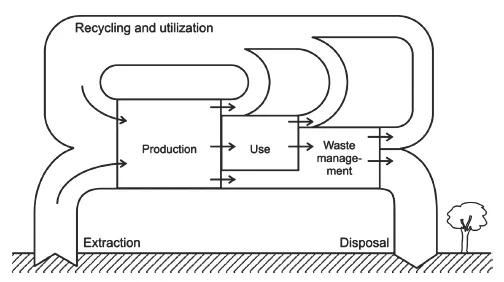
The schematic diagram in Figure 1.1.1 (adapted from Vesilind et al., 2002) illustrates the flow of materials from the environment through society and back to the environment. The diagram pictures the fact that resources are not consumed but merely transformed in the process of extraction from the environment, production and use before ending up as waste. This waste may be returned back into the production-use cycle in society or disposed of into the environment. The material flow is driven by a significant use of energy, and emissions to air, water and soil are associated with all activities within the flow system. Also the extraction of resources and the disposal of waste into the environment may have associated environmental burdens. A large extraction of resources may also lead to the depletion of resources, for example certain metals; and disposal activities may damage resources by contamination, for example groundwater resources at a landfill.
Modern society is characterized with a very large extraction of resources from the environment and a very large disposal of waste in the environment. As the economy expands, the material flow traditionally also expands, leading to increased environmental burdens and resource consumption. Schematically it may seem possible to link the disposal with the extraction of resources and thereby ‘close the loop’, but the resources mined and the biomasses grown (inputs) are so different from the waste disposed (outputs) that this is neither technical nor economical feasible. The control of the material flow allowing for continued economical expansion, also for the less developed part of the world, is rather linked to a more efficient use of the resources extracted and increased recycling and utilization of the waste generated. This again reduces the amount – at least relatively – being disposed of into the environment.
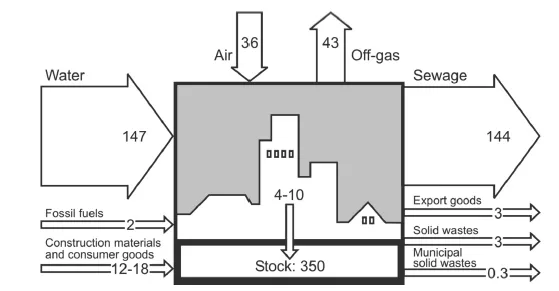
Figure 1.1.1 neglects the fact that many of the goods produced and consumed have very different retention times in society: Packaging has a very short lifetime (days to weeks), daily consumer products like telephones, clothing, etc. have a moderate lifetime (few years), large consumer products like furniture, vehicles, etc. have a long lifetime (many years to decades), while buildings and civic constructions (e.g. roads) have very long life times (decades to centuries). This implies that waste generation is not directly linked to production and use, since many of the goods produced may accumulate in society and appear as waste at a much later point in time. This was illustrated by Brunner and Rechberger (2004), who estimated flows in and out of the city of Vienna, Austria. Figure 1.1.2 shows estimates for one year in...