- Offers new and essential insights into Rawls's idea of "property-owning democracy"
- Addresses the proposed political and economic institutions and policies which Rawls's theory would require
- Considers radical alternatives to existing forms of capitalism
- Provides a major contribution to debates among progressive policymakers and activists about the programmatic direction progressive politics should take in the near future
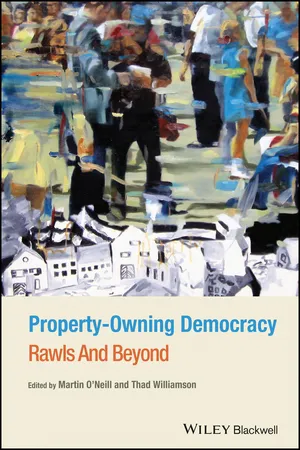
eBook - ePub
Property-Owning Democracy
Rawls and Beyond
- English
- ePUB (mobile friendly)
- Available on iOS & Android
eBook - ePub
Property-Owning Democracy
Rawls and Beyond
About this book
Property-Owning Democracy: Rawls and Beyond features a collection of original essays that represent the first extended treatment of political philosopher John Rawls' idea of a property-owning democracy.
Information
Part One
Property-Owning Democracy: Theoretical Foundations
Chapter 1
Justice or Legitimacy, Barricades or Public Reason?
The Politics of Property-Owning Democracy
Thinking about the sorts of politics that Rawls's work might lead to or inspire presents us with something analogous to a trompe l'oeil. Not the trompe l'oeil of open windows painted on brick walls, but the optical puzzle of a picture that looks first like a vase, then like two profiles, and then a vase again, and indeed the painting is both a vase and the profile of two faces but – and here is the puzzling part for the viewer – they cannot be seen as both simultaneously. Looking at Rawls's work from a philosophical perspective, he moved from philosophical questions of justice to political questions of stability and legitimacy. Thus his work became more political over the years and spoke more directly to the politics of constitutional democracies. But looking at his work from the point of view of politics, Rawls's work become less political over the course of years because it became less about justice.
What do I mean by “less political” in this context? A Theory of Justice is a radical book that claimed (among other things) that strongly egalitarian social institutions are the proper and only conclusion to draw from thinking through our liberal commitments. Thus A Theory of Justice contained a deep indictment of contemporary schemes of distribution. In particular, welfare state capitalism was essentially unjust and should be replaced with property-owning democracy. But replacing welfare state capitalism with property-owning democracy would – certainly in the political world within which Rawls lived, the late twentieth-century United States – require something close to a revolution.
Rawls a revolutionary? Could one ever imagine the careful, gentle, and eminently sensible figure of John Rawls manning a barricade? The very strangeness of this image is part of the shifting ideas of politics that come in and out of focus as we read Rawls from two different perspectives. Rawls's egalitarian vision would take nothing short of a revolution to bring about and yet Rawls was anything but a revolutionary.
In this chapter I trace out the shifting terms of the politics of egalitarianism. In particular I look at the reasons why Rawls refused to embrace the type of politics that would be necessary to bring about the type of justice he appeared to be advocating. Rawls's views on equality are radical, indeed utopian, and as such quite far ahead of prevailing public culture. Outlining the political implications of the difference principle in any detail would involve stepping out of the existing liberal order into a radical critical theory.1 This is to say it would involve taking a critical stand toward existing distributive schemes. The difference principle does not point to a more progressive tax system but rather to a rethinking of the basic structure of our property relations. This is radical. This sort of radicalism not only did not interest Rawls; it appears to undermine his main justificatory strategy, namely the argument that “justice as fairness” was simply a rendering of certain core ideas central to our existing liberal order.
Furthermore, in moving from his Archimedean stage to his political stage, Rawls moved from outlining a theory of justice to outlining how such a theory of justice could become widely accepted and stabilized under conditions of pluralism. The central idea in this move is to seek out principles of justice that have both a strong philosophic justification as well as a strong citizen endorsement, despite the fact that citizens might have very different religious and moral world-views. This is what Rawls calls political liberalism. It is political rather than metaphysical. We need not find agreement on questions of truth and or a full moral view in order to agree on principles to govern the basic structure of our political community. Legitimacy becomes tied to what can be publically justified under conditions of reasonable pluralism, and Rawls had to concede that many of the egalitarian principles he championed in A Theory of Justice could not be publically justified even though he still was convinced that they were just (Freeman, 2007).
Controversial principles concerning social justice moved into the background and more widely accepted views concerning rights and freedoms moved into the foreground. In particular, the difference principle, which is the jewel in the crown of Rawls's egalitarianism and the foundational principle for the endorsement of property-owning democracy, was essentially just but could not be shown to be legitimate (Freeman, 2007). In what follows I trace out the move from justice to legitimacy and ask, “Is there a way back from legitimacy to justice?” In order to see why the difference principle causes problems from the point of view of legitimacy we need to begin at the beginning: with basic ideas of equality.
What Is Equality?
Rawls's discussion of equality is complex and multileveled, and, despite becoming less prominent in his later work, remained an enduring theme throughout his career. Very broadly, we can discern three interlocking spheres of equality at work in Rawls's writings: fundamental equality, political equality, and social and economic equality. Fundamental equality involves some initial claim about the moral status of individuals, namely, that all persons are of equal worth (Barry, 2001). It is this sort of claim that is expressed in the Declaration of Independence, for example, with the words “We hold these truths to be self-evident, that all men are created equal.” There are three things to note about fundamental equality: it is notoriously difficult to “prove,” it is not self-evident what follows from such a claim, and it is the closest thing liberal democracy has to an axiom. All of Rawls's work begins from the premise that we are free and equal in a fundamental and essentially pre-political sense. There is no attempt – nor does Rawls think there is any need – to “prove” this as a universal truth. Nor does he claim it as a fact. It is simply the way we must begin if we are to think about what follows from our broadest liberal commitments.
Although it is not self-evident what follows from fundamental equality, political equality, sometimes called equality of democratic citizenship, is the most common next step (Arneson, 1993). Here we move from making a general claim about moral status to a claim about how institutions should treat individuals. Political equality then encompasses such things as equal basic liberties – for example, freedom of expression, religion, and association; equal right to vote and run for office; equality before the law and due process.
Finally, we come to social and economic equality or, more precisely, social and economic inequality. Few claim that in this sphere there is equality (as in the moral realm) or that there ought to be or could be full equality (as in the political realm). The debate is usually about how much inequality we ought to allow. For strong egalitarians like Rawls, the benchmark is equality, but the question is not how to achieve equality, but rather, how far ought we to let distribution fall away from the benchmark. While there is a great deal still to be said about fundamental equality (and we should never tire of reminding ourselves of its importance), and we have yet to get political equality quite right, there appears to be a broad consensus on these ideas within Western liberal democracies. Social and economic equality is the hard case and so the more interesting case.
In justice as fairness, Rawls's favored conception of justice, political and social equality are embodied in his two principles of justice. The first principle runs as follows: “each person has the same indefeasible claim to a fully adequate scheme of equal basic liberties, which scheme is compatible with the same scheme of liberties for all” (Rawls, 2001, p. 42). The status and centrality of this principle to Rawls's political philosophy never changed and it appears to have deep roots in American political culture.2 The first half of Rawls's second principle also remained central to his conception of justice and also appears to have significant popular support: social and economic inequalities “are to be attached to offices and positions open to all under conditions of fair equality of opportunity” (2001, p. 42).3 It is the second half of the second principle, the difference principle, that has seen the most change and which appears to have the least support in public culture: social and economic inequalities “are to be to the greatest benefit of the least advantaged members of society” (Rawls, 2001, p. 43).4 This principle is the heart and soul of Rawls's egalitarianism. But he pushed this egalitarianism into the background as his work become more political. Why this should be so is worth considering.
From the Fact of Inequality to the Fact of Pluralism
In A Theory of Justice, Rawls argues that questions of justice are really questions about the basic structure of society: that is, they are questions about how things like constitutions, markets, and private property determine and shape life chances. These institutions, however they are set up, necessarily “favor certain starting places over others.” This is a fact of social life, and for Rawls “[i]t is these inequalities, presumably inevitable in the basic structure of any society, to which the principles of social justice must in the first instance apply” (Rawls, 1971, p. 7). Social inequality is inevitable but it is also man-made. Inequality is the result of structures that are subject to our choices and control. There are an infinite number of ways to regulate a market. Thus, although inequality is inevitable, no particular pattern or configuration of inequality is necessary. We must decide which pattern or configuration is justifiable. This is the central problematic of A Theory of Justice. It leads Rawls to develop principles of justice that regulate the basic structure and hence determine life chances. These principles of justice are highly egalitarian and he never repudiates or significantly alters his commitment to them. But things do change.
One way to read that change is as a shift from a concern about the problems raised by the fact of inequality to a concern for the problems raised by the fact of pluralism. These two facts play vastly different roles in his theory. The fact of inequality asks for justification against a benchmark of equality; the fact of pluralism asks for accommodation against a benchmark of autonomy. The first fact must be viewed with suspicion, the second with approval. The fact of inequality demands that we think about and come up with principles of justice; the fact of pluralism demands that we think about and come up with ways of justifying and defending principles of justice in a world characterized by deep disagreement. Thus, one can understand the move from A Theory of Justice to Political Liberalism as a move from the question “What principles of justice follow from our general liberal commitments?” to the question “Why should we think citizens would accept these principles as legitimate?”5
The problem of inequality in A Theory of Justice is posed as a philosophical problem to be worked out in the original position, while the problem of pluralism in Political Liberalism is posed as a political problem to be worked out among citizens. The difference here is not that Rawls moves from ideal theory to the nonideal world of messy politics. In both A Theory of Justice and Political Liberalism ideal theory is the medium; Rawls is working within the assumption of a well-ordered society. A well-ordered society is “a society effectively regulated by a public conception of justice” (Rawls, 2001, p. 5). The Rawlsian strategy is to think about moral and political problems in a context where everything pretty much works as it should and where everyone pretty much acts as she should. Once we get a handle on how things might work in a well-ordered society, we can begin to introduce the problems, uncertainties, and contingencies of the real world.
So Political Liberalism is not political in a pragmatic sense. It is political because it describes the citizen point of view and argues that citizens can endorse a political conception of justice without at the same time having to endorse a shared moral, religious, or deep philosophical perspective.
Although citizens are, of course, present in A Theory of Justice, the most important character is the chooser in the original position. She is asked to view the problem of inequality from an impartial perspective. This perspective requires that she know nothing about her particular place in society. Citizens, in contrast, know everything about themselves and in particular they are very aware of the way their fundamental moral and religious ideas diverge. Citizens, while not under the radical impartiality of the veil of ignorance, are asked to adopt a stance of neutrality while arguing with each other.
Public reason eclipses the original position as the perspective from which citizens view questions of justice. Public reason in its earliest articulation (Rawls, 1993) was the reasoning and deliberation that would be necessary to work out the constitutional and legislative elaboration of the principles of justice chosen in the original position. In a well-ordered society, everyone would share a basic but very general conception of justice (for example, justice as fairness) and would argue from that conception. There would still be lots of room for difference of opinion but it would be about the application and elaboration of principles of justice and not about the principles themselves. But as Rawls became more interested in citizens and legislators working out the constitutional essentials necessary to any conception of justice, he became less insistent that justice as fairness was the only conception of justice that could fit the bill. Justice as fairness became one among many possible conceptions of justice that could serve the function of shared starting point for deliberation. Rawls began to use the phrase “justice as fairness or something like it” when appealing to a conception of justice. Not only did justice as fairness become just one possible conception of justice among a number of possible sets of liberal principles but questions of economic distribution and property rights fell completely outside of public reason (Rawls, 1993, p...
Table of contents
- Cover
- Title Page
- Copyright
- Notes on Contributors
- Acknowledgments
- Foreword
- Introduction
- Part One: Property-Owning Democracy: Theoretical Foundations
- Part Two: Interrogating Property-Owning Democracy: Work, Gender, Political Economy
- Part Three: Toward a Practical Politics of Property-Owning Democracy: Program and Politics
- Index
Trusted by 375,005 students
Access to over 1.5 million titles for a fair monthly price.
Study more efficiently using our study tools.
Frequently asked questions
Yes, you can cancel anytime from the Subscription tab in your account settings on the Perlego website. Your subscription will stay active until the end of your current billing period. Learn how to cancel your subscription
No, books cannot be downloaded as external files, such as PDFs, for use outside of Perlego. However, you can download books within the Perlego app for offline reading on mobile or tablet. Learn how to download books offline
We are an online textbook subscription service, where you can get access to an entire online library for less than the price of a single book per month. With over 1.5 million books across 990+ topics, we’ve got you covered! Learn about our mission
Look out for the read-aloud symbol on your next book to see if you can listen to it. The read-aloud tool reads text aloud for you, highlighting the text as it is being read. You can pause it, speed it up and slow it down. Learn more about Read Aloud
Yes! You can use the Perlego app on both iOS and Android devices to read anytime, anywhere — even offline. Perfect for commutes or when you’re on the go.
Please note we cannot support devices running on iOS 13 and Android 7 or earlier. Learn more about using the app
Please note we cannot support devices running on iOS 13 and Android 7 or earlier. Learn more about using the app
Yes, you can access Property-Owning Democracy by Martin O'Neill, Thad Williamson, Martin O'Neill,Thad Williamson in PDF and/or ePUB format, as well as other popular books in Philosophy & Philosophy History & Theory. We have over 1.5 million books available in our catalogue for you to explore.