![]()
Chapter 1
Overview of Vibrational Optical Activity
1.1 Introduction to Vibrational Optical Activity
Vibrational optical activity (VOA) is a new form of natural optical activity whose early history dates back to the nineteenth century. We now know that the original observations of optical activity, the rotation of the plane of linearly polarized radiation, termed optical rotation (OR), or the differential absorption of left and right circularly polarized light, circular dichroism (CD), have their origins in electronic transitions in molecules. Not until after the establishment of quantum mechanics and molecular spectroscopy in the twentieth century was the physical basis of natural optical activity revealed for the first time.
1.1.1 Field of Vibrational Optical Activity
Vibrational optical activity, as the name implies, is the area of spectroscopy that results from the introduction of optical activity into the field of vibrational spectroscopy. VOA can be broadly defined as the difference in the interaction of left and right circularly polarized radiation with a molecule or molecular assembly undergoing a vibrational transition. This definition allows for a wide variety of spectroscopies, as will be discussed below, but the most important of these are the forms of VOA associated with infrared (IR) absorption and Raman scattering. The infrared form is known as vibrational circular dichroism, or VCD, while the Raman form is known as vibrational Raman optical activity, VROA, or usually just ROA (Raman optical activity). VCD and ROA were discovered experimentally in the early 1970s and have since blossomed independently into two important new fields of spectroscopy for probing the structure and conformation of all classes of chiral molecules and supramolecular assemblies.
VCD has been measured from approximately 600 cm−1 in the mid-infrared region, into the hydrogen stretching region and through the near-infrared region to almost the visible region of the spectrum at 14 000 cm−1. The infrared frequency range of up to 4000 cm−1 is comprised mainly of fundamental transitions, while higher frequency transitions in the near-infrared are dominated by overtone and combination band transitions. ROA has been measured to as low as 50 cm−1, a distinct difference compared with VCD, but ROA is more difficult to measure beyond the range of fundamental transitions and is typically only measured for vibrational transitions below 2000 cm−1. VCD and ROA can both be measured as electronic optical activity in molecules possessing low-lying electronic states, although in the case of VCD it is appropriate to refer to these phenomena as infrared electronic circular dichroism, IR-ECD or IRCD, and electronic ROA, or EROA.
VCD and ROA are typically measured for liquid or solution-state samples. VCD has been measured in the gas phase and in the solid phase as mulls, KBr pellets and films of various types. When sampling solids, distortions of the VCD spectra due to birefringence and particle scattering need to be avoided. To date, ROA has not been measured in gases or diffuse solids, but nothing precludes this sampling option, although technical issues may arise, such as sufficient Raman intensity for gases and competing particle scattering for diffuse solids.
At present, there is only one form of VCD, namely the one-photon differential absorption form, although recently, a second manifestation of VCD, the differential refractive index, termed the called vibrational circular birefringence (VCB), has been measured. A VCB spectrum is the Kramers–Kronig transform of a VCD spectrum and is also known as vibrational optical rotatory dispersion (VORD). As we shall see, ORD is the oldest form of optical activity and the form of VOA that was sought in the 1950s and 1960s before the discovery of VCD. By comparison, ROA is much richer in experimental possibilities. Because one can consider circular (or linear) polarization differences in Raman scattering intensity associated with the incident or scattered radiation, or both, in-phase and out-of-phase, there are four (eight) distinct forms of ROA. Further, for ROA there are choices of scattering geometry and the frequency of the incident radiation, both of which give rise to different ROA spectra. As a result, there is in principle a continuum of different types of VOA measurements that can be envisioned for a given choice of sample molecule.
Beyond this, many other forms of VOA are possible. One form is reflection vibrational optical activity, which would include VCD measured as specular reflection, diffuse reflection or attenuated total reflection (ATR). In principle, VCD could also be measured in fluorescence. Because fluorescence depends on the third power of the exciting frequency, infrared fluorescence VOA would be very weak relative to VCD and thus very difficult to measure. As with fluorescence in the visible and ultraviolet regions of the spectrum, fluorescence VCD could be measured in two forms, fluorescence detected VCD or circularly polarized emission VCD. In the former, one would measure all the fluorescence intensity resulting from the differential absorbance of left and right circularly polarized infrared radiation (VCD) or measure the difference in left and right circularly polarized infrared emission from unpolarized exciting infrared radiation. Finally, we note the various manifestations of nonlinear or multi-photon VCD, such as two-photon infrared absorption VCD.
In the case of ROA there are a variety of different forms of VOA yet to be measured. One recently reported for the first time is near-infrared excited ROA. Other forms of ROA yet to be measured are ultraviolet resonance Raman ROA, surface-enhanced ROA, coherent anti-Stokes ROA, and hyper-ROA in which two laser photons generate an ROA spectrum in the region of twice the laser frequency. Second harmonic generation (SHG) ROA at two-dimensional interfaces has been measured, and attempts have been made to measure sum frequency generation (SFG) VOA, which is an interesting form of optical activity that depends on transition moments which arise in both VCD and ROA.
Another class of optical activity that has VOA content is vibronic optical activity. Here the source of optical activity is a combination of electronic optical activity (EOA) and VOA when changes to both electronic and vibrational states occur in a transition. This form of EOA–VOA arises in ECD whenever vibronic detail is observed. The analogous form of ROA is either vibronically resolved electronic ROA or ROA arising from strong resonance with particular vibronic states of a molecule.
Finally, we consider other forms of radiation that may affect vibrational transitions in molecules. In particular, it is possible to create beams of neutrons that are circular polarized either to the left or to the right. This phenomenon has been considered theoretically, but experimental attempts at measurement have not been reported. Another common form of vibrational spectroscopy that does not involve photons as the source of radiation interaction is electron energy loss spectroscopy. This is essentially Raman scattering using electrons. If modulation between left and right circularly polarized electrons could be realized, then this could become a new form of VOA in the future.
1.1.2 Definition of Vibrational Circular Dichroism
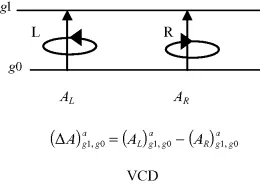
VCD is defined as the difference in the absorbance of left minus right circularly polarized light for a molecule undergoing a vibrational transition. For VCD to be non-zero, the molecule must be chiral or else be in a chiral molecular environment, such as a non-chiral molecule in a chiral molecular crystal or bound to a chiral molecule. The definition of VCD is illustrated in Figure 1.1 for a molecule undergoing a transition from the zeroth (0) to the first (1) vibrational level of the ground electronic state (g) of a molecule.
More generally, we can define VCD for a transition between any two vibrational sublevels ev and ev′ of an electronic state e as:
where
is the absorbance for left circularly polarized light and
is the absorbance for right circularly polarized light. The superscript
a refers to the vibrational mode, or modes, associated with the vibrational transition. The sense of the definition of VCD is left minus right circularly polarization in conformity with the definition used for electronic circular dichroism (ECD). The parent ordinary infrared absorption intensity associated with VCD, also referred to as vibrational absorbance (VA), is defined as the average of the individual absorbance intensities for left and right circularly polarized radiation, namely:
These definitions of VCD and VA represent the total intensity associated with a given vibrational transition with the label
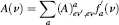
a. Experimentally, one measures VCD and VA spectra as bands in the spectrum that have a shape or distribution as a function of radiation frequency
, which is expressed as
for each vibrational transition. The reason for the prime will be explained in Chapter 3. An experimentally measured VCD or VA spectrum is therefore related to the defined quantities in
Equations (1.1) and
(1.2) by sums over all the vibrational transitions
a in the spectrum as:
From these expressions it can also be seen that the original definitions of VCD and VA in Equations (1.1) and (1.2) represent integrated intensities over the measured VCD, or VA, band of vibrational transition a by writing for example:
where the last integral on the right-hand side of this expression is equal to 1 when a normalized bandshape of unit area is used as:
Experimentally, the VA intensities are defined by the relationship:
where
is the IR transmission intensity of the sample, which is divided by the reference transmission spectrum of the instrument,
, usually without the sample in place. Normalization of the sample transmission by the reference spectrum removes the dependence of the measurement on the characteristics of the instrument used for the measurement of the spectrum, namely throughput and spectral profile. The second part of
Equation (1.7) assumes Beer–Lambert's law and defines the molar absorptivity of the sample,
, where
b and
C are the pathlength and molar concentration in the case of solution-phase samples, respectively. The experimental measurement of VCD is similar, but more complex than the definition of VA in
Equation (1.7), and we defer description of this definition until Chapter 2, when the measurement of VCD is described in detail. The definition of the molar absorptivity in
Equation (1.7) yields a molecular-level definition of VCD intensity,
, which is free of the choice of the sampling variables pathlength and concentration. This is given by:
where (ee) is the enantiomeric excess of the sample. The (ee) can be defined as the concentration of the major enantiomer, CM, minus that of the minor enantiomer, Cm, divided by the sum of the...