![]()
Chapter 1
Light
In the beginning God created the heavens and the earth. The earth was formless and empty, darkness was over the surface of the abyss, and the spirit of God was hovering over the waters. God said ‘Let there be light’ and there was light. God saw that the light was good: and God divided the light from the darkness. God called the light Day, and the darkness he called Night. And there was evening and there was morning, it was the first day.
“Fiat Lux — Let there be light”
Old Testament,
The Pentateuch — Genesis 1,
Chapter 1
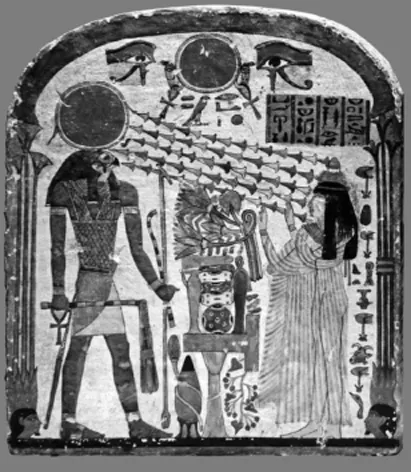
Light has long fascinated man, exalted depictions by painters or praise from writers, with many areas of study for scientists and scholars. Figure 1.1 represents, for example, Lady Taperet (22nd Dynasty, 10th or 9th Century BC) praying to the sun god Ra-Horakhty. The symbolism of light provides an almost unlimited field for celebration of all kinds in all civilizations, past and present.
For centuries, the only known radiation was light. The first written analysis of light seems to date from Greek and Latin civilizations. For the Greeks, Euclid (325–265 BC) and Ptolemy (90–168 BC), the light is emitted from our eye and is the vector of an object image. On the other hand, Epicurus (341–270 BC) and the Latin poet Lucretius (98–55 BC) thought that the bright objects sent little pictures of themselves into space, referred to as “simulacras”. These simulacras were entering our eyes so we could “see” these objects. This latter theory called “corpuscular theory of light” would be taken up again in a more abstract manner during the 17th and 18th Centuries.
Because of this, from the 17th Century, the nature of light was a source of debate that lasted for more than 300 years. With the fundamental question, “Is light a wave or a stream of particles?”
To explain the laws of reflection and refraction of light rays, Rene Descartes (1596–1650) evokes particles that bounce off a mirror like a ball in a French game (jeu de paume) whose speed changes when entering a transparent medium (water or glass, for example). It is the source of the fundamental Snell–Descartes’ laws. The authorship of the refraction law is attributed to Willebrord Snell (1580–1626) after Christian Huygens (1629–1695) refers to the date of the unpublished work of Snell on the subject. Note that the paternity of the discovery of the law of refraction is currently attributed to Ibn Sahl (940–1000) in 985. Ibn Al-Haytham (965–1039) wrote a book on optics (Opticae thesaurus) in which he mentions the phenomenon of refraction, but he could not develop the mathematical law. This discipline was originally called “dioptric”, but later it was called geometrical optics for (or due to the fact that) the trajectory of light rays is built to geometrical rules.
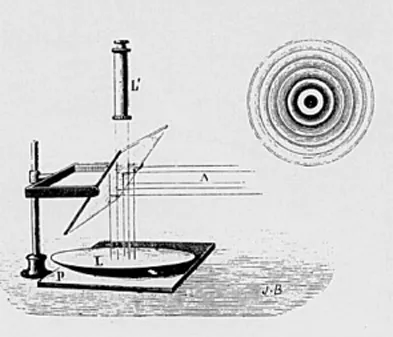
Only a few decades later, Isaac Newtown (1643–1727) developed his particle model of light in 1704. It has a light composed of small “particles” emitted by luminous bodies moving very fast in a vacuum and in different transparent media. He does not hesitate to complicate the model to make it compatible with observations such as “Newton’s rings”. This interference phenomenon (Figure 1.2) is achieved by placing a lens (L) on a flat surface (P) with a light source (L'). It is possible to observe a series of concentric rings (A), alternating light and dark [NEW 18]. This is now explained by the wave approach.
During the same period, Christian Huygens developed a wave model of light, by analogy with the wave propagation on the surface of the water. This model also explains the phenomena of reflection and refraction. But, with his particular prestige acquired by his law of universal gravitation, Newton turned off the debate, and imposed his corpuscular theory of light onto the scientific community at the time.
It was not until about a century later that the existence of many known phenomena was explained by geometrical optics (decomposition of light, interference, etc.) returning to the wave approach with studies of Thomas Young (1773–1829) and Augustin Fresnel (1788–1827). The “wave theory of light” defines the light as a vibration, similar to sound, vibrating in an invisible environment called “Ether”.
Because measurements were not possible with the instruments of the time, an initial estimate of the propagation speed was 200,000–300,000 km/s with a very important frequency of vibration. This model is predominant when explaining the phenomena of interference and diffraction.
Finally, almost half a century later, James Clerk Maxwell (1831–1879) offered four fundamental equations that summarized the knowledge of the time in the electrical, magnetic, and electromagnetic fields. He succeeded in electromagnetic fields by applying what Newton had done in the field of mechanics. One of these, the Maxwell–Ampere equation defines light as an electromagnetic wave consisting of electrical fields and magnetic fields vibrating transversely with a velocity of 300,000 km/s.
This is the electromagnetic wave theory of light and this model, faced with measures of speed of light, dedicates Maxwell’s proposal. But visible light from red to violet is a special case of those electromagnetic radiations, as Maxwell predicted the existence of other radiation emissions from natural or artificial sources (e.g. cosmic rays or radio transmitters).
In fact, in 1887 Heinrich Hertz (1857–1894) invented an electromagnetic wave transmitter whose frequency is below infrared frequencies (below the red). These frequencies, known as radio frequencies, are the wave bands of radio and television. Then in 1895, Wilhelm Röntgen (1845–1923) discovered very high frequency radiation higher than the ultraviolet frequencies, this is X-rays.
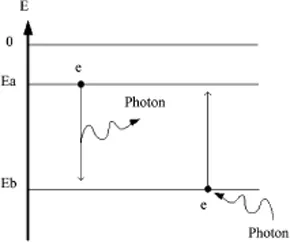
In 1900, Max Planck (1858–1947) made a significant contribution, with the explanation of the spectral composition (color distribution) of emitted light and the quantification of energy exchange between light and matter. These energy exchanges are realized by integer multiples of an indivisible base quantity (Figure 1.3). These quanta or quantum of energy are related to a given frequency radiation multiplied by a constant. This new constant of physics is called Planck’s constant (h) and is initiated by quantum physics.
A few years later, in 1905, Albert Einstein (1879–1955) hypothesized that light was made up of energy (photons) and he proposed a corpuscular theory of light. The laws of Fresnel and Maxwell are still valid, but the energy approach shows that the same wave transports energy called photons. This last point helps to explain such phenomena as the photoelectric effect (discovered by Hertz in 1887). And in 1909, despite reticence from the scientific world at that time to reconcile his theory with the electromagnetic wave model, Einstein concluded that light is both a wave and a particle.
Then, from the theories of Rutherford (1871–1937), Neils Bohr (1885–1962) takes the opposite approach in 1913 and published a model of atomic structure and chemical liaison. This approach became a model (the Bohr’s model), the atom has a nucleus around which gravitate electrons. The farthest orbits from the core comprise more electrons, which determine the chemical properties of the atom. These electrons move from one layer to another by emitting or absorbing a quantum of energy, the photon. Figure 1.3 shows the emission of a photon by de-excitation of an electron (left case) and the excitation of an electron by absorption of a photon (right case). Planck’s constant (h) relates the energy E (E = Ea − Eb) of a photon or an electron (e) to its frequency by the relation E = hν.
In 1924, Louis de Broglie (1892–1987) generalized the wave–particle duality of matter, by proving that an electron can also be a wave.
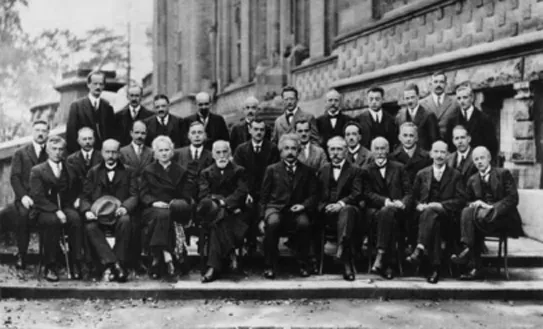
With Leon Brillouin (1889–1969), Erwin Schrödinger (1887–1961), Werner Heisenberg (1901–1976), and Max Born (1882–1970), demonstrated that reality consists of elementary particles that are either in the wave form or in the corpuscular form. The light is a manifestation wave (electromagnetic approach) photon (particle approach). These revolutionary advances occurred at scientific conferences, including the International Congress of Physics of Solvay in Brussels in 1927. This particular conference was attended by the following figures as shown in Figure 1.4. In the first row, from left to right: Max Planck (second), Marie Curie (third), Hendrik Antoon Lorentz (fourth), Albert Einstein (fifth), Paul Langevin (sixth); the second row: William Lawrence Bragg (third), Paul Dirac (fifth), Louis de Broglie (seventh), Max Born (eighth), Niels Bohr (ninth); in the third row: Erwin Schrödinger (sixth), Wolfgang Pauli (eighth), Werner Heisenberg (ninth), and Leon Brillouin (eleventh).
These were the first steps of wave mechanics and then, modern quantum physics.
Even today, light has not fully disclosed all of its mysteries, there will be new discoveries. For example, recent studies have revealed the existence of “slow light”, offering potential for the realization of quantum computer memories or the possibility of “squeezed states”, reduction of certain quantum fluctuations of light.
But the best known example of the “use” of light is the laser. The main feature of the LASER (light amplification by stimulated emission of radiation) is to obtain homogeneous photons. These photons have the same propagation direction, the same frequency, and the same polarization. The first laser (1960) had pulses of the order of microseconds (10–6 s) and now we can obtain a level of the femtosecond (10–15 s), which allows the detection of electronic motion in matter. Among the countless applications of lasers [BES 10], the correction of myopic eyes to optical scanning devices, is worth mentioning as an application in the field of communications. This is the fiber optic communication, without which society and information communication technology (ICT) would not have become so important. Another discipline, the subject of this book, is wireless optical communications.
![]()
Chapter 2
History of Optical Telecommunications
“I have heard a ray of the sun laugh and cough and sing”
1884, Alexander Graham Bell,
Inventor of the photophone and probably the phone,
Patent 235.496 from 12/14/1880
2.1. Some definitions
2.1.1. Communicate
The verb “communicate” appeared in the French language around 1370. It was derived from the Latin communicare meaning “to share, import”. The idea became enriched as a result of the meaning of the Latin cum (with) and municus (burden).
With this idea of sharing, the word first got a sense of participation in something. It lost the right to be in mutual relationship, in communion with someone. From the 16th Century, the word experienced a new extension in its meaning “tran...