Medical Biochemistry at a Glance
eBook - ePub

Medical Biochemistry at a Glance

  1. English
  2. ePUB (mobile friendly)
  3. Available on iOS & Android
eBook - ePub

Medical Biochemistry at a Glance

About this book

Offering a concise, illustrated summary of biochemistry and its relevance to clinical medicine, Medical Biochemistry at a Glance is intended for students of medicine and the biomedical sciences such as nutrition, biochemistry, sports science, medical laboratory sciences, physiotherapy, pharmacy, physiology, pharmacology, genetics and veterinary science. It also provides a succinct review and reference for medical practitioners and biomedical scientists who need to quickly refresh their knowledge of medical biochemistry.

The book is designed as a revision guide for students preparing for examinations and contains topics that have been identified as 'high-yield' facts for the United States Medical Licensing Examination (USMLE), Step 1.

This third edition:

  • Has been thoroughly revised and updated and is now in full colour throughout
  • Is written by the author of the hugely successful Metabolism at a Glance (ISBN 9781405107167)
  • Features updated and improved clinical correlates
  • Expands its coverage with a new section on Molecular Biology
  • Includes a brand new companion website of self-assessment questions and answers at www.ataglanceseries.com/medicalbiochemistry

Frequently asked questions

Yes, you can cancel anytime from the Subscription tab in your account settings on the Perlego website. Your subscription will stay active until the end of your current billing period. Learn how to cancel your subscription.
No, books cannot be downloaded as external files, such as PDFs, for use outside of Perlego. However, you can download books within the Perlego app for offline reading on mobile or tablet. Learn more here.
Perlego offers two plans: Essential and Complete
  • Essential is ideal for learners and professionals who enjoy exploring a wide range of subjects. Access the Essential Library with 800,000+ trusted titles and best-sellers across business, personal growth, and the humanities. Includes unlimited reading time and Standard Read Aloud voice.
  • Complete: Perfect for advanced learners and researchers needing full, unrestricted access. Unlock 1.4M+ books across hundreds of subjects, including academic and specialized titles. The Complete Plan also includes advanced features like Premium Read Aloud and Research Assistant.
Both plans are available with monthly, semester, or annual billing cycles.
We are an online textbook subscription service, where you can get access to an entire online library for less than the price of a single book per month. With over 1 million books across 1000+ topics, we’ve got you covered! Learn more here.
Look out for the read-aloud symbol on your next book to see if you can listen to it. The read-aloud tool reads text aloud for you, highlighting the text as it is being read. You can pause it, speed it up and slow it down. Learn more here.
Yes! You can use the Perlego app on both iOS or Android devices to read anytime, anywhere — even offline. Perfect for commutes or when you’re on the go.
Please note we cannot support devices running on iOS 13 and Android 7 or earlier. Learn more about using the app.
Yes, you can access Medical Biochemistry at a Glance by J. G. Salway in PDF and/or ePUB format, as well as other popular books in Medicine & Medical Theory, Practice & Reference. We have over one million books available in our catalogue for you to explore.

Information

Part 1: Acids, bases and pH
1
Acids, bases and hydrogen ions (protons)
Definition of PH
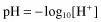
pH is defined as ā€œthe negative logarithm to the base 10 of the hydrogen ion concentrationā€,
c01ue001
For example, at pH 7.0, the hydrogen ion concentration is 0.000 000 1 mmoles/litre or 10āˆ’7 mmol/l.
c01ue002
Therefore, the negative log10 is āˆ’(āˆ’7.0), i.e. +7.0 and hence the pH is 7.0.
What Is PH?
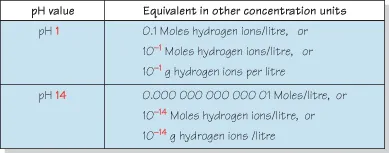
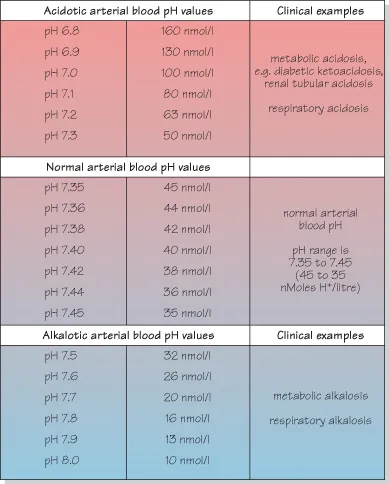
pH is ā€œthe ā€œpower of hydrogenā€. It represents ā€œthe negative logarithm10 of the hydrogen ion concentrationā€. So why make things so complicated: why not use the plain and simple ā€œhydrogen ion concentrationā€? Well, the concept was invented by a chemist for chemists and has advantages in chemistry laboratories. In clinical practice we are concerned with arterial values between pH 6.9 and 7.9. However, chemists need to span the entire range of pH values from pH 1 to pH 14. Values in terms of pH enable a convenient compression of numbers compared with the alternative which would be extremely wide-ranging as shown in Fig. 1.3. Figure 1.6 shows the normal reference range for pH in blood and, in extremis, fatal ranges that may be seen in acidotic or alkalotic diseases.
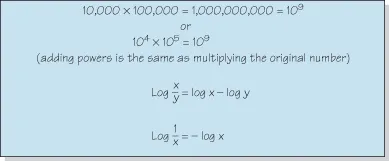
Figure 1.1 Revision of logarithms.
Access a high quality version of this image at http://booksupport.wiley.com.
c01f001
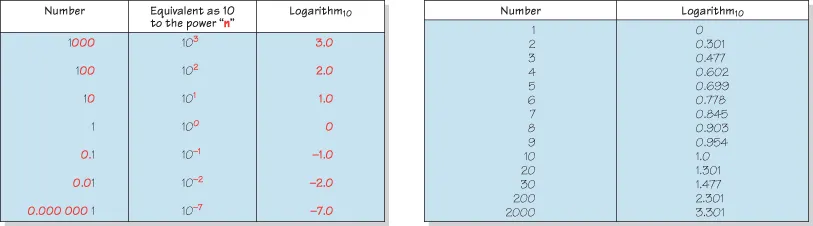
Figure 1.2 Examples of numbers and their logarithms.
Access a high quality version of this image at http://booksupport.wiley.com.
c01f002
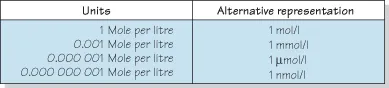
Figure 1.3 Understanding units.
Access a high quality version of this image at http://booksupport.wiley.com.
c01f003
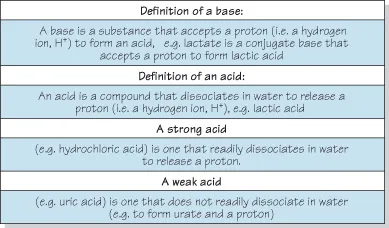
Figure 1.4 BrĆønsted and Lowry definition of acids and bases.
Access a high quality version of this image at http://booksupport.wiley.com.
c01f004
Figure 1.5 pH and equivalent values.
Access a high quality version of this image at http://booksupport.wiley.com.
c01f005
Figure 1.6 Examples of pH values seen in clinical practice.
Access a high quality version of this image at http://booksupport.wiley.com.
c01f006
The PH Scale Is Not Linear
ā€The patient’s blood pH has changed by 0.3 pH unitā€ means it has doubled (or halved) in value.
It is sometimes stated that ā€œthe patient’s arterial blood pH has increased/decreased by, for example, 0.2 pH unitā€. However, notice that because of the logarithmic scale, this can misrepresent the true change in traditional concentration units. For example, a fall of 0.2 pH units from pH 7.20 to pH 7.00 represents 37 nmol/l, whereas a decrease from pH 7.00 to pH 6.8 represents a change of 60 nmol/l.
Also note that because the log10 of 2 = 0.3 (that is 2 = 100.3), a decrease in pH by 0.3, e.g. from pH 7.40 to pH 7.10, represents a two-fold increase in H+ concentration, i.e. from 40 nmol/l to 80 nmol/l. Similarly, an increase in pH from pH 7.40 to pH 7.70 represents a fall in H+ concentration from 40 nmol/l to 20 nmol/l.
The Henderson–Hasselbalch Equation
A weak acid dissociates as shown:
c01ue003
where HB is the weak acid that dissociates to a proton H+ and its conjugate base Bāˆ’. NB Traditionally authors refer to the conjugate base as ā€œAāˆ’ā€, i.e. the initial letter of acid, which is perhaps confusing.
Therefo...
Table of contents

  1. Cover
  2. Dedication
  3. Title page
  4. Copyright page
  5. Preface to the third edition
  6. Acknowledgements to the third edition
  7. Figure key
  8. SI/mass unit conversions
  9. Part 1: Acids, bases and pH
  10. Part 2: Structure of amino acids and proteins
  11. Part 3: Formation of ATP: oxidation and reduction reactions
  12. Part 4: Carbohydrates
  13. Part 5: Enzymes and regulation of pathways
  14. Part 6: Lipids and lipid metabolism
  15. Part 7: Metabolism of amino acids and porphyrins
  16. Part 8: Vitamins
  17. Part 9: Molecular biology
  18. Part 10: Diagnostic clinical chemistry
  19. Index
  20. Artwork
  21. Wiley End User License Agreement