![]()
Chapter 1
Introduction
Whether you are wanting to make contact with friends through Facebook or business associates through Linkedln, to share or find entertainment through YouTube or MySpace, or to locate old school friends through Friends Reunited, the exponential, global expansion of the application of social networks has increasingly influenced our lives, largely because of the opportunities provided by the Internet. The idea of networks and some basic social network analysis (SNA) terminology have entered our everyday lives and increasingly inform our understanding of the society in which we live (for example, Easley and Kleinberg, 2010). Yet much of our thinking relating to organisations and projects, particularly those in construction, is not conceptualised in network terms.
This book is essentially about how people form networks for work; it is about how networks are created and modified and what these network configurations mean for the actors and for the projects. In particular I was keen to contribute to the discussion about how we might use networks prescriptively and proactively. Much of the current work of social network analysts is essentially retrospective – accurately analysing past activities, mostly using a cross-sectional or ‘snapshot’ approach.
Social network analysis is a fascinating mixture of mathematics, IT and sociology. My observation is that there is a gap in our knowledge, as far as projects and their analysis have been concerned, which can be dealt with through the exploitation of SNA. The analysis of relationship networks enables us to understand the interdependent and transitory systems that we have been discussing for so long, particularly in complex project environments.
Understanding the Construction Sector
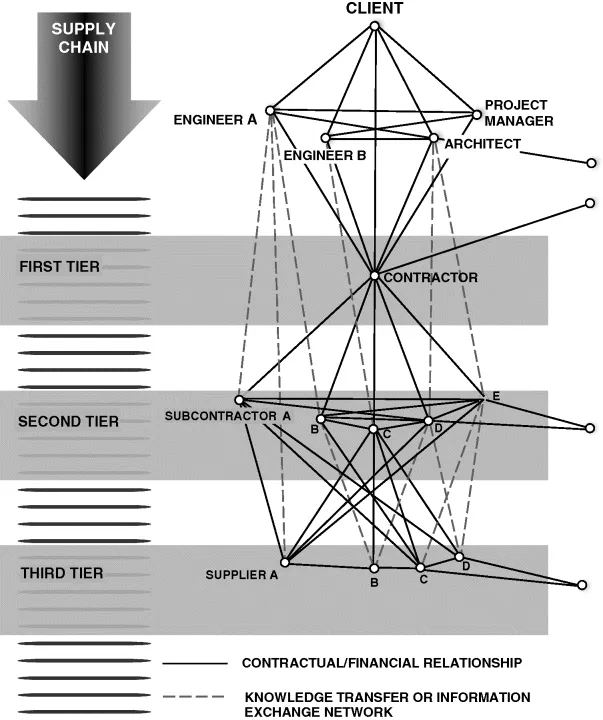
Value for our construction clients is created through projects and programmes carried out by people working in relationships that are collaborative to some degree or another. Those people are employed by a number of firms located within various tiers in the supply chains established by contractors and increasingly client organisations. Some individuals are project actors in their own right; other individuals need to collaborate with others to command ownership and delivery of a project actor role and to achieve delivery of service in relation to that role. Figure 1.1 shows the relationship between supply chains and networks and provides the starting point for this book.
Understanding complex interdependent systems in construction requires an understanding of the classification and variety of possible network configurations into which our project actors are connected. We also need an appreciation of the nature of the linkages, along with network environmental effects acting upon the behaviour of individual actors. These influences affect the formation, development and decay of network relationships. Network structure, and the characteristics of the actors and their position within the structure, are related to the effectiveness of that network to fulfil its function. Let us now turn to a brief review of the construction sector environment within which the proposed network-based analysis of project systems is located.
Context
For most of the nineteenth and twentieth centuries a traditional procurement system prevailed, using consultants to carry out design and financial monitoring and a main contractor which took overall responsibility for production of the building to a design and specification defined by the professional team. Winch (2000) refers to this system as the professional system, the structure and organisation of the industry being dominated and heavily influenced by the professional bodies established by architects (RIBA), engineers (ICE, ISE, CIBSE), quantity surveyors (RICS) and, most recently, contractors (CIOB).
The 1960s brought management contracting to the UK (Winch, 2000) from the USA, and the late 1960s and early 1970s saw the re-emergence of design and build as a significant procurement route in the UK (Masterman, 2002; Franks, 1999). Most importantly, this period of dominance of the professional system, albeit tempered by new initiatives like ‘management contracting’ and ‘design and build’, established the reward and penalty structure for the actors in the British construction industry, in a context of generally adversarial relations (Winch, 2000).
The Latham Report (1994) registered the fact that the construction industry had been very slow to respond to pressure for change in the past and referred to the need for ‘better performance, but with fairness to all . . . [and] teamwork’. The report also recommended that the New Engineering Contract (NEC) form of contract be adopted and that ‘endlessly refining existing conditions of contract [would] not solve adversarial problems’. With hindsight this was a somewhat strange solution to couple with the other, non-contractual, proposals. The recommendations were typical of this type of review and the issues of governance structure and reform implementation are important. In the event the industry did not, apparently, make a policy shift towards the NEC form; the industry did, however, make significant efforts to introduce a less adversarial approach to construction, notably through the extensive introduction of partnering. The terms win–win and later partnering entered the vocabulary of every individual associated with the UK construction industry.
One of the first major client organisations to change its procurement strategies following the publication of the Latham Report was the British Airports Authority (BAA), initially through its subsidiary, London Heathrow Ltd (LHR). BAA launched its Frameworks initiative (BAA, 1997) which constituted a highly structured and well-documented, some might say bureaucratic, approach to partnering.
The incoming Labour government of May 1997 launched the Construction Task Force (CTF) in the face of a slowing pace of implementation within the Construction Industry Board (CIB). The job of the CTF was to implement the findings of the Latham Report. The report of the CTF, Rethinking Construction, was published in July 1998 (Egan Report, 1998). The Egan Report embraced partnering and explored some of the ways in which the industry could reform in a context free from the limitations of competitive bid tendering on a project-by-project basis. Longer-term relationships and the associated financial security provided an environment in which to implement, critically, an important new initiative for the construction industry. This was supply chain management based on the principles of lean thinking, first described in The Machine that Changed the World (Womack et al., 1990) and subsequently developed into Lean Thinking (Womack and Jones, 1996). The Machine that Changed the World influenced the thinking of the BAA project team dealing with the Genesis Terminal Five pilot project. Professor Dan Jones was a member of the Construction Task Force.
The other important new initiative to have flowed from the non-adversarial environment was the reordering of project relationships around technology clusters (Gray, 1996). The concept involved the grouping of actors in relation to specific critical interfaces within the production phase of the project. For example, an upper floor cluster leader would be responsible for the design coordination and construction of the concrete suspended slab, the screed above it, and the ductwork and suspended ceiling below it. This concept was first tried on the BAA Genesis project at Heathrow and was an important feature of the Slough case study and the Aldershot project (Chapter 6).
These innovations in project systems, primarily partnering, supply chain management and technology clusters, have since been adopted more generally by other large client organisations. The Defence Estates' use of these initiatives in a design and build environment is referred to as ‘prime contracting’.
I have referred to these three new initiatives in procurement and management as governance modifiers simply because, as things stand at the time of writing, they have been appended to traditional contract conditions. Any agreement relating to any or all three of these modifiers lies outside the contractual governance of projects. Where organisations have sought to formalise these modifiers, the resulting partnering charters and framework agreements lie alongside the main contractual conditions and in some senses are, arguably, in conflict with them. At present the industry is at a crossroads, with relational contracts in one direction and a move away from contractual governance in another direction. Relational contracts are those that seek to define the nature of the relationship, rather than the detail of the possible future eventualities which the contract is intended to incorporate (see, for example, Macauley, 2000). The Egan Report (1998) on the other hand proposed that construction might be governed without the use of formal contractual agreements. Egan was, in effect, proposing that maintenance of network position be used as an incentive to perform.
The publication of PPC 2000 (Trowers and Hamlins, 2000; subsequently amended in 2003), the Association of Consultant Architects (ACA) Standard Form of Contract for Project Partnering, was a bold step towards drafting a standard form of building contract that envisaged the use of partnering, supply chain management and work clusters. The important work of David Mosey at Trowers and Hamlins, solicitors, although publicly supported by Sir David Egan, has not been given the attention that it deserves by a UK construction industry perhaps more focused upon ‘doing things right’ than ‘doing the right things’. PPC 2000's move away from solely dyadic relationships provides context for the analysis of contractual relationships that is discussed in Chapters 7 and 8.
Problems with Existing Forms of Analysis and Visualisation
The analysis and visualisation of project management systems have not been possible in the past, the construction process being represented by a range of task dependency, structural and process mapping approaches which fail to reflect the network of relationships and their function. This book presents a solution to the problem: how do we set about trying to understand and improve the systems that we use in construction?
Structure of the Book
Chapter 2: Rationale for a Network Approach to the Analysis of Project Management Systems
The chapter asks why we need to find a new approach to the analysis of procurement and project management systems. It looks at some traditional analytical methods – task dependency, structural analysis and process mapping – and critiques these. The chapter deals with some of the important and frequently repetitive findings of reviews of the construction industry. Identifying and classifying the problems is relatively easy, but reaching agreement and consensus on which are the parts worth using in any given report, and implementing change, is almost always much more difficult. The chapter also looks at problems arising out of the situation where we quite intuitively understand construction processes as ‘systems’ and yet we lack an effective means of representing and critiquing those systems. A start is made on the classification of the systems, based upon project functions. The chapter deals with the benefits that social network analysis (SNA) might bring to the understanding, representation and analysis of the multiple concurrent and interdependent systems that comprise the construction project. There is a review of the limitations of other analytical methods which have been applied to construction.
Chapter 3: Twenty-First Century Reform and Emergent Systems in Construction
This chapter explores the industrial contextual drivers for a network approach to analysing construction project systems. Supply chain management (SCM) and collaborative relationships (and the lack of collaborative relationships) are put forward as important contextual issues for the construction industry and to help provide definition and focus for the case studies that follow later in the book. The chapter confronts the tension between the development of collaborative relationships and the fight for survival for many construction firms in the face of recessionary forces. No discussion about SCM would be complete without consideration of Gray's (1996) work on technology clusters. There is also a link to Pryke and Smyth's (2006) work on the relationship approach to managing projects.
Chapter 4: the Construction Project as a System of Interdependent Governance Networks
Chapters 2 and 3 provide context and motivation for the case studies and analysis in later chapters; Chapter 4 starts to elevate the level of abstraction. Network theory and the governance of transactions are dealt with along with reference to the contract theory of the firm. The transaction is suggested as a possible unit of investigation in the study of construction coalitions, and the difficulties in the operationalisation of the work of the prominent transaction cost economist are wrestled with and some proposals are made.
The case is made for applying Reve's (1990) work on the nexus of contracts to Winch's (1989) temporary project coalitions. Five basic theoretical premises for using SNA in the analysis of construction coalitions are posited, and these are followed by some definition of terms. Network density and actor centrality are justified as important SNA measures for the development of a SNA theory of construction project coalitions. Finally a move is made to provide some application for the theoretical discussion presented. It is proposed that the construction coalition might be conceptualised as three groups of transaction sets: contract, performance incentives and information exchange. The importance of density measures in relation to, in particular, information exchange networks is referred to. It is also proposed that changes in centrality values for project actors provide an important measure of the change in coalition actor roles. Finally, comparison of different functional classes of networks provides a measure of the maturity of any given role – and also, perhaps, some measure of the likelihood of the success of that role.
Chapter 5: Social Network Analysis as a Research Method
We take a brief look at the origins and history of SNA. We move on to an appraisal of the limitations associated with the application of SNA to construction research. The chapter covers key concepts and terminology and then provides some examples of the types of issues and problems that might be investigated using SNA. These include financial transactions and performance incentives, contractual relationships, a range of communication types and modes, information and knowledge transfer, risk transfer, abuse of power and conflict resolution. Chapter 5 provides details of a selection of software available for network analysis. Finally, we provide some information about getting started with the analysis of network data using one of the packages of software identified.
Chapter 6: Network Case Studies
This chapter gives details of four case studies from which are drawn the network data analysed in subsequent chapters. Having dealt with the criteria for selection, the chapter then covers the background for each project, information about the procurement strategy, the specification of the works (in broad terms), and some details on the profile and role for each of the project actors. Methodological issues associated with the selection of each case study and/or the data gathering process are also covered. The case studies cover two projects which used ‘traditional’ design (non-collaborative, without contractors) in both public and priv...