eBook - ePub
Synthetic Diamond Films
Preparation, Electrochemistry, Characterization, and Applications
- English
- ePUB (mobile friendly)
- Available on iOS & Android
eBook - ePub
Synthetic Diamond Films
Preparation, Electrochemistry, Characterization, and Applications
About this book
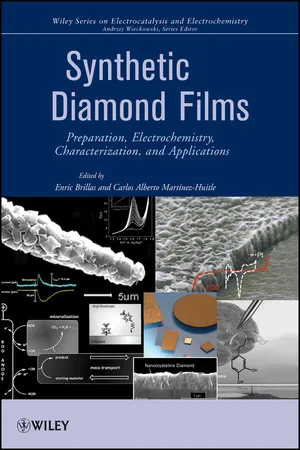
The book gives an overview on the current development status of synthetic diamond films and their applications. Its initial part is devoted to discuss the different types of conductive diamond electrodes that have been synthesized, their preparation methods, and their chemical properties and characterization. The electrochemical properties of diamond films in different scientific areas, with special attention in electroanalysis, are further described. Different strategies to modify these electrodes are also discussed as important technologies with ability to change their electrochemical characteristics for a more specific electroanalytical use. The second part of the book deals with practical applications of diamond electrodes to the industry, organic electrosynthesis, electrochemical energy technology, and biotechnology. Special emphasis is made on the properties of these materials for the production of strong oxidizing species allowing the fast mineralization of organics and their use for water disinfection and decontamination. Recent biotechnological development on biosensors, microelectrodes, and nanostructured electrodes, as well as on neurochemistry, is also presented. The book will be written by a large number of internationally recognized experts and comprises 24 chapters describing the characteristics and theoretical fundaments of the different electrochemical uses and applications of synthetic diamond films.
Information
Part I
Synthesis of Diamond Films
Chapter 1
Electrochemistry on Diamond: History and Current Status
1.1 Enabling Technologies
The use of diamond in electrochemistry was not anticipated during the initial explosion of interest in low-pressure diamond growth during the 1980s. Most attention was focused on electronic, optical, and mechanical applications (e.g., for high temperature electronic devices, radiation detectors, high voltage switches, x-ray windows, audio speaker diaphragms, and protective and tool coatings). Little attention was paid to electrochemical applications.
In this chapter, we describe the enabling technologies underlying diamond electrochemistry, the early work on diamond electrochemistry itself, and two major threads of current research. The present status of the field is covered in the other chapters of this volume.
1.1.1 Chemical Vapor Deposition of Diamond
Diamond electrochemistry has been made possible by development of methods for the chemical vapor deposition of diamond. The first reported growth of diamond at sub-atmospheric pressure, where diamond is metastable with respect to graphite, was by Eversole [1] at Union Carbide Corporation. He grew diamond on high-surface area powder from methane and carbon monoxide. This effort was ultimately abandoned after the announcement of the successful growth of diamond at high pressures by General Electric Corporation [2]. Eversole's work was later extended by Angus et al. at Case Western Reserve University [3–7] and by Deryagin and a large group at the Physical Chemistry Institute in Moscow [8–13]. The Angus group showed the beneficial effect of added hydrogen on diamond yield, developed methods for removing unwanted graphitic carbon using atomic hydrogen, and grew boron-doped diamond by chemical vapor deposition [5]. In their first studies, the Soviet workers reported the growth of filamentary diamond whiskers using a vapor-liquid-solid (VLS) technique with molten iron and nickel [8, 9]. Surprisingly, this process has received little attention in subsequent years. From the same group at the Physical Chemistry Institute, Varnin et al. [11] grew diamond thin films from the gas phase; Spitsyn, Bouilov, and Deryagin [13] reported both diamond films and isolated diamond crystals grown on copper substrates by chemical vapor transport from a graphite source.
These very early studies were the first to show that diamond could be grown at conditions in which it is not the stable phase. At the time, diamond synthesis at low pressures was widely believed to be impossible and in violation of the second law of thermodynamics. Although the early studies showed the feasibility of diamond synthesis by chemical vapor deposition, the growth rates were low. This situation changed dramatically in the mid-1980s. A group at the National Institute for Research in Materials in Tsukuba, Japan, under the leadership of Nobuo Setaka achieved large increases in growth rates by activating the gas phase during growth with a hot filament [14, 15], a microwave discharge [16], and an RF discharge [17, 18]. Matsui, Matsumoto, and Setaka [19] also performed careful characterization of their product diamond. Since the mid-1980s, the interest in chemical vapor deposition of diamond has expanded enormously, and it is now used to grow extremely high-quality diamond in many shapes and sizes.
1.1.2 Doping of Diamond
For most electrochemical applications, it is necessary to use conducting diamond obtained by doping with the group III element, boron. The effect of boron on the electrical conductivity of diamond has been well studied and is covered in several classic review volumes [20–24]. Poferl, Gardner, and Angus [5] in 1973 were the first to grow boron-doped conducting diamond by chemical vapor deposition. This study was done to provide further confirmation of metastable diamond growth. Since then, numerous studies of diamond doping have been made. The boron-doping agent is usually added through small amounts of diborane, trimethyl boron, or organic borates in the source gases, but solid-state boron sources have also been successfully used. Reviews by Pan and Kania [25] and Werner and Locher [26] describe the state of the art in the mid-1990s; more recent discussions [27–29] are available. At low concentrations, boron promotes p-type semiconductivity in diamond with an acceptor level 0.37 eV above the valence band [30]. At boron concentrations higher than 1017 to 1018 cm−3, an impurity band forms and the acceptor gap is reduced [31–34]. At boron concentrations from 1020 to 1021 cm−3, diamond is a semimetal, with resistivities as low as 0.001 Ω-cm.
For electrosynthesis and electrodestruction applications, high conductivities are desirable; for photoelectrochemistry and semiconductor electrochemistry, low conductivity electrodes are used. The uniformity of boron concentration is an important variable in electrochemical applications. Spitsyn et al. in 1981 [13] and Janssen et al. in 1990 [35] showed that more boron was incorporated in (111) growth sectors than in (100) sectors.
1.1.3 Surface Characterization of Diamond
Diamond, graphene and carbon nanotubes are unique among the common semiconductors in having no stable solid surface oxide. Furthermore, the chemistry of the diamond surface is closely related to well-known organic chemical processes. As a consequence, it is possible to tailor the properties of the diamond surface for sensor and other applications by changing the surface functionalization.
The most significant early paper on diamond surfaces was the LEED study by Lander and Morrison at Bell Laboratories in 1966 [36]. They showed that hydrogen-termination of (111) diamond surfaces eliminated the reconstruction of the clean surface and gave an (essentially) bulk-terminated surface. They also found significant atom mobility on the diamond surface between 900°C and 1400°C. Lander and Morrison explicitly stated that this behavior could make epitaxial extension of diamond feasible. Another important early study of diamond surfaces and their interaction with gases was by Lurie and Wilson in 1977 [37].
1.2 First Studies of the Electrochemistry on Diamond
Even after the chemical vapor deposition of diamond became more or less routine, there was little availability of boron-doped conducting diamond. Therefore, some of the earliest electrochemical studies done on diamond were performed on samples in which conductivity was induced by damage from ion implantation. In 1983, Iwaki et al. [38] of the Institute of Physical and Chemical Research in Hirosawa, Japan, reported the use of diamond electrodes made conductive by ion implantation of nitrogen, argon, and zinc. However, the ion implantation converted the diamond surface into nondiamond carbon [38, 39] so the measurements did not reflect the electrochemical characteristics of diamond itself.
1.2.1 From 1987 to 1996
The first measurements of the inherent electrochemical properties of diamond were by Yuri Pleskov and co-workers at the Frumkin Institute of Electrochemistry in Moscow. In 1987, they reported the photoelectrochemical properties of diamond electrodes [40]. They found a photoresponse of diamond at sub-bandgap wavelengths that they attributed to excitation of electrons from mid-gap defect states to the conduction band. They also observed sluggish evolution of hydrogen at cat...
Table of contents
- Cover
- Series Page
- Title Page
- Copyright
- Preface
- Preface to the Wiley Series
- Contributors
- Part I: Synthesis of Diamond Films
- Part II: Electrochemistry of Diamond Films
- Part III: Electroanalytical Applications
- Part IV: Industrial Applications
- Part V: Bioelectrochemical Applications
- Color Plates
- Index
Trusted by 375,005 students
Access to over 1.5 million titles for a fair monthly price.
Study more efficiently using our study tools.
Frequently asked questions
Yes, you can cancel anytime from the Subscription tab in your account settings on the Perlego website. Your subscription will stay active until the end of your current billing period. Learn how to cancel your subscription
No, books cannot be downloaded as external files, such as PDFs, for use outside of Perlego. However, you can download books within the Perlego app for offline reading on mobile or tablet. Learn how to download books offline
Perlego offers two plans: Essential and Complete
- Essential is ideal for learners and professionals who enjoy exploring a wide range of subjects. Access the Essential Library with 800,000+ trusted titles and best-sellers across business, personal growth, and the humanities. Includes unlimited reading time and Standard Read Aloud voice.
- Complete: Perfect for advanced learners and researchers needing full, unrestricted access. Unlock 1.5M+ books across hundreds of subjects, including academic and specialized titles. The Complete Plan also includes advanced features like Premium Read Aloud and Research Assistant.
We are an online textbook subscription service, where you can get access to an entire online library for less than the price of a single book per month. With over 1.5 million books across 990+ topics, we’ve got you covered! Learn about our mission
Look out for the read-aloud symbol on your next book to see if you can listen to it. The read-aloud tool reads text aloud for you, highlighting the text as it is being read. You can pause it, speed it up and slow it down. Learn more about Read Aloud
Yes! You can use the Perlego app on both iOS and Android devices to read anytime, anywhere — even offline. Perfect for commutes or when you’re on the go.
Please note we cannot support devices running on iOS 13 and Android 7 or earlier. Learn more about using the app
Please note we cannot support devices running on iOS 13 and Android 7 or earlier. Learn more about using the app
Yes, you can access Synthetic Diamond Films by Enric Brillas, Carlos Alberto Mart¿nez-Huitle, Enric Brillas,Carlos Alberto Mart¿nez-Huitle in PDF and/or ePUB format, as well as other popular books in Physical Sciences & Physical & Theoretical Chemistry. We have over 1.5 million books available in our catalogue for you to explore.