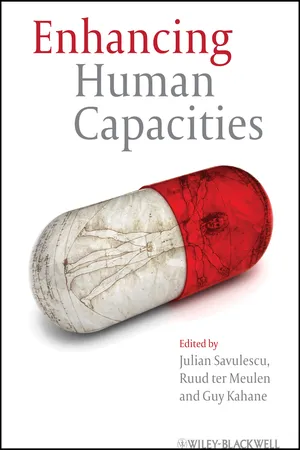
- Presents a rich range of perspectives on enhancement from world leading ethicists and scientists from Europe and North America
- The most comprehensive volume yet on the science and ethics of human enhancement
- Unique in providing a detailed overview of current and expected scientific advances in this area
- Discusses both general conceptual and ethical issues and concrete questions of policy
- Includes sections covering all major forms of enhancement: cognitive, affective, physical, and life extension
eBook - ePub
Enhancing Human Capacities
- English
- ePUB (mobile friendly)
- Available on iOS & Android
eBook - ePub
Enhancing Human Capacities
About this book
Enhancing Human Capacities is the first to review the very latest scientific developments in human enhancement. It is unique in its examination of the ethical and policy implications of these technologies from a broad range of perspectives.
Information
Part I
Key Concepts and Questions
Chapter 1
Well-Being and Enhancement
Many chapters in this volume review current and future possibilities for enhancing human physical ability, cognition, mood, and lifespan. These possibilities raise the ethical question of whether we should enhance normal human capacities in these ways. We are not likely to agree on answers to this question without a clear and shared understanding of the concept of enhancement. The aim of this chapter is to offer such an account of enhancement. We begin by reviewing a number of suggested accounts of enhancement, and point to their shortcomings. We identify two key senses of “enhancement”: functional enhancement, the enhancement of some capacity or power (e.g. vision, intelligence, health) and human enhancement, the enhancement of a human being's life. The latter notion, we suggest, is the notion of enhancement most relevant to ethical debate. We argue that it is best understood in welfarist terms. We will then illustrate this welfarist approach to enhancement by applying it to the case of cognitive enhancement.
Definitions of Enhancement
Although there is much debate about the ethical implications of new technologies, only a few authors have attempted to provide an explicit definition of enhancement. Often discussion focuses on a particular application such as muscle strength, memory or lifespan, or a definition of enhancement is implicitly assumed. However, without an adequate shared understanding of what is meant by “enhancement,” we are not likely to resolve these debates and reach sound ethical conclusions.
The sociological pragmatic approach
In the literature there is a great deal of uncertainty and confusion about the term “enhancement.” Erik Parens (1998) states that:
… some participants think the term enhancement is so freighted with erroneous assumptions and so ripe for abuse that we ought not even to use it. My sense is that if we didn't use enhancement, we would end up with another term with similar problems.
He then continues by using the term as a focus for a discussion of the goals of medicine and society. A similar pragmatic approach is taken by Paul Root Wolpe (2002) who also states that enhancement is a slippery socially constructed concept: “Yet, ultimately, any exclusive enhancement definition must fail, in part because concepts such as disease, normalcy, and health are significantly culturally and historically bound, and thus the result of negotiated values.” Likewise, he then turns to discuss issues of reimbursement, public policy, and normative behavior. James Canton (2002) stresses the relativism inherent in such an approach:
The future may hold different definitions of human enhancement that affect culture, intelligence, memory, physical performance, even longevity. Different cultures will define human performance based on their social and political values. It is for our nation to define these values and chart the future of human performance.
This approach is broadly social and pragmatic: Enhancement captures a certain historically and culturally specific value-laden domain of discourse related to human performance rather than having a substantive transcultural independent meaning. The sociological pragmatic approach describes how particular social groups delineate and value (or disvalue) various technological advances. It is less helpful when we want to ask whether these valuations are valid. This account merely tells us that, for example, some cultures or groups value intelligence more than others.
The ideological approach
Another superficially similar approach is to avoid defining the term at all. This move is made both by proponents and opponents of enhancement. Typically a list of technologies or enhancement goals are stated and the field is defined or marked by them (Kass, 2003; Naam 2005). For example, the President's Council on Bioethics delineates the domain of discourse, after stating the problems of definition and the smooth blending between therapy and enhancement, as one related to human desires and goals. As stated by Kass: “The human meaning and moral assessment must be tackled directly; they are unlikely to be settled by the term ‘enhancement,’ any more than they are by the nature of the technological intervention itself.”
This approach differs from the sociological pragmatic approach by aiming directly at deep values, invoking concepts of metaphysics or spirituality. It is an ideological approach: A set of often controversial values are applied to a range of possible technological advances, and these are directly classified as morally wholesome or problematic. Thus the ideological approach offers a range of specific and contentious value claims but no general conceptual framework for thinking about enhancement.
The “not-medicine” approach: treatment vs. enhancement
Another influential approach has been to define enhancement in terms of going beyond health-restoring treatment or health. Eric T. Juengst (1998) defines it as: “The term enhancement is usually used in bioethics to characterize interventions designed to improve human form or functioning beyond what is necessary to sustain or restore good health.”
Edmund D. Pellegrino (2004) uses a similar definition just for the purpose of arguing against enhancement on the grounds that it goes beyond medicine as a healing enterprise:
… my operating definition of enhancement will be grounded in its general etymological meaning, i.e., to increase, intensify, raise up, exalt, heighten, or magnify. Each of these terms carries the connotation of going “beyond” what exists at some moment, whether it is a certain state of affairs, a bodily function or trait, or a general limitation built into human nature … For this discussion, enhancement will signify an intervention that goes beyond the ends of medicine as they traditionally have been held.
One problem with this approach is that the definition of medicine and treatment itself is contested. Even a maximally inclusive definition such as medicine being the “science and art of diagnosing, treating, curing, and preventing disease, relieving pain, and improving and preserving health” (McKechnie, 1961) still leaves us to define disease and health, equally complex terms (Smith, 2002). For example, Robert Freitas Jr. (1999) reviews nine disease concepts (disease relativism, statistical disease, disease idealism, functional failure, and so forth), and if enhancement is defined as going beyond preventing disease/improving health, this will give us nine different enhancement concepts. The not-medicine approach is thus indeterminate. Indeed, there is some doubt whether it is even possible to draw a consistent and useful distinction between treatment and enhancement.
It is worth mentioning, however, one influential view of disease – Christopher Boorse's (1975) “species-typical functioning” account. By determining the natural functional organization of members of a species it is possible to create a normal function model, which should be, according to Daniels (2000), the standard of functioning a society has an obligation to help reach. This model has been employed influentially by Norman Daniels in addressing enhancement (Sabin & Daniels, 1994). On this view, disease is defined as:
Normal species-functioning conception of disease: Any state of a person's biology or psychology which reduces species-typical normal functioning below some statistically defined level.
And enhancement can be thus defined as improvement in human functioning that goes beyond what is needed for medical treatment:
Normal species-functioning definition of enhancement: Any change in the biology or psychology of a person which increases species-typical normal functioning above some statistically defined level.
For example, low intelligence is defined as intellectual disability and treated as a disease when Intelligence Quotient (IQ) falls below 70. On this species-functioning or naturalistic conception of disease and enhancement, raising someone's IQ from 60 to 70 is treating a disease and raising someone's IQ from 70 to 80 is enhancement.
On a normal distribution of function, about 2.5% of the population will have a disease. Improvements in function of the other 97.5% counts as enhancement. For example, the bottom 2.5% of hearing counts as deafness. The other 97.5% of people are counted as having “normal hearing” even though those at the bottom of that distribution will have impairments in hearing almost identical to those classified as “deaf.” But they fell on the wrong side of the statistical line to be eligible for “medical treatment.” Improving their hearing, even if they hear very little at all, would, on this view, be an enhancement.
The functional approach
A related fourth approach is the functional approach. Rather than avoiding defining enhancement or mainly seeing it as not-medicine, it is defined in terms of enhanced functions of various kinds (whether cognitive function generally or vision or hearing more narrowly).
The archetypal example of this approach is Douglas C. Engelbart's (1962) Augmenting Human Intellect: “By ‘augmenting human intellect’ we mean increasing the capability of a man to approach a complex problem situation, to gain comprehension to suit his particular needs, and to derive solutions to problems.”
Here, cognitive enhancement is defined simply in terms of improved general information-processing abilities. The difference from the Daniels' approach is that no weight need be given to some level of normal, species-typical functioning which would determine whether some manipulation is to count as treatment or enhancement. On this view, any increase in IQ or hearing could count as an enhancement.
The Welfarist Account of Human Enhancement
Enhancement of what?
Enhancement is, indeed, a wide concept. In the broadest sense, it means “increase” or “improvement.” For example, a doctor may enhance his patient's chance of survival by giving the patient a drug. Or a doctor may enhance the functioning of a person's immune system or memory – enhancement in the functional sense. These are no doubt enhancements of a sort – enhancements in an attributive sense. But enhancing a permanently unconscious person's chance of surviving might not be good for the person. It might not constitute human enhancement. It might not enhance intrinsic good – or good in a predicative sense.
As the example of life extension shows, these two senses of enhancement can come apart. Consider memory. Genetic memory enhancement has been demonstrated in rats and mice. In normal animals during maturation expression of the NR2B subunit of the NMDA receptor is gradually replaced with expression of the NR2A subunit, something that may be linked to less brain plasticity in adult animals. Tang et al. (1999) modified mice to overexpress NR2B. The NR2B mice (commonly known as the “Doogie” mouse) demonstrated improved memory performance, both in terms of acquisition and retention. This included unlearning of fear conditioning, which is believed to be due to learning a secondary memory (Falls, Miserendino, & Davis 1992). The modification also made them more sensitive to certain forms of pain, showing a potentially nontrivial trade-off (Wei et al., 2002). It is possible that even though memory is improved, their lives are worse.
The term human enhancement is itself ambiguous. It might mean enhancement of functioning as a member of the species homo sapiens. This would be a functional definition. But when we are considering human enhancement, we are considering improvement of the person's life. The improvement is some change in state of the person – biological or psychological – which is good. Which changes are good depends on the value we are seeking to promote or maximize. In the context of human enhancement, the value immediately in question is the goodness of a person's life, that is, his or her well-being.
The welfarist definition
These reflections suggest a fifth possible definition of human enhancement:
Welfarist definition of human enhancement: Any change in the biology or psychology of a person which increases the chances of leading a good life in the relevant set of circumstances.
In line with the welfarist definition of enhancement, we can classify states of a person as enhancing or advantageous states or abilities:
Any state of a person's biology or psychology which increases the chance of leading a good life in the relevant set of circumstances.
And similarly define contrary disadvantageous states or disabilities:
Any state of a person's biology or psychology which decreases the chance of leading a good life in the relevant set of circumstances (Kahane & Savulescu, 2009).
This account of enhancement makes no use of the distinction between medical treatment and enhancement. On this view, any increase in IQ could count as enhancement – so long as it tends to increase a person's well-being. But, contrary both to the species-functioning and functional approaches, in contexts where increase in IQ is not beneficial to some person, such increase would not count as an enhancement, even if it raises the person to (or well beyond) the level of normal functioning, that is, even if it were a functional enhancement.
Unlike the sociological pragmatic and functional approaches, the welfarist account is inherently normative. It ties enhancement to the value of well-being. Unlike the ideological approach, however, it offers a general framework for thinking about enhancement. It offers more than a mere list of value claims. It singles out well-being as one dimension of value that is constitutive of genuine human enhancement. But it leaves open substantive and contentious questions about the nature of well-being, and important empirical questions about the impact of some treatment on well-being. Moreover, whereas the ideological approach only offers us all-things-considered value judgments about various treatments, the welfarist approach distinguishes ways in which some treatment might benefit a person from other relevant values, such as justice. It thus allows us to say that although some treatment is an enhancement (i.e. contributes to individuals' well-being), it might nevertheless be bad overall, because its employment in the current social context will lead to far greater injustice.
On the welfarist account, common medical treatments are enhancements, or more precisely, a subclass of enhancements, and diseases are best seen as a subclass of disabilities or disadvantageous states.
Folk usage of the term enhancement supports this account (Pellegrino in fact gestures towards this definition in his account). According to the Oxford English Dictionary:
Enhancement
The action or process of enhancement: the fact of being enhanced
Enhance
to raise in degree, heighten, intensify (qualities, states, powers, etc.)
to raise (prices, value)
to raise or increase in price, value, importance, attractiveness, etc.
(Formerly used simply, = “to increase in price or value”; esp. to raise the intrinsic value of (coin). Also (rarely) = “to increase in attractiveness”, to beautify, improve.)
The spirit of all these definitions is that to enhance is to increase value. In the cont...
Table of contents
- Cover
- Title Page
- Copyright
- Notes on Contributors
- Acknowledgments
- Preface
- Part I: Key Concepts and Questions
- Part II: Cognitive Enhancement
- Part III: Mood Enhancement
- Part IV: Physical Enhancement
- Part V: Lifespan Extension
- Part VI: Moral Enhancement
- Part VII: General Policy
- Index
Trusted by 375,005 students
Access to over 1.5 million titles for a fair monthly price.
Study more efficiently using our study tools.
Frequently asked questions
Yes, you can cancel anytime from the Subscription tab in your account settings on the Perlego website. Your subscription will stay active until the end of your current billing period. Learn how to cancel your subscription
No, books cannot be downloaded as external files, such as PDFs, for use outside of Perlego. However, you can download books within the Perlego app for offline reading on mobile or tablet. Learn how to download books offline
Perlego offers two plans: Essential and Complete
- Essential is ideal for learners and professionals who enjoy exploring a wide range of subjects. Access the Essential Library with 800,000+ trusted titles and best-sellers across business, personal growth, and the humanities. Includes unlimited reading time and Standard Read Aloud voice.
- Complete: Perfect for advanced learners and researchers needing full, unrestricted access. Unlock 1.5M+ books across hundreds of subjects, including academic and specialized titles. The Complete Plan also includes advanced features like Premium Read Aloud and Research Assistant.
We are an online textbook subscription service, where you can get access to an entire online library for less than the price of a single book per month. With over 1.5 million books across 990+ topics, we’ve got you covered! Learn about our mission
Look out for the read-aloud symbol on your next book to see if you can listen to it. The read-aloud tool reads text aloud for you, highlighting the text as it is being read. You can pause it, speed it up and slow it down. Learn more about Read Aloud
Yes! You can use the Perlego app on both iOS and Android devices to read anytime, anywhere — even offline. Perfect for commutes or when you’re on the go.
Please note we cannot support devices running on iOS 13 and Android 7 or earlier. Learn more about using the app
Please note we cannot support devices running on iOS 13 and Android 7 or earlier. Learn more about using the app
Yes, you can access Enhancing Human Capacities by Julian Savulescu, Ruud ter Meulen, Guy Kahane, Julian Savulescu,Ruud ter Meulen,Guy Kahane in PDF and/or ePUB format, as well as other popular books in Medicine & Ethics in Medicine. We have over 1.5 million books available in our catalogue for you to explore.