- Shows that Plato wrote to change Athenian society and thereby transform Athenian politics
- Offers accessible discussions of Plato's philosophy of language and political theory
- Selected by Choice as an Outstanding Academic Title for 2011
- English
- ePUB (mobile friendly)
- Available on iOS & Android
eBook - ePub
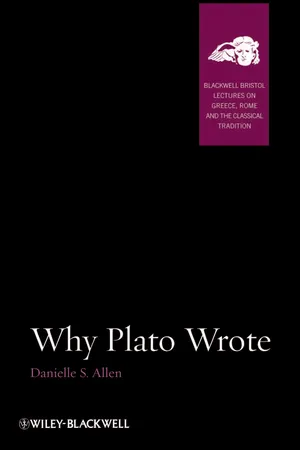
Why Plato Wrote
About this book
Why Plato Wrote argues that Plato was not only the world's first systematic political philosopher, but also the western world's first think-tank activist and message man.
Information
Part I
Why Plato Wrote
1
Who Was Plato?
When Plato, son of Ariston and Perictione, was born to an aristocratic family in Athens in 424/3 BCE, he had two elder brothers, Adeimantus and Glaucon, roughly eight and five years older. Glaucon, at least, would soon be an aspiring politician.1 Plato also had two uncles, Critias and Charmides, who were intensely involved in Athenian politics and who, in 404/3 BCE, joined a group of aristocrats in an oligarchic take-over of the democratic city.2 It seems they invited young Plato to join them. He was then just twenty, the age at which young Athenian men usually got involved in politics, but he declined the invitation. Some years earlier his life had already taken an interesting turn; he had met the famous wise man Socrates, who lived from 469 to 399 BCE. Now, at age twenty, he began to follow Socrates formally.
The word philosopher wasn’t yet much in use during the years that Socrates frequented the Athenian city center and market-place or agora; Socrates would generally have been called a sophistês.3 This word literally means “wise man” but came to have the negative connotation of “sophist,” a person who fast-talks his way out of moral, intellectual, and practical quandaries or trickily leads others into them. Plato probably met Socrates in his early or mid-teens, and even then earned the older man’s admiration; he would have been sixteen in 408–407 BCE, which appears to have been the year that Socrates undertook to educate Plato’s older brother Glaucon in wise political leadership, a conversation that both Xenophon and Plato record.4 Xenophon represents Socrates as having struck up the conversation with Glaucon as a favor to Plato, so the latter must by then already have been a regular associate of Socrates.5
Plato’s record of such a conversation occurs, of course, in the very famous dialogue, The Republic, in which Socrates leads Glaucon (and Adeimantus too) through an answer to the question, “What is justice?” Over the course of the conversation, Socrates builds an argument for a utopia led by philosopher-kings and queens and protected by a class of guardian-soldiers, including both men and women, who hold their property in common, have egalitarian gender relations, and enjoy open marriages. But the historian Xenophon also records a conversation between Socrates and Glaucon about political leadership. In a book called Reminiscences of Socrates, Xenophon represents the conversation between Socrates and Glaucon as having been unextraordinary (Mem. 3.6.1 ff.). According to Xenophon, the wise man asked Plato’s brother questions like: “Tell us how you propose to begin your services to the state”; “Will you try to make your city richer?”; “In order to advise the city whom to fight, it is necessary to know the strength of the city and of the enemy… tell us the naval and military strength of our city, and then that of her enemies.” Although the questions are conventional, Glaucon fares poorly. So Socrates admonishes him: “Don’t you see how risky it is to say or do what you don’t understand?”
Plato’s involvement with Socrates ended prematurely – even before Plato was out of his twenties. In 399 BCE, the citizens of Athens condemned his teacher to death. Why? Five years earlier, in 404 BCE, the group of oligarchs, among whom Plato’s uncles numbered, had taken over the city in an oligarchic coup; Socrates was associated with several of the participants. Within a year, the democratic resistance had in turn overthrown the oligarchs. Admirably, the reinstated democratic citizenry sought reconciliation among different factions in the city and issued a broad amnesty (for all except the leaders of the coup) in which the citizens swore not to remember past events.6 Yet despite this amnesty, some legal cases continued to emerge from the controversies. The plausibility to the Athenians of the charges against Socrates – of impiety and of corrupting the youth – is generally thought to have depended on the preceding political turmoil.7
Both Plato and Xenophon wrote accounts of Socrates’ trial and speeches, each titled The Apology. In the original Greek the word, “apology” simply meant “a defense speech,” and Socrates was not the only citizen to have to deliver a highly politicized one in 399 BCE. In the same year, the orator Lysias wrote an apology for an anonymous citizen who had been charged with subverting the democratic constitution. And these were just two out of six major public trials in the year 400/399 BCE that somehow related to the previous events.8 Nor was Socrates the first philosopher to be brought to trial in Athens. Approximately thirty years earlier, at the beginning of the Peloponnesian War, another time of political stress in the city, the Athenians reportedly prosecuted Anaxagoras.9 Late in the fourth century, they would go after philosophy again, as their subjection to Macedon was becoming permanent. They would prosecute (and acquit) Theophrastus sometime between 317 and 307 BCE and then directly legislate against philosophy in 307 BCE.10
How did Plato react to the judgment and execution of his teacher? He attended the trial and wrote himself into his account of Socrates’ defense speech. In his Crito, he represents himself as having offered to put up money so that Socrates could pay his penalty with a fine rather than with his life. This is the only place in his dialogues that Plato himself shows up. But versions of Plato’s life story, which help answer the question of how he reacted to Socrates’ death, appear in several other texts, among them an allegedly autobiographical letter dating to 354 BCE. Plato supposedly wrote this letter to a group of politicians in Syracuse on the island of Sicily, where he had spent considerable time, but scholars now generally agree that Plato did not himself write this letter. Whoever did, though, knew Plato’s dialogues well and wrote from close proximity to him; the author was probably someone involved in Syracusan politics.11 We can therefore take seriously what this letter – called the Seventh Letter, as one of thirteen attributed to Plato – tells us about his life.
According to the Seventh Letter, the death of Socrates changed Plato’s life. Having thought that he wished to enter Athenian politics, he abandoned that path and sought philosophical associates instead. He moved to Megara, on the border of Attica, where a community of philosophers, who had left Athens in the trial’s wake, had gathered. Then Plato appears to have traveled more widely, arriving in Syracuse in 384/3 BCE, where he became involved with the family of the Syracusan tyrant, Dionysius I, as a teacher and political advisor. Plato’s first stay at Syracuse was brief. By 383 BCE he had returned to Athens and opened his philosophical school, the Academy, just outside the city center of Athens.12 This means that within two decades of Socrates’ death, Plato had already written dialogues important enough to generate a philosophical reputation that could justify opening a school; these dialogues would have included the Apology, Gorgias, Symposium, and Book 1 of the Republic.13 Plato’s time of travels had also been time to write. He then spent the rest of his life at the Academy but for two more stints in Syracuse (in 367 BCE and 361 BCE), where he was again politically entangled. By the time of his second visit in 367 BCE, he had finished the Republic and three other major dialogues. And by the time he died in Athens in 348/7 BCE at the age of seventy-six, he had written, over roughly fifty years, more than two dozen dialogues. Plato, in contrast to his teacher, had lived a writer’s life.
One might think that, with all those books by Plato to consult, scholars would long ago have come up with settled answers to the questions of what Plato thought and what his relationship to Athenian politics was. Yet these two questions have been continually vexing. After all, although Plato wrote more than two dozen dialogues, he speaks in his own voice in none. And since Socrates is often the central character in the dialogues, we are constantly confronted with the difficulty of distinguishing Socratic from Platonic elements in them. The second question – about Plato’s relation to Athenian politics – flows pretty directly from the first. Because of the great difficulty in identifying what Plato himself thought, scholars are at a loss for how to interpret the relation of his richly elaborated political theory to actual politics. Indeed, scholars have taken quite opposing positions on how Plato expected his theory to relate to practice.
At one extreme, some scholars have seen the arguments in the Republic as a straightforward constitutional blueprint that Plato hoped to see implemented. Those adopting this view have seen Plato as a would-be totalitarian advocating the creation of a fascist state.14 At the other end of the spectrum, scholars have seen the arguments of the Republic - and particularly the arguments for the equality of women and communistic property arrangements – as so obviously laughable (as the comic playwright Aristophanes made similar ideas in comedies like The Assemblywomen) that the dialogue must be making a point of their impossibility, not their desirability.15 These scholars see Plato as arguing against any pursuit of radical change in the structure of human life. On this view, the conversion of Plato’s theory into a practical politics mainly entails educating moderate, conservative rulers whose respect for philosophy will help them steer their societies along moderate, conservative courses.16
The Seventh Letter, which ruminates in Plato’s name on why the philosopher engaged with Syracusan politics, provides support for both positions. The letter claims that Plato desired to see his theoretical plans made real: “If anyone ever was to attempt to realize these principles of law and government, now was the time to try, since it was only necessary to win over a single man and I should have accomplished all the good I dreamed of” (328b-c).17 Yet the advice given by Plato to the Syracusans does not directly mirror the blueprint provided in the Republic. For instance, in the Republic, Socrates argues that the construction of a utopian city requires first banishing everyone over the age of ten; the philosopher-rulers need a clean slate from which to start work. But in Syracuse, according to the Seventh Letter, Plato eschewed such political violence. He always sought, the Letter insists, repeating the point three times, to bring about “a blissful and true life” without resorting to massacres, murders, and exiles (327d, 331d, 351c).
Indeed the Seventh Letter describes Plato as pursuing a blissful and true life for Syracuse mainly through the education of its young ruler, Dionysius II, into a love of philosophy. This provides some support to those scholars who see Plato’s relation to politics as resting primarily on his interest in educating elites. But neither the view that Plato’s theoretical ideas provided a blueprint for political change nor the view that he sought primarily to educate elites helps us understand his relationship to politics in Athens. After all, we have no evidence that he worked in legislative arenas to change Athenian institutions in the directions described in the Republic; nor in Athens did he have occasion to educate a tyrant or monarch, or even a closed and controlling political elite, as he had had in Syracuse. Yes, he educated elites but not an oligarchical elite.
A third account of how Plato thought his philosophy related to politics focuses on Plato’s role as a critic in Athens. His dialogues are full of probing commentary on Athenian culture and political leaders as well as being full of metaphors, for instance from the theater and practices of spectatorship, that themselves emerged from Athenian culture. These facts are the basis for an argument that Plato, through his dialogues, acted on Athenian politics as a constant critic showing up its defects.18 Again, the Seventh Letter provides some support. According to the Letter Plato believed that “if to the man of sense his state appears to be ill governed he ought to speak, if so be that his speech is not likely to prove fruitless nor to cause his death” (331cd). Since Plato managed to publish texts critical of Athens over the course of his entire life without suffering punishment, he must be recognized as having succeeded at just such a project of sustained dissent.19
But what about all the positive arguments in his dialogues for an alternative set of political ideals? Plato’s project was not merely critical but also constructive. Some scholars have recognized this, focusing in particular on Plato’s use of the dialogue form to enact an open-ended, and therefore (on their argument) democratic method of engaging with important questions thrown up by democratic life.20 But how did Plato’s investigations of political questions (whether tending in an anti-democratic or democratic direction) feed back into Athenian politics? How did he hope they might feed back? These scholars do not ask or answer this question. And neither the blueprint theory nor the theory about the education of elites fully explains how Plato’s positive project related to Athens. Each of the three existing scholarly accounts of how Plato related to Athenian politics gives us a spark of truth, but the matter isn’t yet fully illuminated. This is because we have not yet asked and answered the fundamental question: Why did Plato write? The fact that Plato wrote distinguishes him absolutely from Socrates. If we can discover why Plato wrote, we will have identified a cornerstone of his philosophy.21
Figuring out why Plato wrote is a tricky operation. In general, pursuing an author’s intentions is unfashionable but even if it were a more conventional undertaking, it also remains, simply, difficult. After all, Plato did not invent the concept of the Socratic dialogue; more than a dozen of Socrates’ students (or students of his students) wrote them.22 How could we distinguish Plato’s intentions from those of any other writer of dialogues? And even Socrates seems to have engaged in some literary experimentation, at least at the end of his life.
In the Phaedo, the dialogue in which Plato recounts Socrates’ last days, we hear that in prison Socrates has been busily writing a hymn to Apollo. When asked by his student cebes, why the aged wise man who had never composed poems should spend his final days versifying, Socrates answers:
I composed these verses not because I wished to rival [the poet] Evenus or his poems, for I knew that would not be easy, but because I wished to test the meaning of certain dreams, and to make sure that I was neglecting no duty in case their repeated commands meant that I must cultivate the Muses in this way. They were something like this. The same dream came to me often in my past life, sometimes in one form and sometimes in another, but always saying the same thing: “Socrates,” it said, “make music and work at it.” And I formerly thought it was urging and encouraging me to do what I was doing already and that just as people encourage runners by cheering, so the dream was encouraging me to do what I was doing, that is, to make music, because philosophy was the greatest kind of music and I was working at that. But now, after the trial and while the festival of the god delayed my execution, I thought, in case the repeated dream really meant to tell me to make this which is ordinarily called music, I ought to do so and not to disobey. For I thought it was safer not to go hence before making sure that I had done what I ought, by obeying the dream and composing verses. So first I composed a hymn to the god whose festival it was; and after the god, considering that a poet, if he is really to be a poet, must compose myths and not speeches, since I was not a maker of myths, I took the myths of Aesop, which I had at hand and knew, and turned into verse the first I came upon. (60d-61b)
This passage reveals Socrates to have experimented with poetry after a lifetime of avoiding it. Importantly, though, it does not in fact reveal him to have written his poems: the verbs for writing are never used in this passage; Socrates is described simply as composing (poieô) poems. Even at the end of his life Socrates seems to hold back from putting his words into durable material form. Yet this passage does reveal that Socrates was self-conscious about the genre of communication that he had employed throughout his life and thought that the divine spirit guiding him wished to direct him specifically to one or another form of communication. The questions of how to communicate, of whether to write, of what to write, if one wrote, were clearly fraught for Socrates and his students.
Another Platonic dialogue, the Theaetetus, does actually describe Socrates as contributing to the writing of a dialogue. The dialogue begins when its narrator, Eucleides, offers to have a slave read out a text recording a conversation between Socrates and Theaetetus. Eucleides reports that when he visited Socrates in prison during the wise man’s final days, Socrates recounted to him this conversation from years earlier; once he was home, Eucleides wrote it down in order to remember it better; and then, on his subsequent visits to Socrates, Socrates read and corrected his text until they had recorded the conversation accurately. Plato, in other words, fictionally attributes the written production of the text of the Theaetetus not only to Eucleides but also to Socrates (142a-143c). This is the nearest we come to seeing Socrates himself write a dialogue. According to Diogenes Laertius, who wrote his biography of Plato some time between the third and fifth centuries ce, Plato, like Eucleides, also read out a dialogue to Socrates. But that reading, of the Lysis, supposedly elicited from Socrates not editorial collaboration but criticism: “O, Hercules! what a number of lies the young man has told about me!” (Diog. Laert. 3.24). Was Plato writing different kinds of dialogues than Eucleides?
Whatever the case, from Plato’s account of the genesis of the Theaetetus we learn that Socrates was understood to have endorsed some writing projects, despite not undertaking any of his own. In particular, Socrates is represented as a willing supporter of a student who wished to produce a text ...
Table of contents
- Cover
- Series page
- Title page
- Copyright
- Dedication
- Acknowledgments
- Abbreviations
- Prologue Why Think about Plato?
- Part I: Why Plato Wrote
- Part II: What Plato Did
- Epilogue And to My Colleagues
- Appendix 1: The Relationship between Paradigms and Forms
- Appendix 2: A Second Tri-partite Division of the Soul?
- Appendix 3: Miso- Compounds in Greek Literature
- Notes
- References
- Further Reading
- Index
Trusted by 375,005 students
Access to over 1.5 million titles for a fair monthly price.
Study more efficiently using our study tools.
Frequently asked questions
Yes, you can cancel anytime from the Subscription tab in your account settings on the Perlego website. Your subscription will stay active until the end of your current billing period. Learn how to cancel your subscription
No, books cannot be downloaded as external files, such as PDFs, for use outside of Perlego. However, you can download books within the Perlego app for offline reading on mobile or tablet. Learn how to download books offline
Perlego offers two plans: Essential and Complete
- Essential is ideal for learners and professionals who enjoy exploring a wide range of subjects. Access the Essential Library with 800,000+ trusted titles and best-sellers across business, personal growth, and the humanities. Includes unlimited reading time and Standard Read Aloud voice.
- Complete: Perfect for advanced learners and researchers needing full, unrestricted access. Unlock 1.5M+ books across hundreds of subjects, including academic and specialized titles. The Complete Plan also includes advanced features like Premium Read Aloud and Research Assistant.
We are an online textbook subscription service, where you can get access to an entire online library for less than the price of a single book per month. With over 1.5 million books across 990+ topics, we’ve got you covered! Learn about our mission
Look out for the read-aloud symbol on your next book to see if you can listen to it. The read-aloud tool reads text aloud for you, highlighting the text as it is being read. You can pause it, speed it up and slow it down. Learn more about Read Aloud
Yes! You can use the Perlego app on both iOS and Android devices to read anytime, anywhere — even offline. Perfect for commutes or when you’re on the go.
Please note we cannot support devices running on iOS 13 and Android 7 or earlier. Learn more about using the app
Please note we cannot support devices running on iOS 13 and Android 7 or earlier. Learn more about using the app
Yes, you can access Why Plato Wrote by Danielle S. Allen in PDF and/or ePUB format, as well as other popular books in Philosophy & Ancient & Classical Philosophy. We have over 1.5 million books available in our catalogue for you to explore.