- This text is the work of two highly respected biblical scholars
- It explores the rich and complex reception history of the last six Minor Prophets in Jewish and Christian theology and exegesis
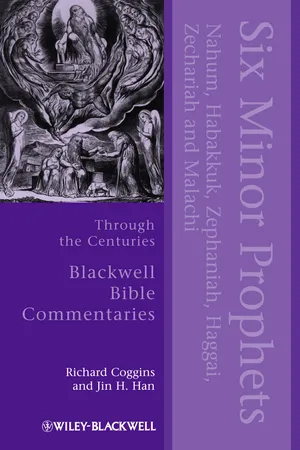
eBook - ePub
Six Minor Prophets Through the Centuries
Nahum, Habakkuk, Zephaniah, Haggai, Zechariah, and Malachi
- English
- ePUB (mobile friendly)
- Available on iOS & Android
eBook - ePub
Six Minor Prophets Through the Centuries
Nahum, Habakkuk, Zephaniah, Haggai, Zechariah, and Malachi
About this book
Six Minor Prophets Through the Centuries is the work of highly respected biblical scholars, Richard Coggins and Jin H. Han. The volume explores the rich and complex reception history of the last six Minor Prophets in Jewish and Christian exegesis, theology, worship, and arts.
Information
Edition
1Topic
Theology & ReligionI Nahum, Habakkuk, and Zephaniah
Introduction
The Three Among the Twelve
The prophetic corpus in the Old Testament ends in a collection of twelve books (“The Twelve,” Trei Asar in Aramaic), commonly known as the Minor Prophets. The prayer of Ben Sira (second century BCE) provides the earliest reference to the collection of the twelve prophetic writings that apparently included Nahum, Habakkuk, and Zephaniah. In this prayer, Ben Sira says, “May the bones of the Twelve Prophets send forth new life from where they lie, for they comforted the people of Jacob and delivered them with confident hope” (Sir. 49:10). His words suggest that comfort and hope may have been the religious theme that facilitated the compilation of the twelve books. Other books may have found their way into the scroll for the same reason. The oldest of the fragments of the Twelve from Qumran (4Q76[4QXXIIa]) offers additional support for the idea that the Twelve were on one scroll by the second century BCE (Brooke 2006: 20–34).
The Talmud suggests that the Twelve were written by “the Men of the Great Assembly” (b. Baba Batra 15a), which in turn suggests that these books were committed to writing in the land of Israel, even though the verb “to write” here may refer to the activity of interpretation rather than to the preparation of the physical text. The Talmud offers a plausible rationale for the collection when it explains that the book of Hosea was not circulated separately because its size put it at risk of being lost (b. Baba Batra 14b). Though small in size, these prophets have been regarded by readers as significant parts of the Bible. They are minor (Lat. lit. “smaller”), “not because their writings are of any less authority or usefulness than those of the greater prophets, or as if these prophets were less in God’s account or might be so in ours than the other, but only because they are shorter, and less in bulk, than the other” (M. Henry n.d. 4: 1117).
The twelve Minor Prophets continued as a collection into the first millennium of the Common Era. In Against Apion 1.8, Josephus (ca. 37–ca. 100) speaks of twenty-two books in the Hebrew Bible, indicating that the twelve prophets were not counted separately (cf. 2 Esd. 14:45). Origen’s list of canonical books does not mention the Minor Prophets, probably because of a scribal error (B. A. Jones 1995: 12). Eusebius of Caesarea (ca. 260–ca. 339) is the first to refer to the Minor Prophets as “the Twelve in one Book” (tōn dodeka en monobibliō), an epithet he attributes to Melito, Bishop of Sardis (Ecclesiastical History 4.26; Eusebius 1989: 133). In his preface to the Minor Prophets, Jerome also mentions the Jewish practice of treating the twelve as one book (NPNF2 6: 493, 501).
The logic behind the present order of the Twelve has been a hotly debated issue in biblical studies. Modern scholars believe that the first six of the Twelve Prophets (Hosea, Joel, Amos, Jonah, Obadiah, and Micah) were collected first, followed by the collection of the late pre-exilic prophets (Nahum, Habakkuk, and Zephaniah) and the postexilic prophets (Haggai, Zechariah, and Malachi). In content, the two subsets of six prophets complement each other, for the first six (Hosea–Micah) raise the question of iniquity, and the last six propose various resolutions to the problem (House 1996: 205–6). The first of the latter subset, Nahum affirms God’s righteousness displayed in the destruction of Nineveh. Habakkuk advises the people of God to wait for the vision of the end time and live by faith until God’s justice is made manifest in history. Zephaniah anticipates horrific devastation on a cosmic scale and concludes with a song that celebrates God’s deliverance of Zion.
The Manner of Presentation
The chapter on each prophetic book begins with a brief description of the main themes, followed by a general survey of its reception and a discussion of its role in the arts, literature, and worship. The commentary proper follows the structure of the biblical books and presents for each verse or passage representative interpretations arranged in chronological order, from the Dead Sea Scrolls down to modern popular culture. In deciding what to include and what to leave out, the main criteria were historical importance and impact on other areas of theological thought and religious practice.
This book draws upon the main Jewish commentators on the Twelve, such as Akiba (ca. 50–ca. 135), Rashi (1040–1105), Ibn Ezra (1092/3–1167), Moses Maimonides (1135–1204), David Kimh.i (ca. 1160–ca. 1235), Malbim (1809–79), and others. Important Christian commentators on the Minor Prophets include Irenaeus (ca. 120–ca. 200), Clement of Alexandria (ca. 150–ca. 215), Tertullian (ca. 162–ca. 220), Origen (ca. 185–235), Cyprian (ca. 200–58), Athanasius (ca. 296–373), Gregory of Nazianzus (330–89), Ambrose (ca. 333–97), Jerome (ca. 340–420), Theodore of Mopsuestia (ca. 350–428/9), Augustine (354–430), John Chrysostom (ca. 347–407), Cyril of Alexandria (ca. 375–444), Theodoret of Cyrrhus (ca. 393–ca. 458), Martin Luther (1483–1546), John Calvin (1509–64), Matthew Henry (1662–1714), John Wesley (1703–91), Edward Bouverie Pusey (1800–82), John Kitto (1804–54), and others. Other important sources for reception history include The Lives of the Prophets, the Qumran pesher commentaries, the Mishnah, the Talmud, the Targum, Seder ‘Olam Rabbah, the Tanḥuma, the Zohar, sermons, hymns, and works of literature and the other arts. Biblical texts are quoted from the New Revised Standard Version, unless specified otherwise.
1 Nahum
The crusher has come up against you.
Secure the fortresses; scan the road;
strengthen your loins;
brace yourself with all your strength.
Secure the fortresses; scan the road;
strengthen your loins;
brace yourself with all your strength.
(Nah. 2:1, author’s translation)
The book of Nahum is famous for its portrayal of a God who executes vengeance upon enemies, demonstrating “Yahweh’s sovereignty over the nations, illustrated in the specific context of the Assyrian menace” (Coggins 1982: 84). Evoking a brutal vision of hatred toward the adversary nation, Nahum’s oracle expresses jubilation over Nineveh’s demise and Israel’s deliverance in such a way as to make the paradoxical nexus of divine wrath and comfort the focal point of the reception history of the book of Nahum.
In the Septuagint, the ancient Greek translation of the Hebrew Bible, the book of Nahum is placed immediately after Jonah, as if anticipating the view held by ancients and moderns alike that “the book of Nahum is best read as a complement to the book of Jonah” (Christensen 1996: 187). When the people of Nineveh listened to Jonah and repented, they were saved; however, the book of Nahum shows that Nineveh returned to its sinful ways and once again stood under God’s condemnation. The pseudepigraphal Lives of the Prophets also juxtaposes Nahum and Jonah, stating that “after Jonah [Nahum] gave to Nineveh a portent, that it would be destroyed by fresh water and an underground fire, which also happened” (11:2; OTP 2: 393).
In the early church, Theodore of Mopsuestia continued to read Nahum in light of Jonah. In his commentary on Jonah, Theodore argues that the Ninevites listened to Jonah and repented because they “were seized with such dread at a simple threat made by an unknown man” (FC 108, Theodore 2004: 245). Theodore attributes Jonah’s forceful ministry to the divine origin of his prophecy rather than the threat of destruction, for “it is obvious that he also mentioned God, the Lord of all, and said he had been sent by him” (ibid., 202). In spite of Jonah’s successful ministry, the repentance of the Ninevites was short-lived, as Nahum shows, and they returned to their old ways, for “when God allowed them to show their true colors, they adopted such a depraved attitude and such ferocity and vicious behavior as to attack all the people of the ten tribes and take them captive; they laid waste their cities, robbed them of all their possessions and advanced even on Jerusalem, which they were anxious to take, showing no respect for the Temple, or the worship of God conducted there” (ibid., 245). Both Martin Luther and John Calvin in the Reformation era castigated Nineveh’s evanescent repentance. Luther complains, “When the punishment ceased, so did the repentance” (1975: 281). In his commentary on Nahum, Calvin agrees that God’s punishment was merely postponed. Nineveh’s backsliding returned after a spurt of repentance “as it is usually the case” (1984–6, 3: 414). A nineteenth-century preacher, James Randall (1790–1882), thought of the book of Nahum as “a melancholy sequel to that of Jonah” (1843: 71). He submitted that the Ninevites were only guilty of ignoring Jonah, but Christians, who have heard from all prophets and preachers, will incur greater guilt than the people of Nineveh did for failing to heed God’s message (ibid., 97).
Not every interpretation has focused on the Jonah connection. Jerome observes two layers of meaning in Nahum’s prophecy, the literal and the spiritual, in his Commentary on Nahum (CCSL 76A, Jerome 1970: 535–78). On the literal level, according to Jerome, the prophet sought to “raise the spirits of his fellow-Jews groaning under the Assyrian yoke” (Kelly 1975: 166 commenting on Jerome [CCSL 76A, Jerome 1970: 533–6]). The words of Nahum have a spiritual lesson for Christians, who “may read them as dire warnings of the doom awaiting those who defy God and spurn the refuge of his Church” (ibid.).
Nahum has had particular appeal for those who understand prophetic books as prophecies that await fulfillment. The most important examples of this approach from antiquity are found in the book of Tobit (second century BCE) and a Qumran pesher commentary discovered at Cave 4 (first century BCE). In the Codex Sinaiticus manuscript, Tobit calls to his deathbed his son Tobias and seven grandsons, and asks Tobias to escape to Media with his family, for Tobit is convinced that the word of God prophesied by Nahum (Codex Vaticanus reads “Jonah” instead) is about to come true (Tob. 14:3–4). The interpretative framework of a prophecy fulfilled in due time is also at work in the Qumran pesher commentary (4QpNah [4Q169]). This work follows the typical structure of pesher commentaries, first citing the scriptural text and then offering a commentary introduced by the formula pishro, “its interpretation [is] ….” The Qumran commentary interpreted prophetic words as references to contemporary events that were affecting the life of the community (Horgan 1979: 158–9). The use of the prophecy-fulfillment pattern can be observed even in modern days. For instance, a footnote in the Scofield Reference Bible argues that “Nineveh stands in Scripture as the representative of apostate religious Gentiledom, as Babylon represents the confusion into which the Gentile political world system has fallen,” and “the coming destruction of apostate Christendom is foreshadowed by [the message of Nahum]” (Scofield 1945: 952).
Most modern interpreters, however, are more concerned with Nahum’s unbridled jubilation over the enemy nation’s destruction than with prophecy and fulfillment. They note the prophet’s approval of divinely sanctioned violence in the interest of his own nation, for his prophecy does not contain even “a hint of the errors of Israel and their punishment” (Wright 1897: 112). He has been called “a representative of the old, narrow and shallow prophetism” (J. M. P. Smith 1911: 281). Another critic accuses him of casting “the first stone as a militant nationalist, showing no awareness whatsoever of the fact that the sins of the Assyrians were also the sins of the Judeans” (Cleland 1956: 957). Nahum’s gory diction, portraying bloody scenes of war, is eerily reminiscent for modern readers of “physical and ideological battles between Israelis and Palestinians, Hutus and Tutsis, Serbs and Croats, ‘terrorists’ and ‘the West’ ” (O’Brien 2004: 20). One has to wonder if God’s involvement in the violence that Nahum portrays does not betray “the ‘dark side’ of God” (Christensen 1999: 201).
A positive assessment of Nahum is not lacking. For some commentators, the prophet articulates the fulfillment of God’s triumph over tyranny. He “proclaimed with passionate conviction the fundamental truth of prophetic religion, that God is in control of the history of the nations and that His moral government manifests itself in the punishment of the brutal tyrant” (Bewer 1949: 22). Biblical scholar Brevard S. Childs comments that the prophet calls attention to “divine justice to suffering Israel, whether suffering from the dominion of Assyria, Babylon, or Rome” (1979: 445). His perspective echoes a sermon preached by a Christian socialist, Frederick Denison Maurice (1805–72), more than a century earlier: “Nahum not only carries on the testimony of Jonah respecting the certain doom of an evil city; he also shows us how the called race in its deepest humiliation, as much as in its greatest prosperity, was still the preacher to the human race … and made the rise and fall of empires, with all the dark crimes that led to both, give out pledges of consolation and hope” (“The Evil City Saved and Destroyed,” Maurice 1853: 347).
Nahum in Literature
Modern biblical scholars praise the literary quality of the book of Nahum. The prophet is lifted up as the “poet laureate” of the Minor Prophets (Patterson and Travers 1990), and the book itself as a work of poetry with “no superior within the prophetic literature of the Hebrew Bible” (Christensen 1999: 201). These contemporary encomiums echo the estimation of eighteenth-century Oxford professor Robert Lowth (1710–87), who gave Nahum superlative praise in his De sacra poesi Hebræorum (1995, 2: 99):
None of the minor prophets … seem to equal Nahum, in boldness, ardour, and sublimity. His prophecy too forms a regular and perfect poem; the exordium is not merely magnificent, it is truly majestic; the preparation for the destruction of Nineveh, and the description of its downfall and desolation, are expressed in the most vivid colours, and are bold and luminous in the highest degree.
The fall of Nineveh, the axis of Nahum’s prophetic passion, is widely depicted in the literature of the nineteenth and twentieth centuries. Edwin Atherstone’s The Fall of Nineveh (1847, 1: 1) describes the city with unmitigated admiration:
Of Nineveh, the mighty city of old;
The queen of all the nations. At her throne
Kings worshipp’d; and from...
The queen of all the nations. At her throne
Kings worshipp’d; and from...
Table of contents
- Cover
- Series page
- Title page
- Copyright page
- Dedication
- Illustrations
- Series Editors’ Preface
- Preface
- Acknowledgments
- Abbreviations
- I Nahum, Habakkuk, and Zephaniah
- II Haggai, Zechariah, and Malachi
- Glossary
- Brief Biographies
- Bibliography
- Online Sources (Select)
- Index of Biblical References
- Index of Names and Subjects
Trusted by 375,005 students
Access to over 1.5 million titles for a fair monthly price.
Study more efficiently using our study tools.
Frequently asked questions
Yes, you can cancel anytime from the Subscription tab in your account settings on the Perlego website. Your subscription will stay active until the end of your current billing period. Learn how to cancel your subscription
No, books cannot be downloaded as external files, such as PDFs, for use outside of Perlego. However, you can download books within the Perlego app for offline reading on mobile or tablet. Learn how to download books offline
Perlego offers two plans: Essential and Complete
- Essential is ideal for learners and professionals who enjoy exploring a wide range of subjects. Access the Essential Library with 800,000+ trusted titles and best-sellers across business, personal growth, and the humanities. Includes unlimited reading time and Standard Read Aloud voice.
- Complete: Perfect for advanced learners and researchers needing full, unrestricted access. Unlock 1.5M+ books across hundreds of subjects, including academic and specialized titles. The Complete Plan also includes advanced features like Premium Read Aloud and Research Assistant.
We are an online textbook subscription service, where you can get access to an entire online library for less than the price of a single book per month. With over 1.5 million books across 990+ topics, we’ve got you covered! Learn about our mission
Look out for the read-aloud symbol on your next book to see if you can listen to it. The read-aloud tool reads text aloud for you, highlighting the text as it is being read. You can pause it, speed it up and slow it down. Learn more about Read Aloud
Yes! You can use the Perlego app on both iOS and Android devices to read anytime, anywhere — even offline. Perfect for commutes or when you’re on the go.
Please note we cannot support devices running on iOS 13 and Android 7 or earlier. Learn more about using the app
Please note we cannot support devices running on iOS 13 and Android 7 or earlier. Learn more about using the app
Yes, you can access Six Minor Prophets Through the Centuries by Richard J. Coggins,Jin H. Han in PDF and/or ePUB format. We have over 1.5 million books available in our catalogue for you to explore.