- Edited by one of the world's leading experts in the field of cultural resource management, with contributions by a wide range of experts, including archaeologists, architectural historians, museum curators, historians, and representatives of affected groups
- Offers a broad view of cultural resource management that includes archaeological sites, cultural landscapes, historic structures, shipwrecks, scientific and technological sites and objects, as well as intangible resources such as language, religion, and cultural values
- Highlights the realities that face CRM practitioners "on the ground"
- English
- ePUB (mobile friendly)
- Available on iOS & Android
eBook - ePub
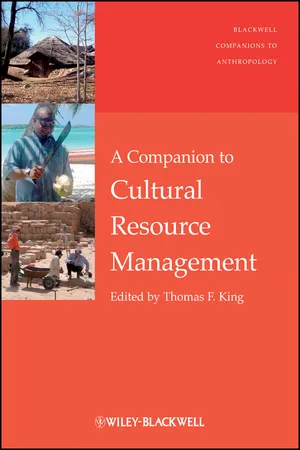
A Companion to Cultural Resource Management
About this book
A Companion to Cultural Resource Management is an essential guide to those wishing to gain a deeper understanding of CRM and heritage management. Expert contributors share their knowledge and illustrate CRM's practice and scope, as well as the core issues and realities in preserving cultural heritages worldwide.
Information
PART I
General Classes of Cultural Resources
The 11 chapters in this part focus on the general classes of cultural resource that CRM usually involves managing. In fact, any given CRM enterprise typically involves only a few of the subjects that these chapters cover; it may focus only on historical architecture, for example, mostly on archaeology, or entirely on language. Sometimes this focusing results from the kinds of resources that actually confront us; there is little reason to worry about, say, architectural history when one is managing a language retention program. Sometimes our attention is focused on some resource classes to the exclusion of others by the laws under which we work (see Part IV). Sometimes, regrettably, we focus on some kinds of resources and ignore others simply because of our own disciplinary biases. But if one is to call oneself a manager of cultural resources, one should at least be aware of all the resource categories discussed in the chapters of Part I, and think about the relevance of each to any piece of work one proposes to undertake.
CHAPTER 1
Studying and Evaluating the Built Environment
Introduction
This essay examines the process of studying and assessing the built environment from the perspective of a practicing architectural historian with nearly 30 years of experience in cultural resource management (CRM). The scope of this topic is daunting, so limiting the discussion clearly is in order. This chapter is not intended as a treatise on architectural history, nor is it intended to document the historic preservation movement, to review heritage legislation, or to restate guidance on the application of program-specific criteria and standards. Volumes exist on these topics.
Rather, this discussion encourages thoughtful and responsible professional practice in CRM. Its content reflects an acknowledged US bias in the field of cultural resource management, together with a firm belief in the importance of history and of the ability of the historic built environment to influence the quality of contemporary life. While a conscious effort has been made to limit the jargon and terms of art, much of what we do in the CRM field is framed by a specialized language and concepts rooted in historic preservation laws and regulations. The approaches reviewed briefly herein are intended to help bridge the chasms between theory, regulation, and real property in order to uncover the meaning and significance of the built environment.
Professional practice in CRM too often is devoted to juggling multiple projects within demanding time frames so that little opportunity is provided to reflect on the underlying objectives and accomplishments of the , CRM has advanced immeasurably the study of the built environment. Identification and evaluation are the foundations of the field, the fulcrums for decision making, and a basis for any national heritage conservation effort.
History is important to society. Thus, aspects of history that a society finds valuable inevitably are reflected in its built environment. This simple premise underlies much practice in contemporary cultural resource management. It provides a theoretical foundation for the field and also explains many of its challenges. For example, definitions of importance and society frequently are subject to debate. What is important and to whom? Understanding of “important history” is dynamic and influenced by scholarship, public policy, current events, and even our own ethnocentrism. Understanding of “society” (the group that values aspects of history) changes with context, and may range from the international community to local neighborhoods to private property owners.
At its best, cultural resource management is an art that applies a methodological discipline to the collection and analysis of archival and field data that are adequate to the objectives of an investigation. While CRM projects make a meaningful contribution to our knowledge of the past, rarely are such projects the final definitive work on a property. Rather, the practical realities, project objectives, and regulatory standards frequently determine the limits of an investigation. While these practical considerations may frame an overall scope of work, they should not influence the adequacy or quality of the work. Such considerations do require that investigations be transparent in their objectives and clear in their parameters so that end users are informed fully both of the level of work and of its limitations.
Built resource management is a subdiscipline within CRM that integrates a broad range of fields, including, but not limited to, cultural, engineering, military, and political history, genealogy, architectural history, geography, anthropology, planning, historic preservation, information management, and public policy, to address the built environment. Cultural resource management is serious business demanding the highest professional ethics, consistent dedication to high-quality work, and occasionally a thick skin.
Documenting and evaluating the relative importance of properties can influence very real decisions on planning and real property management. Indeed, the results of CRM investigations frequently have direct and lasting impacts on what society holds historically important and what is considered worthy to memorialize and/or retain for the future. Agreement may not be reached with the results of all investigations. Approaching the built environment systematically through an integrated program of defensible research designs, clear methodologies, and proper historic context development, field investigations, data analysis, and reporting helps assure that objectives and process are clear and results well reasoned and fully justified.
What is the “Built Environment”?
First, let’s explore the scope of the subject. The built environment can be defined as all space purposefully shaped and manipulated by human activity. The built environment is the result of conscious design decisions that can be both functional and esthetic. The class of resources encompasses buildings, structures, objects, and sites that individually and collectively, as districts, reflect human history.
Buildings are constructions designed to shelter human activity; they are as diverse and complex as their associated society. Generally categorized by use (residential, industrial, religious, civic, educational, etc.) and by building type (dwellings, factories, churches, city halls, schools, etc.), buildings are culturally bound resources that reflect use, events, architectural fashion, design theory, technology, economics, status, politics, power, reverence, order, and aspiration. By nature, building architecture has multiple audiences comprising both active users and passive viewers. Through the design principles of scale, mass, proportion, materials, ornamentation, and plan, building design elicits a spectrum of conscious intellectual and unconscious emotional responses that range from simple recognition of functional types to personal likes or dislikes.
Buildings frequently are categorized broadly into vernacular, e.g., “ordinary” or “local” architecture, and high-style (frequently “architect-designed”) architecture. It should be noted that the precise definition of “vernacular” architecture is an ongoing subject of discussion. While general categories can be useful in describing buildings at the extreme ends of the design spectrum, the dividing line between vernacular and high-style often is blurred, particularly in resources of recent vintage. Advances in construction technology and the availability of mass-produced building materials have limited the number of design decisions required by more contemporary builders, contributing to the standardization of “ordinary” building design. Buildings also may be subject to requirements beyond the control of builders, owners, or architects. Master planning, building codes, and architectural standards linked to land zoning or financing are among the factors that may exert an influence on basic building configuration and materials.
Buildings typically are described in terms of their architectural style. Architectural styles serve systematically to link buildings with defined characteristics to a body of theoretical and historical knowledge. Style serves to anchor a building temporally and esthetically. However, stylistic classification is not a hard science and buildings often combine several stylistic influences. As in the case of most typologies, systems of stylistic classification often are refined to reflect national, regional, or local variations. Occasionally such systems also include more prevalent “vernacular” types. Knowledge of the stylistic sequence developed for an area is as critical as knowledge of its overall development history.
Structures generally are categorized as designed functional constructions that are not intended for shelter. Structures frequently are the stuff of engineering and technology; they can be either movable or permanent. Bridges, roads, dams, boats, earthworks, and aircraft fall into this category. While design can be integrated masterfully with function, structures also can exhibit architectural style through such elements as ornamentation. Still, the fundamental quality of a structure is its functional nature. Due to their use, such resources often are improved or modified over time in response to current technologies. Integrity of use is a key factor in analyzing the historical importance of such resources.
Objects, in contrast, are generally smaller in scale and may be artistic or functional items that are associated with specific places and settings. This category includes such resources as statuary, sculpture, monuments, and boundary markers. Objects tend to be anchored temporally and the result of a single phase of construction or fabrication.
These broad categories notwithstanding, the components of the built environment are interrelated and frequently overlap. Individual buildings, structures, and objects can be part of larger landscapes, which even may be part of overarching landscapes. Landscapes themselves are recognized as a resource type with regard to the built environment under the category of sites.
Sites include high-style and vernacular landscapes, battlefields, and natural features with cultural associations. High-style landscapes are often the work of formally trained landscape architects; they may contain resources such as structures and objects in addition to a designed natural environment, which may include such elements as intentional open space, hardscapes, and specific plant materials. In contrast, vernacular landscapes can be among the most complex resources to define. Rural vernacular landscapes, for example, can be extensive geographically and contain a wide variety of resource types. As in the case of all built resources, though, rural landscapes are unified temporally by a definable period or periods of development and by themes or historical events. Human activity in rural vernacular landscapes is reflected holistically in historically associated buildings, structures, objects, and land-use patterns. While buildings, structures, and objects can be documented readily, historic land use can be ephemeral; tangible evidence of conscious landscape decisions may be difficult to uncover. Change is a constant and modifications in land-use patterns are to be expected; however, sites must retain sufficient evidence to make their historical use recognizable.
The definition of the built environment has expanded over the years with recognition of the complexity of historical land-use patterns, economic systems, and technologies. In CRM, the envelope for macro investigations of landscapes has been pushed further by consideration of viewsheds and viewscapes in the analysis of visual effects caused by modern land-use and development projects.
Who is Interested in the Built Environment?
While society as a whole claims a vested interest in the built environment, built resource surveys and assessments most often are completed to support planning and management decisions in three general areas. These are: regulatory compliance, governmental planning, and resource stewardship. Parties interested in the results of CRM investigations range from preservation advocates and public interest groups, to governmental agencies charged with regulatory and property oversight, to indigenous groups and others with cultural links to historic places, to private property owners, independent scholars, and academics.
Work supporting regulatory compliance generally comprises the largest percentage of projects executed by cultural resource managers. National, regional, and local historic preservation legislation frequently requires consideration of historic properties in the project planning process. Simply stated, the identification of historic properties is a prerequisite to their meaningful consideration.
In practice, distinct differences exist in the treatment requirements for historic properties, depending on the regulatory context. For example, historic properties identified under Section 106 of the US National Historic Preservation Act of 1966, as amended, (16 USC 470) are subject to a process of consideration under which adverse effects to historic properties may be avoided, limited, or mitigated through negotiated agreements. Historic properties identified through compliance with local requirements in the United States may be designated for perpetual preservation in accordance with local historic preservation ordinances. In the United States, historic preservation has been established as a national policy in the public interest. This policy has led to occasional friction between preservation advocates and private property owners or property management agencies. Such arguments rarely center on the historicity of a property, but on the real or perceived limitations inherent to historical designation upon future property use. While the issue of private property rights versus public historic preservation interests has been adjudicated numerous times over the years in favor of the prevailing policy, this tension is unlikely to subside and has the potential to alter CRM on all levels of practice.
National, state or provincial, and local governmental agencies frequently undertake identification and evaluation projects proactively, to support such efforts as master planning, historic district designation, management of endangered resource types, or in anticipation of future public improvements. Such projects also may involve some level of regulatory oversight as well as adherence to internal policies and regulations. The scope of these planning-level projects can be broad or their intent limited to the collection of general exterior survey data, limited photography, and mapping within targeted geographic areas along with sufficient archival research to develop overview histories and to identify general periods of development.
Survey and evaluation projects completed to support resource stewardship generally are tied directly to management decisions. Such investigations can support such efforts as restoration and rehabilitation projects or inform the development of architectural design guidelines. Such investigations generally are among the most intensive and exacting. Work may include painstaking analysis of a property to develop construction chronologies, extensive photography, measured drawings, and in-depth site-specific research.
Professionals working in cultural resource management are not advocates for the positions held by agencies, preservation groups, project sponsors, or property owners regarding the significance of cultural property. Cultural resource managers are not “guns for hire.” Rather, professional loyalties should be to the resource base and to the integrity of the work. Anything less undermines the credibility of a project and practitioner, bringing the veracity of a professional’s work as a whole into question.
Know the Ground Rules for Cultural Resource Management
Cultural resource management is a field spawned by local, national, and international concern for the recognition and appropriate treatment of cultural heritage. The field operates within a morass of international cultural heritage conventions, government policies, laws, ordinances, regulations, procedures, standards, and technical guidelines designed to support the identification, evaluation, and treatment of properties of historical and cultural importance. Knowing why a study is being undertaken is central to its scope, content, and ultimate usefulness. Working knowledge of the relevant review and regulatory context also is critical to the success of any identification and evaluation effort, since it informs all levels of investigation.
Since legislation and...
Table of contents
- Cover
- Series page
- Title page
- Copyright page
- Notes on Contributors
- Acknowledgments
- Introduction
- PART I General Classes of Cultural Resources
- PART II Special Types of Cultural Resources
- PART III Perspectives on Cultural Resource Management
- PART IV Legal, Administrative, and Practical Contexts
- Index
Trusted by 375,005 students
Access to over 1.5 million titles for a fair monthly price.
Study more efficiently using our study tools.
Frequently asked questions
Yes, you can cancel anytime from the Subscription tab in your account settings on the Perlego website. Your subscription will stay active until the end of your current billing period. Learn how to cancel your subscription
No, books cannot be downloaded as external files, such as PDFs, for use outside of Perlego. However, you can download books within the Perlego app for offline reading on mobile or tablet. Learn how to download books offline
Perlego offers two plans: Essential and Complete
- Essential is ideal for learners and professionals who enjoy exploring a wide range of subjects. Access the Essential Library with 800,000+ trusted titles and best-sellers across business, personal growth, and the humanities. Includes unlimited reading time and Standard Read Aloud voice.
- Complete: Perfect for advanced learners and researchers needing full, unrestricted access. Unlock 1.5M+ books across hundreds of subjects, including academic and specialized titles. The Complete Plan also includes advanced features like Premium Read Aloud and Research Assistant.
We are an online textbook subscription service, where you can get access to an entire online library for less than the price of a single book per month. With over 1.5 million books across 990+ topics, we’ve got you covered! Learn about our mission
Look out for the read-aloud symbol on your next book to see if you can listen to it. The read-aloud tool reads text aloud for you, highlighting the text as it is being read. You can pause it, speed it up and slow it down. Learn more about Read Aloud
Yes! You can use the Perlego app on both iOS and Android devices to read anytime, anywhere — even offline. Perfect for commutes or when you’re on the go.
Please note we cannot support devices running on iOS 13 and Android 7 or earlier. Learn more about using the app
Please note we cannot support devices running on iOS 13 and Android 7 or earlier. Learn more about using the app
Yes, you can access A Companion to Cultural Resource Management by Thomas F. King in PDF and/or ePUB format, as well as other popular books in Social Sciences & Cultural & Social Anthropology. We have over 1.5 million books available in our catalogue for you to explore.