- Represents the first collection of work in education to grapple with what Alain Badiou might mean for the enterprise of schooling
- Takes up Badiou's challenge to contemporary and conventional Anglo-American doxa
- Includes original essays by experts in several different educational fields
- English
- ePUB (mobile friendly)
- Available on iOS & Android
eBook - ePub
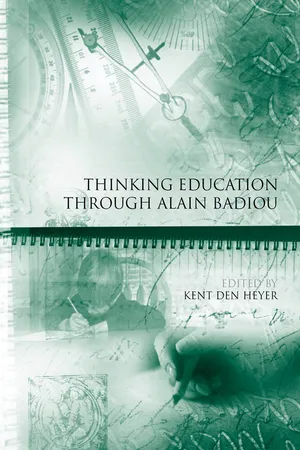
Thinking Education Through Alain Badiou
About this book
Thinking Education Through Alain Badiou represents the first collection to explore the educational implications of French philosopher Alain Badiou's challenge to contemporary philosophical orthodoxy put forth in his 1993 work, Ethics: An Essay on the Understanding of Evil.
Information
1
Introduction: Alain Badiou: ‘Becoming subject’ to education
Welcome to this book thinking education through the work of the French philosopher, Alain Badiou. Since 2000, the increased pace of translating Badiou’s books written in the 1980s and ‘90s into English has created growing interest. Current attention suggests that Badiou will soon join Michael Foucault, Jacques Derrida and Emmanuel Levinas as another major French philosophical influence on Anglo-American scholarship (Gibson, 2006). Indeed, given the traffic in English translation of his work and the number of special issues attempting to come to terms with what his work might mean for a diverse range of scholarly fields—including this one, the first to examine Badiou in relation to education—we might say he has already arrived.
If Badiou has ‘caught on’ outside education, it might be explained by the ‘affirmative’ thrust of his thought that freshly affronts the doxa both of contemporary Anglo-American philosophy and more popular media-ated interpretations of the broader context within which we think. As part of his philosophical intervention into this present situation—and for Badiou all ‘live thought’ constitutes a militant’s intervention—Badiou first describes contemporary philosophy—‘hermeneutics’ and ‘post-modern’ approaches being his favorite targets—as but a form of ‘conservatism with a good conscience’ (Badiou, 2001, p. 14). He asserts that the categories dominating contemporary philosophical work—of the Other, of difference, of language’s trickster nature—lead either to a quasi-theology or observations of the obvious. In any case, and most importantly, Badiou argues that the categories of contemporary philosophy lack any ethical capacity to support people’s potential to affirmatively invent ‘the possibility of new possibilities’ (Badiou, cf. in Cho & Lewis, 2005).
These claims are part of Badiou’s broader project to re-think contemporary political subjectivity in an age he asserts is awash in a relativism on the one hand— in which every opinion is equal to every other—and run aground on an alleged ‘end of history/Washington consensus’ on the other in which each opinion is equally irrelevant to alter a situation dominated by political appeals to economic necessity. In support of people’s capacities to affirmatively invent new realities, Badiou rehabilitates a concept of ‘truths’. Let me briefly provide a brief overview of Badiou’s work given better detail in each of this book’s chapters.
For Badiou, ‘truths’ are not actualities to acquire, properties of interlocking social regimes, temporalized ideals or authenticities, derivable from moral precepts, or facts entrapped within any dialectic (Balibar, 2004). As he interprets, a ‘truth’—or, rather, a generic ‘truth-process’—is absent of pre-specified content (as articulated by any number of religious orders or present appeals for our necessity to believe in the ‘free hand’ of the Market) or destination (as with a ‘scientific’ Marxist interpretation of history). This interpretation of truth is also unrelated to any communitarian identification (e.g. race-thinking, nationalisms, gender, sexual rientations). Rather, truths consist of the material traces (i.e. in speech, art, and social movements) a ‘becoming subject’ produces in ‘fidelity’ to a singular ‘truth-process’ instigated by an ‘event’. It is for these situated truth-processes that Badiou argues ethics and philosophy—and, as explored in this book, education— must lend support.
The status of an ‘event’ is, of course, a matter of much philosophical debate. Mariam Fraser (2006) writes that ‘as a philosophical concept’, an event ‘exists in relation to a specific set of problems, including the problem of how to conceive of modes of individuation that pertain not to being, or to essences and representation, but to becoming and effectivity’ (p. 129). Badiou links his interpretation of an ‘event’ to (one of his teachers) Lacan’s ‘void’: at its most basic description, an event is an encounter with that which defies our symbolic apprehension. This encounter renders insufficient the ‘opinions’ that previously provided the taken-for-granted coordinates of our daily lives: a disturbance that creates the possibility of a truth-process that implicates us in that ‘which cannot be calculated, predicted or managed’ (Badiou, 2001, pp. 122–123; see Peter Taubman, this book).
Encountering this event, we confront the question of ‘fidelity’ which is precisely the question where ethics for Badiou begins: ‘A crisis of fidelity is always what puts to the test, following the collapse of an image, the sole maxim of consistency (and thus ethics): Keep going!’ (Badiou, 2001, p. 79). Badiou writes,
I cannot, within the fidelity to fidelity that defines ethical consistency [of, and, to, a truth-process] take an interest in myself, and thus pursue my own interests. All my capacity for interest, which is my own perseverance in being, has poured out into the future consequences of the solution to this scientific problem, into the examination of the world in the light of love’s being-two, into what I will make of my encounter, one night, with the eternal Hamlet, or into the next stage of the political process, once the gathering in front of the factory has dispersed. There is always only one question in the ethic of truths: how will I, as some-one, continue to exceed my own being? How will I link the things I know, in a consistent fashion, via the effects of being seized by the not-known? (Badiou, 2001, p. 50)
Encouraging this ethical maxim, Badiou warns against the ‘Evil’ (translated from his term in French, ‘le Mal’) made simultaneously possible only because of human potential to engage in the ‘Good’ of truth-processes.1 For Badiou (2001), le Mal/ Evil comes in three derivatives: simulacrum/terror, or embracing a teleological fantasy of an existing situation’s promised fulfillment (rather than the Lacanian ‘void’ at the heart of all situations); betrayal, which is to either to give up on a truth-process or to mistake one’s truth-process for Truth; and disaster, when, mistaking the named content of a singular truth-process for Truth, Truth justifies the destruction of material conditions others require to engage their potential for truth-processes. These are the Evils to which the good of human potential for truth-processes potentially leads. Of course, both history and the present are full of examples where truth-inventions distort into ‘disaster’. For Badiou, however, the relevant conclusion is not to deny the affirmative Good that is a truth, but to remain vigilant to the distortion of the Good that is le Mal.
As I note elsewhere, love provides the most poignant example of an ‘event’ that irrupts within (or, as Badiou describes it in several works, ‘pierces’ a hole in) the ‘opinions’ we assume define our situations (den Heyer, 2009). Love also exemplifies the simultaneously singular and universal quality of Badiou’s affirmative ethics grounded in the particularities of situations.
All lovers—however unique the people and the circumstances—are ‘becoming subject’ to an event—falling in love—that is also universal in that love-as-‘event’ respects no pre-set rules or expectations, pre-existing identities or differences and, we must assume, is potentially available to all. In addition to other consequences, encountering an event such as love subtracts from what one thought to be the case of one’s situation. This subtraction simultaneously creates the possibilities of a ‘supplement’ we enact in becoming more than the ‘one’ we thought (were ‘opinion’ated) we were (Badiou, 2001). In this case, we break with ‘all previous fictional assemblages through which [we] organized [a] self-representation’ (Badiou, 2001, p. 55).2In short, all lovers constitute a ‘becoming subject’ by embodying a ‘disinterested interest’ in inherited opinions and avoiding the Evil of an easy or expected resolution.
As with the case of love, the falling or event has past, and in passing, a hole remains, creating the condition for a collective subject to exercise a fidelity. In this sense, the proper verb tense with Badiou’s use of an event and truth-process is neither the present nor the past, but rather the future anterior. In essence, a ‘becoming subject’—faithful to the unpredictable implications of a truth event— declares ‘this will have been true’ pursuing exactly ‘what it will be absurd not to have believed’ (Gibson, 2006, p. 88: emphasis added). It is in this sense that Badiou borrows Lacan’s concept of ‘anticipatory certitude’ as the militant engagement in a truth-process that is both the object and objective of his ethics (van Rompaey, 2006).
Given reasonable impressions to the contrary, and as explored more fully by contributors to this book, it is necessary to state that, for Badiou, a ‘becoming subject’ is a collective subjectivity entirely dependent on the emergence of an event. His is not a philosophical argument for Enlightened ‘free will’ or for an individualism that is fully in charge of itself. As with love, the unpredictable consequences of an ‘event’ mock such assertions. Further, rather than as a call for individual acts of heroism, his argument is more generously (and accurately, see Anna Strhan’s contribution to this book) interpreted as a collective conviction to acting, speaking, and ‘art-ing’ (see jan jagodzinski, this book) that is always in a beholding relation to the event.
As Keith Jenkins (2004) notes, Badiou’s ethic seeks to support a ‘relativism of a certain kind’ (p. 47). Like love, this relativism is based on the particularities of truth-processes and the concrete enactments of that process. Yet, however singular and particular a truth process, a truth-process must always proceed in the name of all; for ‘when we abandon the universal [e.g. capacity to love], we have universal horror [i.e. expressions of hate] (Badiou, cf. in Hallward, 2000). Badiou’s ‘relativism [of truth processes emergent from particular situations] of a certain kind [that proceed in the name of all—“differences then are precisely what truths depose, or render insignificant”]’ offers educators a potentially powerful guide to re-vivify our purposes for teaching and learning in the present historical situation. For example, while it is as possible to plan an event as it is to schedule when one falls in love, can teachers translate a vision of Badiou’s ethics into curricular arrangements? In what ways might educators take up Badiou’s notion of truth-process to work for educational standards that reflect our higher affirmative potentials (den Heyer, 2009b)?
Taking this kind of question as a starting point, Anna Strhan’s contribution to this book deploys several key concepts from Badiou to contest the poverty of vision about human potential expressed in an education dominated by ‘economic managerialism’. This economic logic she explores turns institutionalized education (and all involved) into the poor abstracted equivalences of a deterritorialized currency devoid of the richness of human and contextual particularities. Strhan further explores the inadequate response to this situation by Marxist derived critical theory.
Strhan writes that such critique actually supports ‘the count of the market’, conceiving that any education problem ‘can [be] rectified by proper economic distributions and recognitions’. In her reading, economic managerialism within education and its ‘critique’ from critical theory constitute a mutually reinforcing part of our contemporary situation; not unlike ‘post’ discourses that often in effect support—rather than adequately propose anything other than—a teetering ‘modernity’.
As with Strhan, all scholars in this book wrestle with Badiou’s philosophical demand and its potential implication for a more proactive arrangement of knowledge in schools organized to instigate truth-processes that might supplement inherited commitments (den Heyer, 2009b). Indeed, this very concern centrally animates the contribution by Kathleen R. Kesson and James G. Henderson.
Starting with the affirmation of teachers as curriculum decision-makers, their chapter exemplifies the practice of eclectic theorizing they propose educators to take up so as to engage the humanly-enriching complexities of teaching-learning. They link Badiou and the affirmative thrust of his philosophy and ethics to prominent US curriculum scholars such as John Dewy, Maxine Greene, Eliot Eisner, and William F. Pinar.
For example, to Pinar’s (2007) recent formulations of curriculum study as ‘disciplinarity’—which includes a vertical dimension referring to ‘the intellectual history of the discipline’ (Pinar, 2007, p. xiii) and a horizontal dimension consisting of interpreting the impacting conditions of a contemporary intellectual, social, and political milieu—Kesson and Henderson add ‘diagonality’. As they interpret, diagonality ‘represents the journey of a courageous and experimental educator, with a mindset capable of embracing paradox, rupture, and uncertainty… as well as an inclination toward the critical self-examination that lies at the heart of democratic ethical fidelity in education’. Such a fidelity, they suggest, requires a teacher capacity to be less certain and more comfortable with our ontological reality ‘constituted by an infinite set of elements… In effect, from an ontological point of view, [teachers] have no choice’ but to embrace uncertainty in their work of artistic inquiry and potential for truth-processes. As articulated by Kesson and Henderson, Badiou presents us with a difficult demand.
Badiou’s demand is absent of content or means. He provides us only with an mathematically-derived ontological reading of infinity—within which we identify ourselves with the sub-sets the situation provides and requires in order to continue to exist (whether a sub-set defined by race, sexual orientation etc)—and a philosophical exhortation to ‘continue to exceed ourselves’ even as we face the unpredictable consequences certain to come.
In this demand, Badiou’s thought resonates with the psychoanalytical insights explored by Shoshona Felman (1987) and the ‘impossibility of teaching:’ ‘in one way or another every pedagogy stems from its confrontation with the impossibility of teaching’ (Felman, 1987, p. 72). What fresh readings does Badiou’s work offer psychoanalytical theorizations of an education that presumes a steady subject and a singular subjectivity? This question is central to the contribution here by Peter Taubman.
Specifically, in his typically inviting style of expression, Taubman asks what dangers are inherent in Badiou’s ‘event’-ual ethics? What distinguishes an event as 9/11 might be interpreted to have been for the Bush Administration from an event with less bloody consequences for others who suffer a fidelity by Bush et al. to that event? Readers will benefit from Taubman’s consideration of what to take and what to take with great caution from Badiou’s formulation of ethics. Taubman reads Badiou to explore an ethic of teaching that subjectively engages with the desires that, in part, constitute our shared relationality and the Lacanian Real that underwrites such. jagodzinski too takes up Badiou through Lacan (among other influential French scholars) but directs our attention to their implications in regards to ‘art-ing’ and art education.
jagodzinski reads Badiou’s articulation of inaesthetics through Lacan’s three registers (Real, Symbolic, Imaginary) and the work of Gilles Deleuze and Jacques Rancière. He relates these thinkers to explore the ways in which ‘art cannot be taught’, but can, however, ‘educate!’ Along the way, jagodzinski provides grateful readers with examples of art that both provide material reference to Badiou’s intellectual oeuvre and point to its lacunae. These consist of five problems explored by jagodzinski as impacting both Badiou’s theorization of art and its theoretical implications for education. In this regard, jagodzinski offers readers a depth of technical engagement with Badiou that escapes introductory enunciations. Among other insights he provides is an invention of a term I hope continues to receive consideration in talk about education: ‘I have been using the term self-refleXive as opposed to selfreflection or self-reflexivity, to get at the “X” referring to the fidelity of the event itself’.
In a resonate exploration to that of jagodzinski, Thomas Peterson takes up art education related to the teaching, learning, and living of poetry. Examining Badiou’s claim that poetry is a vehicle for truths, Peterson challenges poetry’s educated domestication; a domestication he labels as a ‘liberal’ orthodoxy that denies any relevance to either the event or truth as referenced by jagodzinski’s ‘X’. Rather, in contemporary education, students are directed to take apart a poem to reveal its author’s psychological dimensions or intentions or to connect it as an instance of this or that movement. As Peterson details, such direction is not only empirical questionable, but constitutes an evasion of humanity’s potential ‘… to aspire to the Immortal’ of which poetry constitutes a material trace. Rejecting contemporary enactments of liberalism (in schools and beyond), Peterson arrives at the conclusion that ‘a truth-process requires that teacher and student come together as a unified subject involved in an active and transitive confrontation with past knowledge’. With similar concern, Charles Barbour organizes his contribution around the question of whether—and to what extent—education can become a space of love, science, art, or politics where a truth might break through?
Barbour leans up against each other the work of Badiou with his contemporary, compatriot, and sometime philosophical foe, Rancière. While jagodzinski emphasizes the aesthetic site of disagreement between Badiou and Rancière, Barbour highlights their thought regarding the more commonly recognized political field. While they offer distinct lines of thought regarding the role of aesthetic sensibilities in politics, Barbour explores a shared axiomatic quality to their work. As he details, both Rancière and Badiou can be reasonably summarized as writing in defense of people’s capacity to willfully exercise their own intelligence (Rancière, 1991) and potential for becoming subject to their own truth-processes (Badiou, 2001) independently of both institutionalized life and curricular plans. In short, both work from an ‘axiom of equality’.
As Barbour cites Badiou to note, equality ‘must be postulated not willed’. Genuine political action involves ‘not the desire for equality, but the consequence of its axiom’ (Badiou, 2005, p. 112). Barbour writes, ‘equality can be neither planned nor accomplished. It can only be practiced, and through this practice verified. It can only be practiced if it is axiomatically assumed. And conversely, it can never be practiced if it is axiomatically denied’. In articulating this quality of axiomatic equality shared by Rancière and Badiou and its potential consequences with verve, Barbour lays the groundwork for thinking through an education premised on equality rather than a project allegedly seeking such.3
As with Barbour, the work of all scholars collected here express an evident commitment to a vision of education as a space where people come together to work out not only what is possible, but also to explore ‘precisely that which, from within the situation, is declared to be impossible… an event-ality still suspended from its name’ (Badiou, 2001, pp. 121/126). These scholars also provide readers who may be coming freshly to Badiou with a sense both of the resonance and disjuncture between his oeuvre and those thinkers more familiar to the audience of this book. For this they are to be commended. Likewise, I would also like to thank Michael Peters for his willingness to create the space for this book to exist. To all, ‘keep going’!
Notes
1. It is important to emphasize that, in the French, ‘le Mal’, connotes sickness in addition to something very bad and thus invokes shades of Lacan and Foucaultian analyses into human situations. Evil, however, is a tactically useful translation in my opinion in that it secularizes the term as a question of ethics and human situations rather than morality and derived rules of right and wrong from hole/ly texts. I wish to thank Jim Henderson for pointing me towards the implications of this translation.
2. Tangentially, this notion of ‘fictional assemblages’ provides a wonderful description of curriculum as relates to history and schooling more generally.
3. I would like to thank Charles Barbour. With great generosity of spirit, he was the first to introduce me to the work of Badiou which then set this and other projects in motion.
References
Badiou, A. (2001) Ethics: An essay on the understanding of evil, P. Hallward, trans. (London, Verso).
Badiou, A. (2005) Handbook of Inaesthetics, A. Toscano, trans. (Stanford, CA, Stanford University Press).
Balibar, E. (2004) The History of Truth: Alain Badiou in French philosophy, in: P. Hallward (ed.), Think Again: Alain Badiou and the future of philosophy (London, Continuum), pp. 21–88.
Cho, D. & Lewis, T. (2005) Education and Event: Thinking radical pedagogy in the era of standardization, Studies in Media & Information Library Education, 5:2. http://utpress.utoronto.ca...
Table of contents
- Cover
- Series
- Title
- Copyright
- Notes on Contributors
- Foreword
- 1: Introduction: Alain Badiou: ‘Becoming subject’ to education
- 2: Badiou, Pedagogy and the Arts
- 3: Badiou’s Challenge to Art and its Education: Or, ‘art cannot be taught—it can however educate!’
- 4: Alain Badiou, Jacques Lacan and the Ethics of Teaching
- 5: Reconceptualizing Professional Development for Curriculum Leadership: Inspired by John Dewey and informed by Alain Badiou
- 6: The Obliteration of Truth by Management: Badiou, St. Paul and the question of economic managerialism in education
- 7: Militants of Truth, Communities
- Index
Trusted by 375,005 students
Access to over 1.5 million titles for a fair monthly price.
Study more efficiently using our study tools.
Frequently asked questions
Yes, you can cancel anytime from the Subscription tab in your account settings on the Perlego website. Your subscription will stay active until the end of your current billing period. Learn how to cancel your subscription
No, books cannot be downloaded as external files, such as PDFs, for use outside of Perlego. However, you can download books within the Perlego app for offline reading on mobile or tablet. Learn how to download books offline
Perlego offers two plans: Essential and Complete
- Essential is ideal for learners and professionals who enjoy exploring a wide range of subjects. Access the Essential Library with 800,000+ trusted titles and best-sellers across business, personal growth, and the humanities. Includes unlimited reading time and Standard Read Aloud voice.
- Complete: Perfect for advanced learners and researchers needing full, unrestricted access. Unlock 1.5M+ books across hundreds of subjects, including academic and specialized titles. The Complete Plan also includes advanced features like Premium Read Aloud and Research Assistant.
We are an online textbook subscription service, where you can get access to an entire online library for less than the price of a single book per month. With over 1.5 million books across 990+ topics, we’ve got you covered! Learn about our mission
Look out for the read-aloud symbol on your next book to see if you can listen to it. The read-aloud tool reads text aloud for you, highlighting the text as it is being read. You can pause it, speed it up and slow it down. Learn more about Read Aloud
Yes! You can use the Perlego app on both iOS and Android devices to read anytime, anywhere — even offline. Perfect for commutes or when you’re on the go.
Please note we cannot support devices running on iOS 13 and Android 7 or earlier. Learn more about using the app
Please note we cannot support devices running on iOS 13 and Android 7 or earlier. Learn more about using the app
Yes, you can access Thinking Education Through Alain Badiou by Kent den Heyer in PDF and/or ePUB format, as well as other popular books in Philosophie & Histoire et théorie de la philosophie. We have over 1.5 million books available in our catalogue for you to explore.