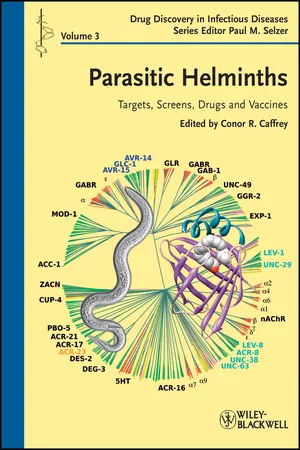
This third volume in the successful 'Drug Discovery in Infectious Diseases' series is the first to deal with drug discovery in helminthic infections in human and animals. The result is a broad overview of different drug target evaluation methods, including specific examples of successful drug development against helminthes, and with a whole section devoted to vaccine development.
With its well-balanced mix of high-profile contributors from academia and industry, this handbook and reference will appeal to a wide audience, including parasitologists, pharmaceutical industry, epidemiologists, and veterinary scientists.
- English
- ePUB (mobile friendly)
- Available on iOS & Android
eBook - ePub
About this book
Information
Part One
Targets
Chapter 1
Ligand-Gated Ion Channels as Targets for Anthelmintic Drugs: Past, Current, and Future Perspectives
Abstract
Ligand-gated ion channels (LGIC) are targets for anthelmintic drugs used in human health and veterinary applications. Given the diverse physiological roles of LGICs in neuromuscular function, the nervous system, and elsewhere, it is not surprising that random chemical screening programs often identify drug candidates targeting this superfamily of transmembrane proteins. Such leads provide the basis for further chemical optimization, resulting in important commercial products. Currently, members of three LGIC families are known to be targeted by anthelmintics. These include the nicotinic acetylcholine receptors gating cation channels, glutamate-gated chloride channels, and γ-aminobutyric acid-gated chloride channels. The recent impact of genomics on model invertebrates and parasitic species has been far-reaching, leading to the description of new helminth LGIC families. Among the current challenges for anthelmintic drug discovery are the assessment of newly discovered LGICs as viable targets (validation) and circumventing resistance when exploring further the well-established targets. Recombinant expression of helminth LGICs is not always straightforward. However, new developments in the understanding of LGIC chaperones and automated screening technologies may hold promise for target validation and chemical library screening on whole organisms or ex vivo preparations. Here, we describe LGIC targets for the current anthelmintics of commercial importance and discuss the potential impact of that knowledge on screening for new compounds. In addition, we discuss some new technologies for anthelmintic drug hunting, aimed at the discovery of novel treatments to control veterinary parasites and some neglected human diseases.
Introduction
Anthelmintic drugs are central to combating many human and veterinary disorders. One in four of the world's population is infected with a parasitic roundworm or nematode, with infestation being particularly severe in tropical and subtropical regions. The consequent debilitating effects on the workforce and the compounding risk of other pathogenic infections represents a considerable social and economic burden. If we add to that a very high level of roundworm infestation among the world's farmed animals, and the devastating impact of trematode parasites in man and animals, then the need for adequate helminth control is transparent [1, 2].
The veterinary economic burden is reflected in the scale of the global animal health drug market (approximately US$11 billion/annum) [3]. The human health antiparasitic drug market is around US$0.5 billion/annum. However, it costs around US$40 million to develop a new drug that controls livestock nematodes, whereas it can cost US$800 million for a new drug for human use. Understandably, the cost barrier has limited progress, but the size of the global markets for antiparasitic drugs and chemicals make their pursuit of commercial interest as well as an important human and animal health priority.
Exciting new developments in research on vaccines targeting helminth parasites are underway and these, undoubtedly, will make important contributions in the future. However, at present, chemical approaches to helminth control predominate. For example, the world's three top-selling veterinary antiparasitic drugs (imidacloprid, fipronil, and ivermectin) and several others such as selamectin, levamisole, pyrantel, morantel, tribendimidine, piperazine, and amino-acetonitrile derivatives (AADs) act on Cys-loop ligand-gated ion channels (LGICs). These transmembrane receptor molecules facilitate the fast actions of neurotransmitter chemicals at nerve–nerve synapses and neuromuscular junctions (NMJs) in invertebrates. Often they offer rapid control of the pathogen. Much of our current knowledge of these important drug targets stems from the genetic model organism and free-living nematode, Caenorhabditis elegans, which possesses the most extensive known superfamily of Cys-loop LGICs, consisting of 102 subunit-encoding genes [4]. They include cation-permeable channels gated by acetylcholine (ACh) and γ-aminobutyric acid (GABA) as well as anion-selective channels gated by ACh, GABA, glutamate, 5-hydroxytryptamine (5-HT), dopamine, and tyramine [5–7]. Less than half of the genes in the C. elegans Cys-loop LGIC superfamily have been functionally characterized.
Unfortunately, many of the anthelmintic drugs in current use are under threat (Table 1.1). Important compounds such as ivermectin, which have given excellent service, are at the end of their patent life. Repeated use of effective chemicals leads to the development of pathogen resistance. Indeed, multidrug resistance against the three major classes of anthelmintics including macrocyclic lactones, which target glutamate-gated chloride channels (GluCls), has become a global problem for the treatment of gastrointestinal nematode parasites of farm animals [8–10]. The increasing development costs and poor return from conventional screening approaches are also problematic. Together, these factors bring a sense of urgency to the development of new, effective anthelmintics.
Table 1.1 Target sites for currently used anthelmintics.
| Chemical group | Compound name | Site of action |
| Avermectins | ivermectin, moxidectin | GluCl channel |
| Imidazothiazole | levamisole, tetramisol | ACh cation channel |
| Tetrahydropyrimidines | pyrantel, morantel | ACh cation channel |
| Tribendimine | tribendimine | ACh cation channel |
| Benzimadazole | albendazole, triclabendazole | β-tubulin |
| Piperazine | piperazine | GABACl channel |
| AADs | monepantel | ACh cation channel |
| Oxindole alkaloids | paraherquamide, derquantel | ACh cation channel |
| Cyclo-octadepsipeptides | emodepside | voltage-gated potassium channel |
| Praziquantel | praziquantel | voltage-gated calcium channela |
| Salicylanilide | niclosamide | ATPase activity (?) |
| Surmamin | germanin | ryanodine receptors |
| Diethylcarbamazine | hetrazan, carbilazine | arachidonic acid |
| a Still under discussion [95]. | ||
The life of a patent has always been finite, but as the time from discovery to market becomes protracted and the bar is raised for new, safer molecules with improved specifications on toxicity and environmental residues, the task of discovery becomes more difficult. The introduction of generic forms of a drug has the potential to lower the cost of treatment and make it available more widely, although this positive benefit may be offset by expediting the onset of resistance. Anthelmintic resistance is affected by the treatment frequency and dose, drug efficiency, the burden of adult worms, and the host immune reaction [6]. Monitoring drug resistance is expensive. The escalating challenges of drug development mean that new anthelmintic compounds have been added to the list of available treatments at the slow rate of just one per decade [11]. Thus, there is an urgent need to develop new, effective anthelmintics.
The Cys-loop LGICs form a receptor superfamily, rich in known targets for anthelmintics. Is there more mileage in these proven targets? Can new drugs be developed that act at a different locus on the same receptor without necessarily leading to cross-resistance? Are there new LGIC targets yet to be discovered and mined? Can the wealth of new data emerging from genomics [12], forward (e.g., chemistry-to-gene screens) and reverse (e.g., RNA interference (RNAi)) genetics, and functional studies on invertebrate model organisms such as C. elegans be harnessed to good effect in expediting anthelmintic drug discovery? Can parasite genome studies (completed or underway) also have a major impact? What can we learn from those parasite genomes already sequenced, following on from pioneering work on the first parasite genome, that of Brugia malayi [13]. Where there is no genome, valuable expressed sequence tag resources are sometimes available as starting points in the search for new LGIC targets. One important advance, which will undoubtedly accelerate anthelmintic drug discovery, is the recently reported crystal structure of the C. elegans GluCl complexed with its orthosteric ligand (glutamate), the allosteric ligand and anthelmintic drug (ivermectin), and a noncompetitive antagonist (picrotoxin) [14]. This is the first eukaryotic LGIC for which a crystal structure is available. Know...
Table of contents
- Cover
- Titles of the Series “Drug Discovery in Infectious Diseases”
- Title Page
- Copyright
- Foreword to Parasitic Helminths: Targets, Screens, Drugs and Vaccines
- Preface
- List of Contributors
- Part I: Targets
- Part II: Screens
- Part III: Drugs
- Part IV: Vaccines
- Index
Trusted by 375,005 students
Access to over 1.5 million titles for a fair monthly price.
Study more efficiently using our study tools.
Frequently asked questions
Yes, you can cancel anytime from the Subscription tab in your account settings on the Perlego website. Your subscription will stay active until the end of your current billing period. Learn how to cancel your subscription
No, books cannot be downloaded as external files, such as PDFs, for use outside of Perlego. However, you can download books within the Perlego app for offline reading on mobile or tablet. Learn how to download books offline
Perlego offers two plans: Essential and Complete
- Essential is ideal for learners and professionals who enjoy exploring a wide range of subjects. Access the Essential Library with 800,000+ trusted titles and best-sellers across business, personal growth, and the humanities. Includes unlimited reading time and Standard Read Aloud voice.
- Complete: Perfect for advanced learners and researchers needing full, unrestricted access. Unlock 1.5M+ books across hundreds of subjects, including academic and specialized titles. The Complete Plan also includes advanced features like Premium Read Aloud and Research Assistant.
We are an online textbook subscription service, where you can get access to an entire online library for less than the price of a single book per month. With over 1.5 million books across 990+ topics, we’ve got you covered! Learn about our mission
Look out for the read-aloud symbol on your next book to see if you can listen to it. The read-aloud tool reads text aloud for you, highlighting the text as it is being read. You can pause it, speed it up and slow it down. Learn more about Read Aloud
Yes! You can use the Perlego app on both iOS and Android devices to read anytime, anywhere — even offline. Perfect for commutes or when you’re on the go.
Please note we cannot support devices running on iOS 13 and Android 7 or earlier. Learn more about using the app
Please note we cannot support devices running on iOS 13 and Android 7 or earlier. Learn more about using the app
Yes, you can access Parasitic Helminths by Conor R. Caffrey, Paul M. Selzer in PDF and/or ePUB format, as well as other popular books in Biological Sciences & Neuroscience. We have over 1.5 million books available in our catalogue for you to explore.