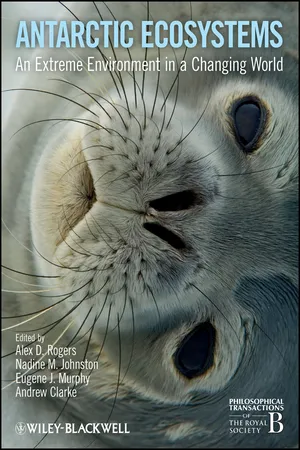
eBook - ePub
Antarctic Ecosystems
An Extreme Environment in a Changing World
- English
- ePUB (mobile friendly)
- Available on iOS & Android
eBook - ePub
Antarctic Ecosystems
An Extreme Environment in a Changing World
About this book
Since its discovery Antarctica has held a deep fascination for biologists. Extreme environmental conditions, seasonality and isolation have lead to some of the most striking examples of natural selection and adaptation on Earth. Paradoxically, some of these adaptations may pose constraints on the ability of the Antarctic biota to respond to climate change. Parts of Antarctica are showing some of the largest changes in temperature and other environmental conditions in the world. In this volume, published in association with the Royal Society, leading polar scientists present a synthesis of the latest research on the biological systems in Antarctica, covering organisms from microbes to vertebrate higher predators. This book comes at a time when new technologies and approaches allow the implications of climate change and other direct human impacts on Antarctica to be viewed at a range of scales; across entire regions, whole ecosystems and down to the level of species and variation within their genomes. Chapters address both Antarctic terrestrial and marine ecosystems, and the scientific and management challenges of the future are explored.
Information
Part 1
Terrestrial and Freshwater Habitats
Chapter 1
Spatial and Temporal Variability in Terrestrial Antarctic Biodiversity
1.1 Introduction
Of all the characteristics of biodiversity, the most noteworthy is its variability. Recognition that the significance of the mechanisms underlying this variation changes as the scale of interest is altered, and that variation at one level may cascade up (or down) to affect many others in the ecological and genealogical hierarchies, are hallmarks of modern ecology (Wiens, 1989). For example, it is clear that both local- and regional-scale processes affect the identity and richness of species at any given site (Ricklefs, 1987. 2004; Hawkins & Porter, 2003; Witman et al., 2004; Kreft & Jetz, 2007) and that local–regional interactions can profoundly affect the properties of assemblages (Gaston, 2000; Blackburn & Gaston, 2001a; Leibold et al., 2004; Rangel & Diniz-Filho, 2005; Thomas et al., 2008), even in circumstances where life history characteristics have little influence over the demographic rates of their constituent species (Hubbell, 2001; He, 2005). Likewise, genetic-level variation in primary producers can cascade up through individuals to affect the functioning of whole ecosystems, including feedback loops to plant performance (Treseder & Vitousek 2001; Whitham et al., 2003). For example, genetic variation among pinyon pines in resistance to a stem-boring moth, whose feeding activity on susceptible pines can lead to cone elimination, has effects on seed-feeding birds and mammals, and also on fungi in the decomposer community (Whitham et al., 2003). In consequence, understanding the determinants of biodiversity requires investigation of processes at a variety of spatial and temporal scales and, as a first step, the identification of the patterns which are the reflection, though sometimes beguiling, of these processes (Gaston & Blackburn, 1999). Doing so is essential, not only because of the insight into the natural world that such understanding brings, but also because it is only in this way that appropriate interventions can be recommended to slow the extraordinary impact humans are having on regional and global diversity (Brooks et al., 2002; Thomas et al., 2004; Gaston, 2005; Chown & Gaston, 2008; Butchart et al., 2010).
In the terrestrial ecosystems of the Antarctic (including the outlying sub-Antarctic islands), these impacts are smaller than they have been elsewhere. Humans first sighted the Antarctic Peninsula in 1820, with the first landing probably in 1821, and the first landing on East Antarctica (at Cape Adare) in 1895. Many of the sub-Antarctic islands have equally short human histories (Headland, 1989; Chown et al., 2005). Early human impacts were restricted mostly to marine systems as a consequence of sealing and whaling (Knox, 1994; Trathan & Reid, 2009). Changes to the terrestrial environment were localized in their extent and nature at this time, although this period did see the introductions of many of the alien vertebrates and other groups now present on these islands (Convey & Lebouvier, 2009), and hence the start of their now considerable impacts on ecosystem structure and function (e.g., Chapuis et al., 1994; Bergstrom et al., 2009).
Now the situation is quite different, and both the direct local and indirect influences of humans are increasing across the region (Tin et al., 2009). For example, invasive alien species have profoundly altered species assemblages and ecosystem functioning on most sub-Antarctic islands, and their direct effects are starting to be felt on the continent itself (Frenot et al., 2005; Convey, 2008; Lee & Chown, 2009), often in ways that are not immediately obvious (Kerry, 1990; Wynn-Williams, 1996; Hughes, 2003). Indirect human influences include the long-range transport to and presence of persistent organic and inorganic pollutants in Antarctic systems (Corsolini et al., 2002; Bargagli, 2005; Dickhut et al., 2005), and substantial alterations to terrestrial communities as a consequence of changing climates associated with global warming (Smith, 1994; Bergstrom & Chown, 1999; Walther et al., 2002; Convey, 2003a. 2006; le Roux & McGeoch, 2008). The significance of these impacts, and their scope for increase, given ongoing global change (Archer & Rahmstorf, 2010) and growing human use of the Antarctic (Naveen et al., 2001; Frenot et al., 2005; Tin et al., 2009), have been recognized by the Committee for Environmental Protection of the Antarctic Treaty System (e.g., Mansfield & Gilbert, 2008), and by those nations that have responsibility for the sub-Antarctic islands (e.g., Anonymous, 1996; McIntosh & Walton, 2000). Both the requirements for conservation of Antarctic systems and the ways in which the likely impacts of increasing human travel to the Antarctic can be mitigated are major issues of political concern (http://www.cep.ats.aq/cep/). However, these issues can only be adequately addressed with a sound understanding of the spatial and temporal variability of Antarctic terrestrial biodiversity, the processes underlying it, and the ways in which humans are currently affecting Antarctic environments and are likely to do so in the future.
Antarctic terrestrial diversity lies at the low end of the global spectrum for many, if not most organisms (Convey, 2001; Clarke, 2003; Chown & Lee, 2009), food webs are typically simple (Block, 1984. 1985. 1994; Burger, 1985; Freckman & Virginia, 1997; Wall & Virginia, 1999), and life histories tend to be dominated by responses to a seasonally variable, ‘stressful’ environment (Smith, 1984; Convey, 1996a; Vernon et al., 1998). Moreover, very little of the largely ice-covered Antarctic continent (0.32% ice free) is available to the terrestrial biota. Even in the areas that can be used, substantial spatial variation in abundance and occupancy exists (Janetschek, 1970; Smith, 1984; Kennedy, 1993). Indeed, it has been clear ever since extensive work on Antarctic terrestrial systems commenced that they are highly variable both through time and space, and this theme continues to permeate recent work (Frati et al., 2001; Sinclair, 2001; Hugo et al., 2004; Lawley et al., 2004; McGeoch et al., 2008). However, how and why this variation changes with spatial and temporal scale across the range of ecosystems and species found in the terrestrial Antarctic has perhaps been less well appreciated. This is partly due to the fact that wide recognition of the significance of scale is relatively recent, and partly because data collection (both in the past and today) has tended to focus on certain areas, species and scales. For example, whilst Antarctic terrestrial biodiversity and the biogeography thereof have been thought to be well known, many ice-free areas have yet to be systematically explored, and investigations of several areas are surprisingly recent (Broady & Weinstein, 1998; Convey et al., 2000a. 2000b; Marshall & Chown, 2002; Stevens & Hogg, 2002; Bargagli et al., 2004; Convey & McInnes, 2005; Peat et al., 2007; Hodgson et al., 2010). Moreover, no comprehensive database of the distributions of Antarctic and sub-Antarctic species yet exists (see Griffiths et al., 2003 for a marine example). Several non-digital compilations have now been published (e.g., Pugh, 1993; Bednarek-Ochyra et al., 2000; Øvstedal & Smith, 2001; Pugh et al., 2002; Pugh & Scott, 2002; Ochyra et al., 2009), and spatially explicit data used by some of these sources and obtained from elsewhere are now becoming available online (http://data.aad.gov.au/aadc/biodiversity/). However, coverage of ice-free areas remains limited and diversity largely reflects survey effort (see Figure 1.1).
Figure 1.1 Spatial representation of the number of (A) records and (B) taxa across 200 km × 200 km grid squares based on the Antarctic terrestrial biodiversity database held by the Scientific Committee on Antarctic Research (SCAR) (see http://data.aad.gov.au/aadc/biodiversity/). Darker shading represents more records or taxa. In (C) the relationship between species richness and record density is shown, revealing the substantial effect of survey effort on taxon richness estimates. The lines are those representing a linear or quadratic fit to the data. Spatially explicit data are for algae, lichens, mosses, nematodes, tardigrades, springtails, and mites, but do not include all species from each of these groups. The analytical work and figures are taken from Terauds et al. (manuscript in preparation). (See the colour version of this figure in Plate section.)

Likewise, quantitative ecological work was, until relatively recently, restricted largely to several maritime and sub-Antarctic islands (see Smith, 1984; Block, 1984; Hänel & Chown, 1999 for access to this literature), although early work had commenced, but has not been systematically continued, elsewhere (Janetschek, 1967). In a similar vein, although more than 27 springtail and 60 mite species have been recorded from the Antarctic continent, comprehensive investigations of the autecology, life histories and environmental responses of these groups have, until recently, been restricted to just a few species, most notably the springtail Cryptopygus antarcticus and the mite, Alaskozetes antarcticus (Block, 1984; Block & Convey, 1995; Convey, 1996a). Autecological studies of other arthropods and entire important taxonomic groups (e.g., nematodes) are largely absent (Hogg et al., 2006).
Over the last several years, however, this useful early work has been integrated into a broader picture of variation across ...
Table of contents
- Cover
- Title Page
- Copyright
- Contributors
- Introduction: Antarctic Ecology in a Changing World
- Part 1: Terrestrial and Freshwater Habitats
- Part 2: Marine Habitats and Regions
- Part 3: Molecular Adaptations and Evolution
- Part 4: Conservation and Management Aspects
- Index
- Plate Section
Trusted by 375,005 students
Access to over 1.5 million titles for a fair monthly price.
Study more efficiently using our study tools.
Frequently asked questions
Yes, you can cancel anytime from the Subscription tab in your account settings on the Perlego website. Your subscription will stay active until the end of your current billing period. Learn how to cancel your subscription
No, books cannot be downloaded as external files, such as PDFs, for use outside of Perlego. However, you can download books within the Perlego app for offline reading on mobile or tablet. Learn how to download books offline
Perlego offers two plans: Essential and Complete
- Essential is ideal for learners and professionals who enjoy exploring a wide range of subjects. Access the Essential Library with 800,000+ trusted titles and best-sellers across business, personal growth, and the humanities. Includes unlimited reading time and Standard Read Aloud voice.
- Complete: Perfect for advanced learners and researchers needing full, unrestricted access. Unlock 1.5M+ books across hundreds of subjects, including academic and specialized titles. The Complete Plan also includes advanced features like Premium Read Aloud and Research Assistant.
We are an online textbook subscription service, where you can get access to an entire online library for less than the price of a single book per month. With over 1.5 million books across 990+ topics, we’ve got you covered! Learn about our mission
Look out for the read-aloud symbol on your next book to see if you can listen to it. The read-aloud tool reads text aloud for you, highlighting the text as it is being read. You can pause it, speed it up and slow it down. Learn more about Read Aloud
Yes! You can use the Perlego app on both iOS and Android devices to read anytime, anywhere — even offline. Perfect for commutes or when you’re on the go.
Please note we cannot support devices running on iOS 13 and Android 7 or earlier. Learn more about using the app
Please note we cannot support devices running on iOS 13 and Android 7 or earlier. Learn more about using the app
Yes, you can access Antarctic Ecosystems by Alex D. Rogers, Nadine M. Johnston, Eugene J. Murphy, Andrew Clarke, Alex D. Rogers,Nadine M. Johnston,Eugene J. Murphy,Andrew Clarke,Andrew Clarke in PDF and/or ePUB format, as well as other popular books in Biological Sciences & Zoology. We have over 1.5 million books available in our catalogue for you to explore.