- Applies modern political theory to ancient Mediterranean history, taking a Realist approach to its analysis of Roman involvement in the Greek Mediterranean
- Focuses on the harsh nature of interactions among states under conditions of anarchy while examining the conduct of both Rome and Greek states during the period, and focuses on what the concepts of modern political science can tell us about ancient international relations
- Includes detailed discussion of the crisis that convulsed the Greek world in the last decade of the third century BC
- Provides a balanced portrait of Roman militarism and imperialism in the Hellenistic world
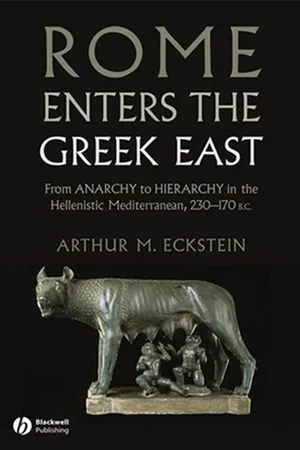
eBook - ePub
Rome Enters the Greek East
From Anarchy to Hierarchy in the Hellenistic Mediterranean, 230-170 BC
- English
- ePUB (mobile friendly)
- Available on iOS & Android
eBook - ePub
Rome Enters the Greek East
From Anarchy to Hierarchy in the Hellenistic Mediterranean, 230-170 BC
About this book
This volume examines the period from Rome's earliest involvement in the eastern Mediterranean to the establishment of Roman geopolitical dominance over all the Greek states from the Adriatic Sea to Syria by the 180s BC.
Information
PART I
ROME IN CONTACT WITH THE GREEK EAST, 230–205 BC
Chapter 1
Roman Expansion and the Pressures of Anarchy
The purpose of this study is a reexamination of the early involvement of the Republic of Rome in the eastern Mediterranean, down to the replacement of the long-prevailing Hellenistic anarchy in the region by a hierarchy of states with Rome at the top. This was established by 188 BC, and brought a minimum of order to the Greek world in the subsequent period down to 171 BC – though not with total stability. The hierarchy was created by victories over Antigonid Macedon and then over the Seleucid Empire won by a coalition of Greek states at whose head stood not a great Greek power, but Rome.
In one sense, this subject is well-trodden ground. The ancient historical writer Polybius of Megalopolis, a near-contemporary of many of these events, showed the way in terms of both the geographical and the chronological scale of our study; and prominent modern scholars have been studying Roman imperial expansion into the Greek Mediterranean for over a century.1 But Roman expansion in the East remains highly contentious territory. There are sharp clashes among modern scholars even over the historicity of certain major events, and always about the motives behind the actions of the states involved. There are especially sharp differences of analysis concerning the causes of Roman imperial expansion in the East (as well as, of course, Roman expansion in general), and the causes of Roman success.2
Following this introductory chapter, the first part of the present study examines the extent of Roman geopolitical interest in the Greek East and the extent of Roman political gains in the region down to the period after the end of the first Roman war against Philip V of Macedon in 205. The second part of the study examines the crisis in the eastern Mediterranean that developed at the end of the third century BC. The intense scholarly debate begins here.
It was Maurice Holleaux who first proposed that Roman interest in the Greek world east of the Adriatic, and the extent of the Republic’s concrete interests there, remained minimal down to 201/200 BC. Holleaux argued, further, that the situation was changed dramatically at that point because of the arrival at Rome of envoys from several Greek states, led by Rhodes and Ptolemaic Egypt, warning of the threat posed by the sharp rise in power of the expansionist monarchs Philip V of Macedon and Antiochus III (the Great) of the Seleucid Empire. It was the Greek envoys’ news of a treaty of alliance between the kings to destroy the Ptolemaic kingdom altogether and gain its resources – an unusual if not unprecedented act in Hellenistic geopolitics – that compelled the Roman Senate to intervene for the first time with great force and large intentions in the East. Theodor Mommsen had already argued that it was the profound shift in the balance of power in the Greek East that led to the Roman intervention there in 200 BC; and Holleaux’s thesis has in fact never been subjected to a detailed and thorough scholarly refutation.3 Nevertheless, it has been steadily eroded over time to the point that many recent studies of this crucial period in Mediterranean history either downplay the importance of the Pact Between the Kings (for instance, Habicht, Badian, Errington, Harris), or fail to mention it altogether.4
Meanwhile, an entire school of scholars led by W. V. Harris has argued that Rome from the beginning was as voraciously imperialist and exceptionally aggressive in its ambitions in the eastern Mediterranean as in the West, and that therefore the only explanation needed for the Roman decision of winter 201/200 BC to intervene in the Greek East was the inherently brutal imperialism and ferocious bellicosity of Roman society.5 To be sure, Erich Gruen has attempted to restore the balance in analysis by emphasizing the powerful independent role which, he argues, the rival policies, expansive ambitions, mutual conflicts, and outright aggressions of the Greek states themselves played in the complex events that led to the rise of Roman power in the East, emphasizing as well the influence which Greek interstate practices had upon Roman approaches to the region.6 But Gruen’s attempt to bring the Greeks back in as a crucial factor in events has often been bypassed in recent scholarship in favor of the point of view promoted by Harris, which centers itself sternly on Roman action, Roman ambition, Roman expansion, Roman aggression – in short, on Roman imperialism.7
These are the main issues we will be tackling in the first two-thirds of the present study – which is a defense of the two fundamental elements in Holleaux’s thesis. This defense is underpinned, however, not only by detailed scholarship in a traditional vein which underlines, as Gruen has done, the Greek impact upon complicated events, but also by the employment of modern international relations theory, which emphasizes the tremendous impact and pressures on the decision-making of all governmental elites caused, in what is essentially an anarchy, by the shifting distribution of power among states within an existing state-system (see below).
Let us look now in more detail at the controversy over early Roman involvement in the Greek East. Sharp disagreement exists, first, over the causes of Rome’s two wars in Illyria, in 229/228 BC and in 219 BC. Sharp disagreement exists, second, over the nature and extent of the control Rome gained over Illyria as a consequence of these wars. Prominent scholars have recently argued that from 229/228 onward Rome had formally sworn treaties of alliance with the Greek polities and indigenous tribes in maritime Illyris, treaties that legally bound them to the Republic; thus the Romans intentionally created a powerful geopolitical stronghold from which further advances into Greece could be launched. Other scholars, however, deny that the results of these wars were nearly so politically and strategically far-reaching.8 Third, major scholars argue that the impact – and perhaps even a goal – of the first Roman war against Philip V of Macedon (214–205 BC) was the establishment of a large network of relationships with Greek states that set the stage for Rome soon thereafter becoming the major force in Greek politics. Yet the contrary has also recently been argued: that Greek ruling elites down to 205 viewed Rome’s first war with Macedon as a war primarily fought among Greek polities in a Greek context, with Rome merely an ally of one side, and that this war left Rome with few political gains in Greece.9
On one reconstruction, Rome advanced purposefully into a powerful position among the Greek states well before the crisis that began to shake the eastern Mediterranean from 207 BC with the faltering and then the collapse of the Ptolemaic Empire. On the other reconstruction, however, the Romans merely acted energetically but sporadically from 230 BC to protect what they saw as their interests in the Greek East, but those interests were minimal, and Roman political aims and gains quite limited. As for the Illyrian polities, from 229 BC down to the outbreak of Rome’s first war with Macedon in 214, and indeed well beyond it, they were linked to Rome solely by informal ties of friendship. Moreover, they were not very important places – and they were isolated by formidable mountains from the rest of the Greek world. Somewhat later, the first war between Rome and Macedon did confirm the Senate in a perception – originating in the invasion of Italy by Pyrrhus the king of Epirus in 280–275 BC – that significant threats to Roman security in Italy could suddenly emerge from the most powerful states of the East; and this probably led to a potential Roman desire to increase control over Greek affairs. But down to 205 BC this potential desire was not actualized; it was countered at Rome by a natural focus on Rome’s terrible struggles in the West for survival, and consequently a lower level of concern about Greek affairs. Similarly, Rome was not yet an important factor in the decision-making of many Greek polities. This is the reconstruction of early Roman involvement in the Greek Mediterranean which will be supported in Chapters 2 and 3 – a view similar to that of Holleaux, but with new evidence and arguments.
This study also places the sudden emergence of deep Roman involvement in the Greek Mediterranean specifically within the framework of the crisis that convulsed the Greek world in the last decade of the third century BC. The origins and nature of this crisis will be our focus in the second part of the study (Chapters 4, 5, and 6). Detailed discussion is necessary because the thesis presented here is again close to that of Holleaux, and highly controversial: namely, that a profound crisis among the great Greek monarchies that began in Egypt ca. 207 and intensified after 204 transformed the geopolitical situation in the East, and was the primary (though not the only) cause for the sudden expansion of Roman influence and power deep into the Greek world between 200 and 188. The faltering of the Ptolemies led first to the treaty of alliance between Antigonid Macedon and the Seleucid Empire to divide up the Ptolemaic realm, then to large-scale warfare in the Greek Mediterranean from the frontiers of Egypt all the way to the Hellespont (203/202–201 BC), then to a revolution in Greek diplomacy towards Rome (201/200 BC) – apparent in the desperate pleas by major Greek states for Roman help – and then to the decision of the Senate to initiate major diplomatic and military involvement in the eastern situation, an involvement that rapidly escalated because of unexpected events.
We approach this crisis by employing types of historical argument that are on the one hand traditional in ancient studies, but which are also set within a new and broad political-science framework. It is a theoretical framework unfamiliar to most modern historians of antiquity, a broad theoretical framework originating in modern international relations studies; and it helps explain the warlike conduct both of Rome and of the Greek states over la longue durée, while also helping to explain their specific conduct during the crisis of the eastern Mediterranean in the last decade of the third century. This theoretical framework is provided by the central school of thought in the modern study of international relations, a school of thought termed “Realism.”
Realism focuses on the harsh and competitive natur...
Table of contents
- Cover
- Half Title page
- Dedication
- Title page
- Copyright page
- Acknowledgments
- Map
- Part I: Rome in Contact with the Greek East, 230–205 BC
- Part II: The Power-Transition Crisis in the Greek Mediterranean, 207–200 BC
- Part III: From Hegemonic war to Hierarchy, 200–170 BC
- Bibliography
- Index
Trusted by 375,005 students
Access to over 1.5 million titles for a fair monthly price.
Study more efficiently using our study tools.
Frequently asked questions
Yes, you can cancel anytime from the Subscription tab in your account settings on the Perlego website. Your subscription will stay active until the end of your current billing period. Learn how to cancel your subscription
No, books cannot be downloaded as external files, such as PDFs, for use outside of Perlego. However, you can download books within the Perlego app for offline reading on mobile or tablet. Learn how to download books offline
Perlego offers two plans: Essential and Complete
- Essential is ideal for learners and professionals who enjoy exploring a wide range of subjects. Access the Essential Library with 800,000+ trusted titles and best-sellers across business, personal growth, and the humanities. Includes unlimited reading time and Standard Read Aloud voice.
- Complete: Perfect for advanced learners and researchers needing full, unrestricted access. Unlock 1.5M+ books across hundreds of subjects, including academic and specialized titles. The Complete Plan also includes advanced features like Premium Read Aloud and Research Assistant.
We are an online textbook subscription service, where you can get access to an entire online library for less than the price of a single book per month. With over 1.5 million books across 990+ topics, we’ve got you covered! Learn about our mission
Look out for the read-aloud symbol on your next book to see if you can listen to it. The read-aloud tool reads text aloud for you, highlighting the text as it is being read. You can pause it, speed it up and slow it down. Learn more about Read Aloud
Yes! You can use the Perlego app on both iOS and Android devices to read anytime, anywhere — even offline. Perfect for commutes or when you’re on the go.
Please note we cannot support devices running on iOS 13 and Android 7 or earlier. Learn more about using the app
Please note we cannot support devices running on iOS 13 and Android 7 or earlier. Learn more about using the app
Yes, you can access Rome Enters the Greek East by Arthur M. Eckstein in PDF and/or ePUB format, as well as other popular books in History & Roman Ancient History. We have over 1.5 million books available in our catalogue for you to explore.