eBook - ePub
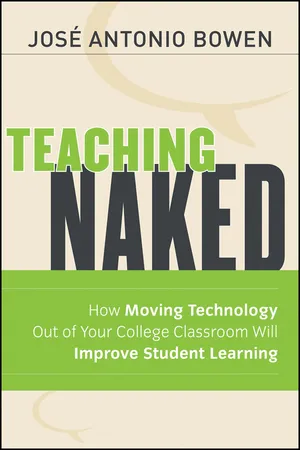
Teaching Naked
How Moving Technology Out of Your College Classroom Will Improve Student Learning
- English
- ePUB (mobile friendly)
- Available on iOS & Android
eBook - ePub
Teaching Naked
How Moving Technology Out of Your College Classroom Will Improve Student Learning
About this book
You've heard about "flipping your classroom"—now find out how to do it! Introducing a new way to think about higher education, learning, and technology that prioritizes the benefits of the human dimension. José Bowen recognizes that technology is profoundly changing education and that if students are going to continue to pay enormous sums for campus classes, colleges will need to provide more than what can be found online and maximize "naked" face-to-face contact with faculty. Here, he illustrates how technology is most powerfully used outside the classroom, and, when used effectively, how it can ensure that students arrive to class more prepared for meaningful interaction with faculty. Bowen offers practical advice for faculty and administrators on how to engage students with new technology while restructuring classes into more active learning environments.
Information
Part I
The New Digital Landscape
Chapter 1
The Flat Classroom and Global Competition
The new classroom is a flat screen. The leading edge of a transformation in learning through technology can be seen in corporate learning, military training, distance learning, K–12 education, and a plethora of medical, legal, governmental, and other certifications. In 2009, 29.3% of college students were taking at least one online course, up from 21.6% in fall 2007 (Allen & Seaman, 2010). New technology offers new learning environments, expanded potential for environmental and social good, and economies of scale. E-learning is the experience and expectation of our entering students, and it will continue to compete with traditional universities for eyeballs as well as dollars.
At the same time, higher education remains one of the few industries where the price, even though increasingly out of range for many consumers, fails to cover the true cost of delivering the product. A new for-profit sector has removed much of the “overhead” of traditional universities, and is delivering learning more cheaply. In higher education, the pricing gap between cheap and expensive products is colossal, yet there is little evidence that the price difference even remotely reflects the quality of learning. While a handful of elite universities will remain able to charge elite prices because of their brand equity, history, alumni networks, high demand, and limited supply, the vast majority of American universities are about to face a perfect storm of new global technological competition that will put even more pressure and scrutiny on tuition prices. In a reversal of recent trends, a likely outcome is a reduction in both what it costs to deliver a quality education and what people are willing to pay.
The Ubiquity of E-learning
Outside of the academy, online learning is well established. Corporations and professional organizations have been using video conferencing and e-learning for years in even the most sensitive areas. From Nestle to NASA, corporations and governments use online learning modules, live Web-based classes, and self-paced courses to train employees in equipment operation, sales techniques, emergency procedures, and performance reviews.
Complicated and important things are being taught online. The American Association for Thoracic Surgery has a large and up-to-date E-Learning Center (www.ctsnet.org) with articles and videos on a variety of procedures. Watching a video (available on mobile devices) seems a much better way to learn a new surgical skill than from drawings in a journal. The European Organization for the Safety of Air Navigation (www.eurocontrol.int) offers its Common Core Content for the Institute of Air Traffic Control as online modules. Over 2,000 online aviation schools will teach you to fly, maintain, or dispatch any size airplane or helicopter (www.aviationschoolsonline.com). Google assembled its tutorials, videos, and courses on Web programming into one place but then decided to make this “Google Code University” free, open-source, and available to the world (www.code.google.com/edu). There are courses on programming languages, Web security, and how to make phone apps. These courses are offered by universities, individuals, and companies around the world, but if you do not see what you need you can invent a new course and share it.
Even ethics is being taught online. Most research institutions have a commitment to the ethical treatment of human subjects and require ethics training for principal investigators even for unfunded projects. Government agencies mandate training in human subjects protection before funding can be awarded. Most institutions use the online course developed by the Collaborative Institutional Training Initiative (CITI), which began its Web-based training program in human subjects protection in 2000. By 2010, over 1.3 million researchers at 1,130 institutions and facilities had completed a CITI course. In 2004, Georgetown University created an online tutorial in scholarly research and academic integrity for all incoming freshmen to take before they started classes at Georgetown (https://library.georgetown.edu/tutorials/academic-integrity). It uses complex real scenarios to teach students the importance of academic honesty, the nature of scholarship, and how research fits into university life.
Developing online learning for corporations is big business. Many large companies have internal learning and development (L&D) departments. The global market for self-paced e-learning in 2009 was $27.1 billion and is predicted to grow by 12.8% a year (Ambient, 2009a). Not surprisingly, the technology industry has led the way; your computer support people take online courses before they install your new software, and Apple and Microsoft offer significant online resources and courses. Is your company ready for International Financial Reporting Standards (IFRS)? Deloitte has e-learning modules that feature “real life scenarios to demonstrate application of the standards, ‘coach me’ sections to explain the principles and theory, worked examples to show aspects of the standards in action, reference materials, and a printable certificate if you pass the assessment at the end of each module” (www.deloitteifrslearning.com). Deloitte’s learning modules have been downloaded over one million times by major corporations and thousands of users in over in 130 countries.
As is the case with classroom instruction, the quality of online courses is uneven, but at its best interactive technology provides not only content, but also practice and individualized feedback that can be difficult to administer in a typical classroom environment. One small e-learning company (www.IsoDynamic.com) specializes in online courses on complex subjects that require just this sort of navigated feedback. A six-hour course for the Maryland Library Partnership, for example, teaches customer service to librarians using role-playing scenarios that allow users to try new skills in a low-risk environment. Courses in the mental health area include tutorials on administering rating scales for autism and depression in which users practice their skills by observing subjects on video, responding to questions, making assessments, and receiving immediate feedback.
Foreign language learning is also well established on flat screens as a $1.3 billion industry in 2009 (IbisWorld, 2009). One of the largest areas in e-learning is English language learning, predicted to become a $1.69 billion industry by 2014 (Ambient, 2009b). Teaching Mandarin to Westerners using face-to-face instruction on Skype is such a major industry in China that the seventh (!) International Conference on Internet Chinese Education occurred in 2011. It will be no surprise to anyone who has called for technical help in the last few years that American accent training is another growing industry: voice recognition software has been used to teach correct pronunciation since 2005.
The U.S. government is also a heavy user of flat-screen classrooms. The National Institutes of Health (NIH) requires that all principal investigators pass an online clinical research training course (www.cc.nih.gov/training/training/crt.html). The U.S. Food and Drug Administration (FDA) offers online courses through its Center for Drug Evaluation and Research (CDER). CDERLearn (http://www.fda.gov/Training/ForHealthProfessionals/default.htm) offers online training as “one way to share FDA expertise with many more people than face-to-face classroom sessions would allow.” Researchers can learn how to bring an unapproved drug into compliance, whereas physicians can learn how to communicate risk to their patients. Many state and federal agencies, like the federal General Services Administration, outsource their training, compliance, and professional development to Web-based e-learning companies.
The U.S. Army continues to use simulators with huge screens, realistic cockpits, and hydraulics, but it also now employs a wide variety of simulations that run on regular computers (including the free America’s Army, www.americasarmy.com, which doubles as a recruitment vehicle) and mans its own gaming unit. The Department of Defense (DOD) has subsidized college tuition for active-duty service members since 1947; with over 400,000 men and women in the U.S. Army, Navy, Marines, Air Force, and Coast Guard the DOD spent $474 million on college tuition in 2008 (Golden, 2010). While traditional colleges still serve the majority of these students, many of these potential students are in remote areas, and online education and for-profit universities have been particularly aggressive in recruiting their business. Many service members already complete fully online degrees, but many others will be looking to transfer these credits toward degrees at four-year schools.
Learning management systems (LMS, formerly known as course management systems or CMS) software is now standard even in elementary schools. Parents expect daily updates on grades, but, more importantly, students expect to find assignments, tutorials, and help online. Today’s students have been learning on-screen for years before they start school, and the homework tutor is more likely to be a flat screen than a parent. In addition to the millions of videos and podcasts from YouTube and iTunesU, there is also University of Illinois professor Bill Hammack, the engineering guy (www.engineerguy.com). From public broadcasting (www.PBS.org/teachers) to museums (www.moma/org/modernteachers), institutions of all sorts are creating, and often giving away, educational content and resources (see www.TeachingNaked.org for a growing list).
The most popular homework tutor, and in fact the most popular educator online (Young, 2010), is Salman Khan, a young Harvard MBA with degrees in computer science from MIT whose online Khan Academy has 70,000 students a month from all over the globe watching 35,000 videos a day (www.KhanAcademy.org). Khan began with a complete math curriculum (organized into what he calls “playlists”) from basic addition through calculus, linear algebra, and differential equations. With over 3,100 videos (now including his newer ventures into biology, chemistry, physics, finance, and even history), mostly in high-definition, Khan aspires to provide a free education to anyone in the world in 10-minute chunks.
With over two million lessons delivered per month and grants from the Google Foundation ($2M) and Bill Gates ($1.5M), the Khan Academy is a growing revolution. In addition to its huge body of content videos, Khan has introduced a (free) software package including a detailed knowledge map that can track progress and guide students to new problems tailored to their level. Students have to get 10 correct answers in a row to move on, and they collect badges for various levels of effort or accomplishment. For students, it is like a giant video game. Parents and teachers can get detailed and live information on students’ performance, including every problem done, time on task, what videos they have watched, and where they might be stuck. Teachers can also see the progress and proficiency of an entire class on color-coded maps, with green for mastery, yellow for working on it, and red for students who might need teacher intervention. In trials, teachers have already begun to invert their teaching model. Rather than suggesting Khan lectures as a supplement, teachers are using Khan as the primary content, delivered online when students are at home so that they can do “homework” in the form of practice exercises during class time (Thompson, 2011).
For established schools, these resources are a wonderful new supplement, but for the estimated one to two million homeschoolers, online resources are a revolution. One million high school students were enrolled in online courses in 2007, and that number is growing even more rapidly than enrollment in college online courses (Van Der Werf & Sabatier, 2009). One study at Harvard predicts that half of all high school courses will be delivered online by 2019 (Christensen & Horn, 2008). That revolution will transform existing high schools and make the option of home schooling much easier and more attractive. Then those students will want to get college degrees.
The point here is not that online learning is better but just that it is here. Outside of traditional higher education, online resources have been transformative: you can already become a pilot, pharmacist, veterinarian, lawyer, or a rabbi online. With other industries believing that learning can take place on a flat screen, online learning challenges higher education’s traditional course delivery model and its ability to increase tuition. The breadth of technologies, the capabilities of recent software, and the amount of free content will surprise most faculty. Most university professors and administrators are keen on additional resources for students, especially free ones. As long as these technologies expand what we already do (and since most do not threaten traditional colleges), we can probably be convinced to use online resources as a supplement. This tepid embrace, however, will change. With the high price of traditional models, new technology that puts interactive information, video, or gaming at the user’s fingertips is already competing for some of higher education’s traditional students. A large global market wants cheap, high-quality, online education, and American students increasingly want more flexibility and convenient schedules. Someone will meet that demand. American not-for-profit higher education needs to adjust to meet this new competition.
The Inevitability of Competition
The global market for online education is being most aggressively pursued by for-profit universities and e-learning companies. While American higher education has recognized that online video content, LMS, e-mail, and educational gaming are transforming students and classrooms, we have been slow to recognize these same forces as a source of competition. American universities are eerily like General Motors in the 1970s. We are far enough ahead of the rest of the world, in both brand recognition and quality, that it will take time for the competition to make a serious impact. But like Detroit in the 1970s, our very success makes it harder for us to see how radical are the coming challenges, and few universities are yet taking seriously the threat of new products and changing consumers.
The advantages of a new technology are often hardest to see if you are surrounded by a previous technology that works. Americans, with our tremendously successful landline infrastructure, were slow to adopt cell phones, even though we had the money to invest in new technology. The benefits of cell phones were more quickly realized in poor regions of the world with no landline infrastructure. The importance of a cell phone (even a phone with poor reception and no Web or video) is most obvious to a person who has never had any phone. Likewise, the revolutionary importance of Wikipedia is much more apparent to the isolated individual in the third world than to university scholars surrounded by lecture halls and libraries. No one at Yale needs a virtual physics lecture, but for the majority of the world, Open Yale Courses (www.oyc.yale.edu) provides the first access to this experience. The Internet, like the book before it, is making a wealth of knowledge available to the people who could previously not afford the privilege of any higher education.
The Internet also enables increased competition between professional and amateur and between accredited, licensed, and unlicensed. There is still a wide quality gap between the best professional work and the worst amateur work, but before the Internet there was no way for even the best amateur, unaccredited, or unli...
Table of contents
- Cover
- Contents
- Title
- Copyright
- Dedication
- Preface
- About the Author
- Part I: The New Digital Landscape
- Part II: Designing 21st-Century Courses
- Part III: Strategies for Universities of the Future
- Bibliography
- Index
Trusted by 375,005 students
Access to over 1.5 million titles for a fair monthly price.
Study more efficiently using our study tools.
Frequently asked questions
Yes, you can cancel anytime from the Subscription tab in your account settings on the Perlego website. Your subscription will stay active until the end of your current billing period. Learn how to cancel your subscription
No, books cannot be downloaded as external files, such as PDFs, for use outside of Perlego. However, you can download books within the Perlego app for offline reading on mobile or tablet. Learn how to download books offline
Perlego offers two plans: Essential and Complete
- Essential is ideal for learners and professionals who enjoy exploring a wide range of subjects. Access the Essential Library with 800,000+ trusted titles and best-sellers across business, personal growth, and the humanities. Includes unlimited reading time and Standard Read Aloud voice.
- Complete: Perfect for advanced learners and researchers needing full, unrestricted access. Unlock 1.5M+ books across hundreds of subjects, including academic and specialized titles. The Complete Plan also includes advanced features like Premium Read Aloud and Research Assistant.
We are an online textbook subscription service, where you can get access to an entire online library for less than the price of a single book per month. With over 1.5 million books across 990+ topics, we’ve got you covered! Learn about our mission
Look out for the read-aloud symbol on your next book to see if you can listen to it. The read-aloud tool reads text aloud for you, highlighting the text as it is being read. You can pause it, speed it up and slow it down. Learn more about Read Aloud
Yes! You can use the Perlego app on both iOS and Android devices to read anytime, anywhere — even offline. Perfect for commutes or when you’re on the go.
Please note we cannot support devices running on iOS 13 and Android 7 or earlier. Learn more about using the app
Please note we cannot support devices running on iOS 13 and Android 7 or earlier. Learn more about using the app
Yes, you can access Teaching Naked by José Antonio Bowen in PDF and/or ePUB format, as well as other popular books in Education & Adult Education. We have over 1.5 million books available in our catalogue for you to explore.