- Explains the most important elements of poetry in clear language and an easily accessible manner
- Offers readers both the expertise of an established scholar and the insights of a practicing poet
- Draws on examples from more than 1,500 years of English literature
- English
- ePUB (mobile friendly)
- Available on iOS & Android
eBook - ePub
About this book
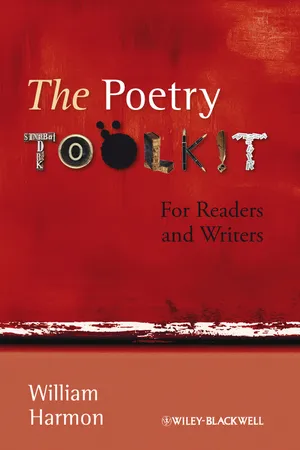
The Poetry Toolkit: For Readers and Writers provides students with the essential intellectual and practical tools necessary to read, understand, and write poetry.
Information
Chapter 1
The Arts of Story-Telling
Most poems belong in one of three categories: NARRATIVE, DRAMATIC, LYRIC. Narrative poems, like many prose narratives, give an account of an action or incident. Insofar as they tell stories, poems and prose texts do not much differ. Since everybody enjoys hearing stories and almost everybody tells stories sooner or later, there is not much mystery about the arts of story-telling.
There is, however, a good deal of controversy about the technical terminology of story-telling, and a number of vexatious words have emerged since 1970. “Narratology,” which first appeared in English in 1971, has caused some complaints because, among other offenses, it mixes Latin and Greek elements. But the same complaints were once prompted by “television,” “homosexual,” and even “bicycle” (some wanted “dicycle”!), but those words have long since joined the mainstream. Even so, narratology has remained an awkwardly technical-seeming term without very much technical material to justify it. Likewise, “prosaics” has been suggested as a complement to “poetics,” on a rather shallow analogy: if poetry has poetics, prose ought to have “prosaics.” And one can see titles like “The Prosaics of Ancient Romances.” But prosaic has a well-established primary meaning of “mundane,” “routine,” “commonplace,” “dull,” and it seems unlikely that “prosaics” will ever gain much ground as a critical term for anything but mild condemnation. Turbulence in terminology may suggest chaos or confusion, but it may just as well suggest a productive ferment.
It is worth mentioning here that, as one progresses through the six main elements of a literary work – PLOT, CHARACTER, MENTAL STATE, DICTION, SOUND EFFECTS, GRAPHIC EFFECTS – one goes from almost unlimited regions of ill-defined concepts that merge helter-skelter into one another. Then, with diction, one reaches matters somewhat more definite, or at least less indefinite. If there are, say, a thousand considerations in the interdependent realms of plot, character, and inner state, the considerations of diction may number only in the hundreds, and those of sound and graphic effects only in the scores. With the later elements, one can suggest a certain amount of systematic analysis that just will not work with the earlier. It is a fact that an English syllable will contain no more than eight individual sounds (seven consonants and one vowel); it is not a fact that all plots can be reduced to eight basic patterns. Accordingly, these early chapters will seem more confused and less systematic than the later ones, but that is just the way things are.
Narrative poetry is much like narrative prose, in that it relates an orderly set of events involving characters in certain states of mind performing actions. If there is a coherent account with a beginning, middle, and end, it can be called a STORY with an ACTION. If the story is EPISODIC and therefore somewhat less coherent, then it is a story with activity but not necessarily an overall action.
The word “plot” is used for any plan, outline, or scheme. There are criminal plots and assassination plots and garden plots and graveyard plots. The overall story is a plot of action; there are also plots of character, thought, feeling, diction, sound, and layout. (In the theater, there are a lighting plot, a property plot, a makeup plot, and a costume plot, detailing what the technical crew needs to do at certain points in a show, demonstrating nightfall or daybreak, aging, growing, shrinking, promotion, demotion, and so forth. A member of a technical crew may be indifferent or oblivious to a play as such, concentrating only on a change of lighting, scenery, properties, sound effects, or costumes coming midway in the second act.)
In a sense, every sentence is a little story, with some kind of character as the SUBJECT and some kind of action as the PREDICATE. We may agree that a good story ought to be intelligible, interesting, and neither too long nor too short. We do not insist that a story be new or even novel, since many people – and not just children – enjoy hearing the same story over and over. Even so, one may not quite accept the argument of Robert Graves's “To Juan at the Winter Solstice”: “There is one story and one story only/That will prove worth your telling.” That may seem reductive and simplistic. (Note, however, that that sentiment does not have to be a universal generalization; it is part of a poem, after all, and may register the state of mind of a certain undefined character in certain undefined circumstances, possibly explained by the identity of “Juan” and the importance of the winter solstice; explanations can be found on the Internet.)
Over the years, thinkers have come up with some set number of basic plots – such as courtship, homecoming, discovery, comeuppance, or revenge – but there is no foolproof repository of formulas. We tell the stories that engage and amuse us.
A basic story begins “Once upon a time.” It is in the past tense (“there was a child”) and the third person (“child” – or the pronouns “he,” “she,” “it,” “they”). Most narratives employ an identifiable point of view that governs how the story is managed. Point of view is a matter of pronoun person, verb tense, and other properties; typical points of view include past-tense third-person omniscient, past-tense third-person limited, past-tense first-person limited. (For good reasons, first-person omniscient is unlikely.)
The past-tense points of view can also be translated into present-tense points of view, and in many cases past and present are mixed. Second-person narration, again for understandable reasons, is unusual, although it is sometimes encountered, particularly in fiction since 1950.
English offers some idiomatic uses of “you” to mean people in general, but its presence gives a text an opportunity to seem to address the reader. In T. S. Eliot's The Waste Land, at or near the end of sections one, four, and five, this indefinite or unexplained pronoun seems to include a reader: “You! hypocrite lecteur! – mon semblable, – mon frère! . . . Consider Phlebas, who was once handsome and tall as you. . . . Why then Ile fit you.” The first sentence of Ernest Hemingway's To Have and Have Not seems to ask “you” a question: “You know how it is there early in the morning in Havana with the bums still asleep against the walls of the buildings; before even the ice wagons come by with ice for the bars?” The first and last sentences of J. D. Salinger's The Catcher in the Rye both include such a second-person pronoun, along with an imperative form that implies “you” without stating it: “If you really want to hear about it, the first thing you'll probably want to know is wh...
Table of contents
- Cover
- Series Page
- Title Page
- Copyright
- Preface
- Key to Symbols
- Chapter 1: The Arts of Story-Telling
- Chapter 2: The Arts of Character
- Chapter 3: The Arts of Sentiment: States of Mind and Feeling
- Chapter 4: The Arts of Diction
- Chapter 5: The Arts of Sound
- Chapter 6: The Arts of Layout
- Chapter 7: The Arts of Reaction
- Glossary
- Suggestions for Reading: A Biased Bibliography
- Acknowledgments
- Index
Trusted by 375,005 students
Access to over 1.5 million titles for a fair monthly price.
Study more efficiently using our study tools.
Frequently asked questions
Yes, you can cancel anytime from the Subscription tab in your account settings on the Perlego website. Your subscription will stay active until the end of your current billing period. Learn how to cancel your subscription
No, books cannot be downloaded as external files, such as PDFs, for use outside of Perlego. However, you can download books within the Perlego app for offline reading on mobile or tablet. Learn how to download books offline
Perlego offers two plans: Essential and Complete
- Essential is ideal for learners and professionals who enjoy exploring a wide range of subjects. Access the Essential Library with 800,000+ trusted titles and best-sellers across business, personal growth, and the humanities. Includes unlimited reading time and Standard Read Aloud voice.
- Complete: Perfect for advanced learners and researchers needing full, unrestricted access. Unlock 1.5M+ books across hundreds of subjects, including academic and specialized titles. The Complete Plan also includes advanced features like Premium Read Aloud and Research Assistant.
We are an online textbook subscription service, where you can get access to an entire online library for less than the price of a single book per month. With over 1.5 million books across 990+ topics, we’ve got you covered! Learn about our mission
Look out for the read-aloud symbol on your next book to see if you can listen to it. The read-aloud tool reads text aloud for you, highlighting the text as it is being read. You can pause it, speed it up and slow it down. Learn more about Read Aloud
Yes! You can use the Perlego app on both iOS and Android devices to read anytime, anywhere — even offline. Perfect for commutes or when you’re on the go.
Please note we cannot support devices running on iOS 13 and Android 7 or earlier. Learn more about using the app
Please note we cannot support devices running on iOS 13 and Android 7 or earlier. Learn more about using the app
Yes, you can access The Poetry Toolkit by William Harmon in PDF and/or ePUB format, as well as other popular books in Literature & Literary Criticism in Poetry. We have over 1.5 million books available in our catalogue for you to explore.