- The first book to focus on the issue of enhancing CBT with pharmacological agents
- Features chapters from leading authors in the fields of psychiatry, pharmacology, clinical psychology, neuroscience, and emotion research
- Contributes significantly to the field by summarizing the contemporary research in combination treatments in anxiety disorders
- A valuable resource for clinicians in training, as well as experienced clinicians seeking to help patients with anxiety disorders
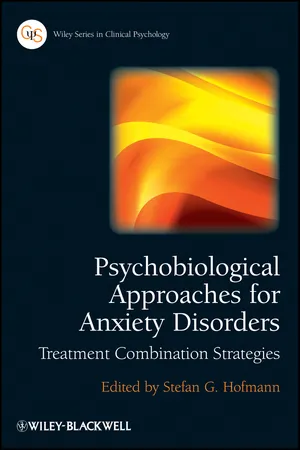
eBook - ePub
Psychobiological Approaches for Anxiety Disorders
Treatment Combination Strategies
- English
- ePUB (mobile friendly)
- Available on iOS & Android
eBook - ePub
About this book
Psychobiological Approaches for Anxiety Disorders presents a comprehensive overview of the latest empirical evidence and research results on combining pharmacological agents and CBT techniques for the treatment of anxiety disorders.
Information
Chapter 1
The Biology and Efficacy of Combination Strategies for Anxiety Disorders
Introduction
Optimal treatment of anxiety disorders is important as they are the most prevalent psychiatric disorders in community studies, and generalized anxiety disorder is the most prevalent psychiatric disorder in primary care (Kessler et al. 2010). In addition, anxiety disorders begin early in life, and predispose to the development of comorbid disorders such as depression and substance use disorders; early and robust treatment may therefore be important in secondary prevention (Goodwin and Gorman 2002). Anxiety disorders are not only associated with significant suffering in affected individuals and families, but also contribute enormously to the societal burden of disease; a number are among the most disabling of all medical conditions (Lopez et al. 2006).
Fortunately, there have been significant advances in the treatment of anxiety disorders. A range of medications have been approved in the past few decades for the major anxiety disorders on the basis of randomized controlled trials showing efficacy and safety. Similarly, during the same period, a number of psychotherapies have been rigorously studied, and shown to have both short-term and longer-term efficacy. Expert guidelines, often incorporating systematic meta-analyses of the research literature, have been developed, and highlight the evidence base for first-line interventions, such as selective serotonin uptake inhibitors (SSRIs) and cognitive behavioral therapy (CBT) (Ipser and Stein 2009). The majority of patients with anxiety disorders can be expected to respond to such first-line interventions.
At the same time, underdiagnosis and undertreatment of, and resistance to treatment in, anxiety disorders remain significant problems. Underdiagnosis and undertreatment may reflect a range of structural and attitudinal barriers, including insufficient numbers of well-trained therapists and insufficient mental health literacy in both the general population and primary care practitioners. First-line treatments may work in the majority of cases, but even when appropriately diagnosed and treated, 40% or more of patients may fail to respond (Pallanti et al. 2002; Bandelow and Ruther 2004). There is a relative lack of effectiveness trials in anxiety disorders, but in real-world settings, where patients may have increased comorbidity, and where clinicians are required to be generalists rather than specialists, treatment response rates may be lower, and tolerability concerns more obvious, particularly over the longer term.
Combination treatment is an important consideration in attempts to improve the efficacy and effectiveness of intervention in anxiety disorders. Given the multiple factors, including neurobiological and psychological variables, involved in anxiety disorder pathogenesis, there is a prima facie case for a comprehensive treatment approach including pharmacotherapy and psychotherapy. Indeed, early thinking suggested pharmacotherapy was useful for a rapid treatment response, while psychotherapy was valuable for a maintained response, even after discontinuation of short-term intervention (Riba and Ballon 2005). It has therefore been surprising to see a growing evidence base suggesting relatively little advantage in combining pharmacotherapy and psychotherapy for anxiety disorders (Foa et al. 2002; Otto et al. 2005; Black 2006; Bandelow et al. 2007; Hofmann et al. 2009).
Perhaps one of the most exciting developments in combination treatment of anxiety disorders, if not in all of medicine, has been the adoption of a rigorous translational neuroscience approach (Davis et al. 2006; Otto et al. 2007; Hofmann et al. 2011; Kaplan and Moore 2011). Advances in a range of basic neuroscience areas, including animal models of anxiety disorders, have allowed combination interventions to be studied in the laboratory. Rather than relying on standard first-line pharmacotherapies, such work has focused on targets (e.g. in glutamatergic systems) that may be specifically relevant to enhancing cognitive-behavioral interventions. Such work provides a rigorous foundation for moving findings through to the bedside, in the form of proof-of-principle clinical studies. This approach appears to have significant potential and has therefore attracted considerable interest from researchers, making this book extremely timely.
This chapter will briefly focus on a number of background issues relevant to combination treatment in anxiety disorders. First, we will review some of the psychobiology relevant to an understanding of how combined treatments work. Second, we will review some of the findings addressing, and issues concerning, the efficacy of such combined treatments.
Psychobiology of Combination Treatments
There is a growing understanding of the neurocircuitry underlying the fear response in animals and anxiety disorders in humans. Advances in structural and functional neuro-imaging have been key in developing our understanding of such circuitry in clinical conditions (Shin and Liberzon 2010). Thus, a growing body of evidence suggests that anxiety disorders are characterized by abnormalities in both prefrontal and subcortical (e.g. amygdala, hippocampus) circuitry (Grillon 2002; Anderson and Insel 2006). Neurotransmitters involved in such pathways include serotonergic, noradrenergic, glutamatergic, gamma-aminobutyric acid (GABA)ergic, and neuropeptide systems, and many available pharmacotherapies act on such systems (Charney 2003).
One approach to understanding the psychobiology of combined pharmacotherapy and psychotherapy is to argue that pharmacotherapy acts predominantly on bottom-up neurotransmitter-mediated mechanisms, while psychotherapy acts mainly on top-down cognitive-affective processes. Medications, such as SSRIs, may act on the amygdala and its efferent pathways (e.g. to hypothalamus and brainstem) to reduce panic attacks, which in turn leads to reduced anticipatory anxiety and phobic avoidance (Gorman et al. 2000). However, interventions such as CBT, may act upstream of the amgydala, strengthening the ability of medial prefrontal areas to inhibit sub-cortically mediated processes, by decreasing cognitive misattributions and deconditioning the fear response (Mayberg 2002).
While such an approach may be heuristically useful, it may entail some over-simplification. First, neurocircuitry alterations following psychotherapy are not limited to prefrontal areas; instead they may be widespread (Roffman et al. 2005; Frewen et al. 2008). Conversely, the effects of pharmacotherapy are unlikely to be limited to sub-cortical neurotransmitter activity; rather they may lead to significant changes in high-level cognitive and affective processing. Furthermore, such an approach does not explain why certain combinations of pharmacotherapy and psychotherapy appear ineffective or even contra-indicated (Otto et al. 2005). Indeed, both pharmacotherapy and psychotherapy are interventions that have complex and interactive effects on the brain-mind.
Another question that requires a more complex approach is whether combination strategies are likely to be similar across different anxiety disorders, or whether specific combined treatment approaches will be needed for each disorder. On the one hand, imaging studies suggest that there are a number of overlapping mechanisms that cut across different anxiety disorders. A recent meta-analysis of brain imaging studies in anxiety disorders, for example, found an increase in the activity of the amygdala and insula in participants with post-traumatic stress disorder (PTSD), social anxiety disorder, and with specific phobia, relative to healthy control subjects (Etkin and Wager 2007). Thus, it may be predicted that SSRIs act to decrease insula activity, while CBT acts to decrease amygdala activity, in a number of these conditions (Furmark et al. 2002; Carey et al. 2004). On the other hand, there is also involvement of distinctive neurocircuitry in different anxiety disorders (Etkin and Wager 2007). Furthermore, within a particular disorder, different neuronal circuitry may be involved in different symptom presentations (Lueken et al. 2011). Thus, it is possible that different forms of combined treatment may be effective, not only for different anxiety disorders, but also for different subtypes of particular anxiety disorders.
Imaging studies in humans will no doubt continue to be important in answering such questions. For example, particular neurocircuitry findings predict response to pharmacotherapy, while others predict response to psychotherapy, or to combined treatment (Brody et al. 1998; Furmark et al. 2002; 2005). Data from studies that address the impact of particular gene variants on neuro-imaging findings are also likely to be important in developing more integrative models. Also, in order to develop more complex models of combined treatments, it would be helpful to have good laboratory models of anxiety disorders and interventions. Fortunately, there is a range of ongoing work in this area. We briefly review some of the relevant work targeting neurotransmitter systems (e.g. glutamatergic, noradrenergic, and adenosine systems), neuroendocrine systems (e.g. glucorticorticoids), and social neuropeptides (e.g. oxytocin (OT)).
Neurotransmitter Systems
Laboratory research has suggested the glutamatergic system as a target for combined pharmacotherapy and psychotherapy; this research demonstrated that the N-methyl-D-aspartate (NMDA)-glutamate receptor of the lateral and basolateral amygdaloid nuclei was involved in fear conditioning and fear extinction in rodents (Davis et al. 1993). Given that antagonists of the NMDA receptor prevented both the acquisition and extinction of fear (Lee and Kim 1998), the question arose of whether an NMDA agonist would facilitate the extinction of conditioned fear (Walker et al. 2002). Indeed, rats that received the partial NMDA agonist D-cycloserine (DCS), in combination with repeated exposure to the conditioned stimulus, had enhanced extinction of their fear as compared to the rats that received DCS alone (Walker et al. 2002). The work provided a solid foundation for clinical trials of combined DCS and CBT; the first of these seminal proof-of-principle clinical studies was undertaken in acrophobia (Ressler et al. 2004), and several others soon followed.
Animal research has also questioned the extent to which the effects of DCS on fear extinction are generalized. Rats given DCS and fear extinction training to one stimulus, also exhibited reduced fear to another stimulus (Ledgerwood et al. 2005). Furthermore, some animal work has indicated that DCS may prevent the relapse of learned fear (Ledgerwood et al. 2004). However, it has also been suggested that if DCS enhances fear extinction by improving learning, then it may also facilitate recall of av...
Table of contents
- Cover
- Wiley Series in
- Title Page
- Copyright
- About the Contributors
- About the Editor
- Introduction
- Chapter 1: The Biology and Efficacy of Combination Strategies for Anxiety Disorders
- Chapter 2: Benzodiazepines
- Chapter 3: Tricyclic Antidepressants and Monoamine Oxidase Inhibitors
- Chapter 4: Selective Serotonin Reuptake Inhibitors, Reversible Inhibitors of Monoamine Oxidase-A, and Buspirone
- Chapter 5: D-Cycloserine
- Chapter 6: Yohimbine Hydrochloride
- Chapter 7: Cortisol
- Chapter 8: Oxytocin
- Chapter 9: Dietary Supplements
- Chapter 10: A Roadmap for the Research and Practice of Combination Strategies
- Index
Trusted by 375,005 students
Access to over 1.5 million titles for a fair monthly price.
Study more efficiently using our study tools.
Frequently asked questions
Yes, you can cancel anytime from the Subscription tab in your account settings on the Perlego website. Your subscription will stay active until the end of your current billing period. Learn how to cancel your subscription
No, books cannot be downloaded as external files, such as PDFs, for use outside of Perlego. However, you can download books within the Perlego app for offline reading on mobile or tablet. Learn how to download books offline
Perlego offers two plans: Essential and Complete
- Essential is ideal for learners and professionals who enjoy exploring a wide range of subjects. Access the Essential Library with 800,000+ trusted titles and best-sellers across business, personal growth, and the humanities. Includes unlimited reading time and Standard Read Aloud voice.
- Complete: Perfect for advanced learners and researchers needing full, unrestricted access. Unlock 1.5M+ books across hundreds of subjects, including academic and specialized titles. The Complete Plan also includes advanced features like Premium Read Aloud and Research Assistant.
We are an online textbook subscription service, where you can get access to an entire online library for less than the price of a single book per month. With over 1.5 million books across 990+ topics, we’ve got you covered! Learn about our mission
Look out for the read-aloud symbol on your next book to see if you can listen to it. The read-aloud tool reads text aloud for you, highlighting the text as it is being read. You can pause it, speed it up and slow it down. Learn more about Read Aloud
Yes! You can use the Perlego app on both iOS and Android devices to read anytime, anywhere — even offline. Perfect for commutes or when you’re on the go.
Please note we cannot support devices running on iOS 13 and Android 7 or earlier. Learn more about using the app
Please note we cannot support devices running on iOS 13 and Android 7 or earlier. Learn more about using the app
Yes, you can access Psychobiological Approaches for Anxiety Disorders by Stefan G. Hofmann in PDF and/or ePUB format, as well as other popular books in Psychology & Clinical Psychology. We have over 1.5 million books available in our catalogue for you to explore.