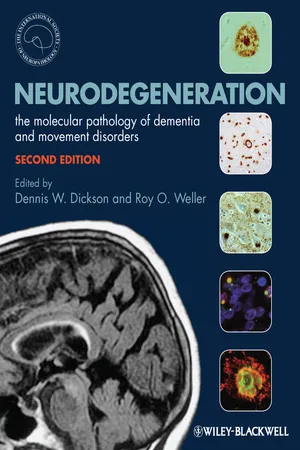
eBook - ePub
Neurodegeneration
The Molecular Pathology of Dementia and Movement Disorders
- English
- ePUB (mobile friendly)
- Available on iOS & Android
eBook - ePub
Neurodegeneration
The Molecular Pathology of Dementia and Movement Disorders
About this book
Most textbooks on neurodegenerative disorders have used a classification scheme based upon either clinical syndromes or anatomical distribution of the pathology. In contrast, this book looks to the future and uses a classification based upon molecular mechanisms, rather than clinical or anatomical boundaries. Major advances in molecular genetics and the application of biochemical and immunocytochemical techniques to neurodegenerative disorders have generated this new approach. Throughout most of the current volume, diseases are clustered according to the proteins that accumulate within cells (e.g. tau, ?-synuclein and TDP -43) and in the extracellular compartments (e.g. ?-amyloid and prion proteins) or according to a shared pathogenetic mechanism, such as trinucleotide repeats, that are a feature of specific genetic disorders. Chapters throughout the book conform to a standard lay-out for ease of access by the reader and are written by a panel of International Experts Since the first edition of this book, major advances have been made in the discovery of common molecular mechanisms between many neurodegenerative diseases most notably in the frontotemporal lobar degenerations (FTLD) and motor neuron disease or amyotrophic lateral sclerosis. This book will be essential reading for clinicians, neuropathologists and basic neuroscientists who require the firm up-to-date knowledge of mechanisms, diagnostic pathology and genetics of Neurodegenerative diseases that is required for progress in therapy and management.
Information
Part 1: Introduction: Basic Mechanisms of Neurodegeneration
1
Introduction to Neurodegeneration: The Molecular Pathology of Dementia and Movement Disorders
Introduction
Neurodegenerative diseases share the common property of neuronal loss of specific populations of neurons, encapsulating the concept of selective vulnerability. Neuronal loss in many of these conditions involves anatomically related functional systems, such as the extrapyramidal and pyramidal motor systems or the higher order association and limbic cortices. The particular system affected determines the clinical presentation; in fact, the distribution of the pathology is more predictive of the clinical presentation than the molecular nature of the pathology, as illustrated in tauopathies and frontotemporal degenerations. It remains one of the major unattained goals of modern research on the degenerative diseases to determine the molecular basis for selective vulnerability.
While much of the focus in research on neurodegeneration is directed to neurons, the role of glia in neurodegenerative disorders is also increasingly recognized [1]. Glia, especially astrocytes, display reactive changes as a part of virtually every neurodegenerative disorder. More recently, oligodendroglia and astrocytes have been implicated in fundamental abnormalities of multiple system atrophy [2] and several of the tauopathies [3].
The other glial cells that play a role in virtually all neurodegenerative disorders are microglia. Microglia are cells of the mononuclear phagocytic system that respond to virtually all forms of cellular injury. They are also the cells linked to neuroinflammation, a term used to refer to innate immune responses in the brain characterized by activated microglia, but sparse or no blood-borne leukocytes. Neuroinflammation has been studied most extensively in Alzheimer’s disease (AD) [4] and Parkinson’s disease (PD) [5], but is common to virtually all neurodegenerative disorders.
Molecular Classification of Neurodegenerative Disorders
Most textbooks on neurodegenerative disorders have used a classification scheme based upon either the clinical syndromes or the anatomical distribution of pathology. In contrast, this book takes a different approach by using a classification based upon molecular mechanisms, rather than clinical or anatomical boundaries. Major advances in molecular genetics and the application of biochemical and immunocytochemical techniques to neurodegenerative disorders have generated this new approach. Throughout most of the current volume, diseases are clustered according to the proteins that accumulate within cells or in the extracellular compartments or according to a shared pathogenetic mechanism, such as trinucleotide repeats that are a feature of specific genetic disorders.
β-Amyloid
The most common of the neurodegenerative disorders is AD, in which mutations in the amyloid precursor protein (APP) gene or genes related to APP metabolism strongly implicate amyloid in the pathogenesis of AD [6]. In addition to β-amyloid deposits, AD is also associated with neurofibrillary degeneration characterized by accumulation of aggregates of the microtubule-associated protein tau within vulnerable neurons. Although there may be some common factors in the pathogenesis of all amyloidoses, neurodegenerative disorders associated with accumulation of amyloids other than β-amyloid, such as familial British dementia (FBD), are discussed separately. Similarly, the primacy of prion protein in Creutzfeld–Jakob disease (CJD) warrants its consideration in the context of other transmissible spongiform encephalopathies rather than in association with the β-amyloidoses.
Tau
In addition to AD, neurofibrillary pathology is present in a range of disorders. While previously considered a relatively non-specific response of neurons to diverse insults, this view has changed with the discovery that mutations in the tau gene (MAPT) cause frontotemporal dementia and parkinsonism linked to chromosome 17 (FTDP-17T) [7]. Disorders in which abnormalities in tau are considered to play a critical role in disease pathogenesis have been referred to as tauopathies [8]. This group of disorders includes both genetically determined and sporadic conditions, including FTDP-17T, Pick’s disease, progressive supranuclear palsy, Guam Parkinson dementia complex, argyrophilic grain disease and others.
α-Synuclein
The second most common neurodegenerative disorder is PD, which has long been associated with Lewy bodies in vulnerable neurons. The discovery of mutations in the gene for α-synuclein (SNCA) in familial PD [9] and the later recognition that α-synuclein was the major structural component of Lewy bodies [10] raised α-synuclein to the level of a major class of diseases. Biochemical and structural alterations in α-synuclein have been detected in several disorders in addition to PD, including dementia with Lewy bodies, pure autonomic failure and multiple system atrophy.
Trinucleotide Repeats
Huntington’s disease (HD) is one of the most extensively studied hereditary neurodegenerative diseases. The discovery that the mutations in the gene encoding huntingtin (HTT) lead to expansion of a trinucleotide repeat, specifically CAG, in the coding region of HTT [11] revealed a common molecular mechanism for a group of disorders that are grouped in this book as the trinucleotide repeat diseases [12]. Not all trinucleotide repeat diseases are associated with CAG repeats and not all of the repeats are in the coding region of the gene. Moreover, the range of clinical and pathological phenotypes in trinucleotide repeat disorders is wide. Nevertheless, these disorders have a shared genetic signature that now warrants their current grouping. Future research may eventually disclose pathomechanisms that will provide a more rational basis for subclassification of these disorders.
Prions
A common theme for many of the degenerative disorders is the formation of abnormal conformers of normal cellular proteins that have an increased tendency to aggregate and to be transmissible from cell to cell [13]; the prion disorders are the archetypal example of conformational disorders. There are few differences between the pathogenic and normal cellular form of PrP besides conformation, yet this is sufficient to lead to a fulminant and invariably fatal neurodegeneration. Prion diseases, like many of the other neurodegenerative disorders, include sporadic and familial forms. Even the sporadic forms may have a genetic predisposition, specifically polymorphisms in the prion protein gene (PRNP) [14].
TDP-43 and FUS
Since the first edition of this book, major advances have been made in the discovery of common molecular mechanisms between frontotemporal lobar degenerations (FTLD) and motor neuron disease or amyotrophic lateral sclerosis (ALS) [15]. Specifically, the major protein that accumulates in the most common forms of FTLD and ALS is the RNA/DNA binding protein, TDP-43. Mutations in the gene for TDP-43 (TARDBP) cause some forms of familial ALS, while other genes are implicated in FTLD, such as the genes for progranulin (GRN) and valosin containing protein/p97 (VCP) [16]. In addition to FTLD and ALS, TDP-43 has also been detected in other disorders [17], where it appears to be a secondary disease process, not dissimilar to α-synuclein pathology (Lewy bodies) that can occur in the setting of a range of other disorders, especially AD [5]. Evidence that RNA/DNA binding proteins are fundamental to this group of disorders is derived from the study of another member of the protein family, i.e. FUS/TLS [18]. This protein is mutated in rare forms of familial motor neuron disease, and FUS protein accumulates in neuronal inclusions in rare forms of FTLD that are negative for TDP-43 pathology [19]. Interestingly, most cases of FTLD associated with inclusions enriched in intermediate filaments (neuronal intermediate filament inclusions disease – NIFID [20]) also have FUS pathology. These advances now provide a rational basis for grouping these disorders.
Shared Mechanisms in Neurodegenerative Disorders
Despite their clinical and pathological diversity, many of the neurodegenerative disorders share certain fundamental disease processes, including oxidative stress and programmed cell death, as well as disorders of protein aggregation or protein degradation, or both. These topics are the focus of chapters in the first part of this book. Programmed cell death is an attractive mechanism to explain selective vulnerability of neuronal populations since most neurodegeneration is not associated with influx of blood-borne inflammatory cells, as is the case with other types of tissue damage, such as necrosis. The molecular pathways involved in activation of apoptosis fall in two categories – intrinsic and extrinsic. The extrinsic pathway is triggered by extracellular ligands and their cell surface receptors, while intrinsic pathways act through changes in mitochondrial permeability, thus linking mitochondria to both oxidative stress and cell death mechanisms. Mitochondria are one of the major sources of reactive oxygen species generated as byproducts of oxidative phosphorylation. Accumulation of reactive oxygen species and the cellular defenses against oxidative stress are implicated in a number of neurodegenerative disorders.
One consequence of cellular oxidative stress is post-translational modification (e.g. nitration) of proteins. These proteins take on abnormal properties that may lead to changes in their solubility and promote aggregation. Aggregation of abnormal conformers of neuronal and glial proteins is increasingly recognized as a common mechanism of a number of neurodegenerative disorders, as noted for prion protein. The role of protein–protein interaction, protein aggregation and changes in structural properties suggests that abnormal conformation of proteins is critical to aggregation and inclusion formation. Accompanying protein aggregation and accumulation are usually evidence of aberration of the normal cellular mechanisms for protein degradation. In addition to the actions of cellular and extracellular proteinases, two major pathways exist for protein degradation that involves cellular organelles adapted for this purpose – lysosomes and proteasomes. Much current research in neurodegenerative disease is focused on the role of ubiquitin proteasomal system in basic cellular processes as well as in disease. Lysosomal pathways, particularly autophagy, may also be involved in a number of neurodegenerative disorders and interaction of the two processes is increasingly recognized.
In addition to these major disease mechanisms, Part 1 also includes an overview of recent advances in genetics, which underpins the molecular classification of disease that is the basis for the organization of the book. Chapter 7 is a review of some of the animal models most widely used to study human neurodegenerative diseases, particularly related to amyloid, tau and α-synuclein.
References
1 Miller DW, Cookson MR, Dickson DW. Glial cell inclusions and the pathogenesis of neurodegenerative diseases. Neuron Glia Biol 2004; 1(1): 13–21.
2 Wenning GK, Stefanova N, Jellinger KA, Poewe W, Schlossmacher MG. Multiple system atrophy: a primary oligodendrogliopathy. Ann Neurol 2008; 64(3): 239–246.
3 Komori T. Tau-positive glial inclusions in progressive supranuclear palsy, corticobasal degeneration and Pick’s disease. Brain Pathol 1999; 9(4): 663–679.
4 Eikelenboom P, van Exel E, Hoozemans JJ, Veerhuis R, Rozemuller AJ, van Gool WA. Neuroinflammation – an early event in both the history and pathogenesis of Alzheimer’s disease. Neurodegener Dis 2010; 7(1-3): 38–41.
5 McGeer PL, McGeer EG. Glial reactions in Parkinson’s disease. Mov Disord 2008; 23(4): 474–483.
6 Hardy ...
Table of contents
- Cover
- Title page
- Copyright page
- List of Contributors
- Preface
- List of Abbreviations
- Part 1: Introduction: Basic Mechanisms of Neurodegeneration
- Part 2: Alzheimer’s Disease and Aging
- Part 3: Tauopathies
- Part 4: Synucleinopathies
- Part 5: Trinucleotide Repeat Disorders
- Part 6: Prion Disorders
- Part 7: Frontotemporal Lobar Degeneration and Amyotrophic Lateral Sclerosis/Motor Neuron Disease
- Part 8: Other Neurodegenerative Disorders
- Index
Trusted by 375,005 students
Access to over 1.5 million titles for a fair monthly price.
Study more efficiently using our study tools.
Frequently asked questions
Yes, you can cancel anytime from the Subscription tab in your account settings on the Perlego website. Your subscription will stay active until the end of your current billing period. Learn how to cancel your subscription
No, books cannot be downloaded as external files, such as PDFs, for use outside of Perlego. However, you can download books within the Perlego app for offline reading on mobile or tablet. Learn how to download books offline
Perlego offers two plans: Essential and Complete
- Essential is ideal for learners and professionals who enjoy exploring a wide range of subjects. Access the Essential Library with 800,000+ trusted titles and best-sellers across business, personal growth, and the humanities. Includes unlimited reading time and Standard Read Aloud voice.
- Complete: Perfect for advanced learners and researchers needing full, unrestricted access. Unlock 1.5M+ books across hundreds of subjects, including academic and specialized titles. The Complete Plan also includes advanced features like Premium Read Aloud and Research Assistant.
We are an online textbook subscription service, where you can get access to an entire online library for less than the price of a single book per month. With over 1.5 million books across 990+ topics, we’ve got you covered! Learn about our mission
Look out for the read-aloud symbol on your next book to see if you can listen to it. The read-aloud tool reads text aloud for you, highlighting the text as it is being read. You can pause it, speed it up and slow it down. Learn more about Read Aloud
Yes! You can use the Perlego app on both iOS and Android devices to read anytime, anywhere — even offline. Perfect for commutes or when you’re on the go.
Please note we cannot support devices running on iOS 13 and Android 7 or earlier. Learn more about using the app
Please note we cannot support devices running on iOS 13 and Android 7 or earlier. Learn more about using the app
Yes, you can access Neurodegeneration by Dennis Dickson, Roy O. Weller, Dennis Dickson,Roy O. Weller in PDF and/or ePUB format, as well as other popular books in Medicine & Neurology. We have over 1.5 million books available in our catalogue for you to explore.