- Written by a leading Shakespearean scholar
- Discusses an array of topics, including sex and gender, politics and political theory, writing and acting, religious controversy and issues of faith, skepticism and misanthropy, and closure
- Explores Shakespeare as a great poet, a great dramatist and a "great mind"
- English
- ePUB (mobile friendly)
- Available on iOS & Android
eBook - ePub
About this book
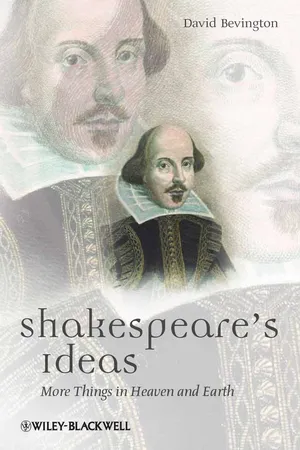
An in-depth exploration, through his plays and poems, of the philosophy of Shakespeare as a great poet, a great dramatist and a "great mind".
Information
1
A Natural Philosopher
TOUCHSTONE Hast any philosophy in thee, shepherd?
CORIN No more but that I know the more one sickens the worse at ease he is; and that he that wants money, means, and content is without three good friends; that the property of rain is to wet and fire to burn; that good pasture makes fat sheep and that a great cause of the night is lack of the sun; that he that hath learned no wit by nature nor art may complain of good breeding or comes of a very dull kindred.
TOUCHSTONE Such a one is a natural philosopher.
(As You Like It, 3.2.21–30)
Even if Shakespeare was not a philosopher in the sense of writing essays or treatises arguing philosophical positions and proposing an embracing philosophical scheme, we need to take the ideas in his plays and poems seriously. This book is dedicated to the proposition that the writings of Shakespeare reveal the workings of a great mind. True, we have no literary criticism or other theorizing as such from his pen. Unlike his near-contemporary Ben Jonson, whose theories of dramatic art are loudly proclaimed in prologues, manifestos, satirical diatribes, and recorded conversations, Shakespeare never speaks in his own voice about his ideas on writing or on what we would broadly call his ‘philosophy’. That is because he is a dramatist with a special genius for allowing his characters to speak on their own behalfs without his editorial intervention.
Shakespeare does not discuss philosophers very often, and may not have read widely in them. He cites Aristotle twice in throwaway comments (see Chapter 4). He never mentions Plato or his Academy. Socrates appears once by name as the hapless henpecked husband of Xantippe (The Taming of the Shrew, 1.2.69–70). Shakespeare’s four references to Pythagoras seem to regard his ideas as a bizarre joke. Seneca is named once as the quintessential ‘heavy’ dramatist, not as a philosopher (Hamlet, 2.2.400). Although the concept of stoicism is important to Shakespeare, as we shall see in Chapter 6, he uses the word ‘stoics’ only in a single comic remark to characterize students who prefer diligent study to fun and games (Taming, 1.1.31), and he says nothing about Zeno or his followers. ‘Sceptic’, ‘sceptical’, and ‘scepticism’ form no part of Shakespeare’s vocabulary, however much he may have pondered what we would call sceptical ideas, nor does he name Pyrrhon or Pyrrhonism or Sextus Empiricus. Shakespeare tends to use ‘epicurean’ in its slang sense of ‘hedonistic’. Medieval theologians like Abelard, Eusebius, Tertullian, Augustine, Thomas Aquinas, William of Ockam, and Duns Scotus are nowhere to be found. So too with Renaissance neoplatonists like Pico della Mirandola, Marsilio Ficino, and Baldassare Castiglione, or radical thinkers like Giordano Bruno. ‘Lutheran’ surfaces once (Henry VIII, 3.2.100) as a defamatory Catholic-inspired label for Anne Bullen. John Calvin’s name is absent, even though his widely-circulated ideas are discernible. ‘Machiavel’ turns up thrice as a synonym for ‘villain’ or ‘political intriguer’. We hear nothing of Agrippa, or Paracelsus, or Ramus. Shakespeare never names Montaigne, although his debt to one essay at least is evident in The Tempest.
Is Shakespeare gently laughing at himself when he has Touchstone describe Corin as a ‘natural philosopher’? A ‘natural philosopher’ need not be a guileless innocent; the phrase can suggest one who is innately gifted and wisely self-taught, even if not schooled in a narrowly pedantic sense. It can also suggest one who studies ‘natural philosophy’, i.e., knowledge of the natural world.
Learned or not, the plays and poems are full of ideas. Writers on Shakespeare from Dr Samuel Johnson and John Keats to Ralph Waldo Emerson, Virginia Woolf, Northrop Frye, Harold Bloom, Stanley Cavell, and Stephen Greenblatt have lauded Shakespeare as a great moral philosopher. The titles of numerous critical studies underscore the importance of the topic. Kenneth J. Spalding’s The Philosophy of Shakespeare (Oxford, 1953) discusses the subject under subheadings of ‘The Mind of Shakespeare’, ‘Shakespeare and Man’, ‘Social Man’, ‘The Statesman’, ‘Individual Man’, ‘Man’s Salvation’, and ‘The Last Question’. Franz Lütgenau’s similarly-titled Shakespeare als Philosoph (Leipzig, 1909) asks what Shakespeare’s writings have to say about free will versus determinism, relativity vs. certainty, scepticism, Pythagorean doctrine, dualism, Pantheism, astrology, and still more. Ben Kimpel’s Moral Philosophies in Shakespeare’s Plays (Lewiston, ME, 1987) focuses on the duality of good and evil, arguing that Shakespeare ultimately endorses a providential reading of divine justice. John J. Joughin’s collection of essays entitled Philosophical Shakespeares (London and New York, 2000), devoted to the postmodern proposition that we must acknowledge multiple philosophies in Shakespeare, begins with a foreword by Stanley Cavell addressing the critical problem of how to distinguish the ideas from the literary texts into which they are inseparably woven. Tzachi Zamir’s Double Vision, subtitled Moral Philosophy and Shakespearean Drama (Princeton, 2007), analyzes the epistemological and moral bases of philosophical criticism as necessary groundwork for practical criticism. More studies of this kind are listed in the section on ‘Further Reading’ at the end of this book.
Important as the ideas are in Shakespeare’s plays, we are on far less certain ground in attempting to determine which of them are specifically his own. Do Shakespeare’s characters sometimes serve as mouthpieces for his own personal beliefs? The notion is attractive because the things that are said by Hamlet, or Lear, or Macbeth, or just about any other thoughtful character are so wise and stimulating and eloquently expressed that we like to imagine that we can hear the author himself. Yet we must be vigilantly aware that each speaker is a narrative voice, even in the Sonnets and other nondramatic poems. If that is true in nondramatic verse, it is insistently more true in drama. Knowing as little as we do about Shakespeare’s personal views outside of his writings, we must exercise great care in assuming that we can hear him asking ‘To be, or not to be’ with Hamlet, or agreeing glumly with the Earl of Gloucester in King Lear that ‘As flies to wanton boys are we to the gods; / They kill us for their sport’, or endorsing Macbeth’s nihilistic conclusion that ‘Life’s but a walking shadow’. One can as easily and fruitlessly generalize on the basis of Puck’s ‘Lord, what fools these mortals be!’ in A Midsummer Night’s Dream, or Feste’s song, ‘Then come and kiss me, sweet and twenty; / Youth’s a stuff will not endure’ in Twelfth Night. Shakespeare’s utterances often achieve the status of proverbial speech because they are so persuasively and exquisitely worded.
This, then, is the challenge of this present book, as of other earlier studies that have asked about Shakespeare’s ideas. He is a remarkable subject because he has revealed so little directly about himself while at the same time uttering such extraordinary wisdom that we want to understand him as a thinker. Biographical information about him has accumulated in considerable detail, but not in the form of letters written by him, or recorded conversations. Our materials for a study of Shakespeare’s ideas must be the plays and poems that he wrote.
Shakespeare was a dramatist in ways that tend to conceal the author behind the work. He generally took his plots from known and published sources. The history plays and to an extent Macbeth take their basic narratives from Raphael Holinshed’s The Chronicles of England, Scotland, and Ireland, newly published in a second edition in 1587. The Roman plays, especially Julius Caesar, Antony and Cleopatra, and Coriolanus, take their narrative material from Plutarch’s Lives of the Noble Grecians and Romans, translated into English by Thomas North in 1579. Many other plays, including The Merchant of Venice, Much Ado About Nothing, Twelfth Night, All’s Well That Ends Well, Othello, and Cymbeline, are derived plotwise from Italian or other continental short stories, plentifully available in England in Shakespeare’s lifetime and generally in translation. Romeo and Juliet takes as its point of departure a long narrative poem in English by Arthur Brooke called The Tragical History of Romeus and Juliet, written first in Italian by Bandell and now in English by Ar. Br, 1562, with a long history of earlier versions prior to that of the Italian short-story writer Matteo Bandello. Hamlet owes its plot ultimately to Saxo Grammaticus’s Historia Danica (1180–1208). Troilus and Cressida goes back to Homer, Chaucer, John Lydgate, and William Caxton, among others, for its information about the Trojan War and the doomed love affair of the play’s title characters. Titus Andronicus is seemingly based on a now-lost prose original of which analogs are still available. Timon of Athens seems to have been inspired by a dialogue called Timon, or The Misanthrope, by Lucian of Samosata (c. ad 125–80). The Two Noble Kinsmen, by Shakespeare and John Fletcher, goes back to Chaucer’s ‘Knight’s Tale’. Sometimes Shakespeare extensively revised an already existing play, as in the case of Measure for Measure, King John, Henry IV Parts I and II, Henry V, King Lear, and perhaps Hamlet. He adroitly made use of classical and neoclassical comedies by Plautus, Ariosto, and others in such plays as The Comedy of Errors and The Taming of the Shrew. He showed that he knew how to capitalize on the narrative traditions of pastoral and romance in The Two Gentlemen of Verona, As You Like It, Pericles, and The Winter’s Tale. Only Love’s Labour’s Lost, A Midsummer Night’s Dream, The Merry Wives of Windsor, and The Tempest stand as plays for which no single organizing plot can be found as Shakespeare’s source, and even here his borrowing from other writers is extensive.
This wide use of sources was characteristic of other Renaissance dramatists as well. As such it points to an important feature of early modern dramatic writing: the author-dramatist was essentially anonymous, or nearly so. Many plays were published without the author’s name on the title page or anywhere in the edition. Shakespeare’s name did not make an appearance on a printed play-text by him until 1598, when Love’s Labour’s Lost was published in quarto (a small and relatively inexpensive form of book publishing) as ‘Newly corrected and augmented by W. Shakespere’. By that time Shakespeare may have been in London for a decade or so, gaining steadily in reputation as a dramatist: as early as 1592 his 1 and 3 Henry VI caught the attention of his fellow-dramatists Robert Greene and Thomas Nashe, and by 1598 he was lauded by Francis Meres as the Plautus and Seneca of his generation. Yet official recognition in print came slowly. The reason we have no manuscripts of his today, or correspondence, or any biography of him written during his lifetime, is that dramatists like Shakespeare were regarded as popular entertainers. Sophisticated readers did not ordinarily ‘collect’ Shakespeare. When Thomas Bodley gave to Oxford University the library that today bears his name, instructing that institution to assemble in its collection every book published in England, he specified that they need not bother to include plays. Plays were ephemeral. The situation was perhaps like that of today in our cultural estimation of films: we are likely to know who has directed an important film, and who are its lead actors, but seldom are we able to come up with the name of the script writer or writers, unless they happen to be someone like Tom Stoppard with credentials from the more visibly cultured world of stage drama, fiction, poetry, music, etc.
Popular dramatists were generally known in Shakespeare’s day as makers and compilers rather than as artists. They were artisans, often drawn (as in Shakespeare’s case) from the ranks of performers, who in turn tended to come from the artisan class. James Burbage, builder of the Theatre in 1576 and father of Shakespeare’s longtime leading man, Rchard Burbage, had been a joiner or expert carpenter. Some of Shakespeare’s colleagues in the company known as the Chamberlain’s Men and then the King’s Men were members of London’s powerful trade guilds, such as the Grocers and the Goldsmiths. Shakespeare’s own father had been a manufacturer and seller of leather goods and other commodities in Stratford-upon-Avon. Even Ben Jonson had as his stepfather a mason, and was himself apprenticed for a time, albeit unwillingly, to that craft. Playwriting was a trade, like acting. The dramatist was a journeyman, a craftsman. Our modern conception of creative writing as usually autobiographical in its method and subject would have seemed strange to Shakespeare and his contemporaries. Their job was to fashion theatrical entertainments around popular and familiar stories. Such an idea of authorship tends to distance a play from its writer in terms of personal expression. Can an author who chronicles the story of a Richard II or Hamlet be assumed to be searching out ways to express his own views on politics or human destiny?
Patronage of the drama, and in other arts as well, tended to encourage this same sort of craftsmanship in which the maker subsumed his identity into the work at hand. Many of the great paintings of the Renaissance were executed at the behest of church authorities and wealthy patrons. Artists might be commissioned to provide representations of religious subjects for a particular location in a particular church. The subject might well be dictated, such as the Annunciation, or the Descent from the Cross, in which case the details of composition might also be specified, including the size of the painting and the arrangement of the figures. Where, in such an instance, was there room for what we would call creativity? The results in the best-known instances could be astonishingly beautiful and revelatory of the artist’s genius, and yet even here the degree of personal expression can be hard to determine.
The same is true in the drama of the early modern period. Shakespeare wrote for his patrons, who were in his case the playgoing public of London. What kinds of pressures would he have felt? Don Marquis, creator of a delightful newspaper column (1913–37) in the New York Sun called ‘The Sun Dial’ and featuring, among others, Archy the vers libre cockroach and Mehitabel the cat, devoted one piece to imagining what it would have been like for Shakespeare to write the kinds of plays demanded of him by his popular audiences. Archy the cockroach narrates the account, using no capitals or punctuation because he is hopping from key to key on Don Marquis’s typewriter. He imagines Shakespeare in a tavern, complaining to his drinking companions about the harsh demands placed on him by his unlearned spectators.
what they want
is kings talking like kings
never had sense enough to talk
and stabbings and stranglings
and fat men making love
and clowns basting each
other with clubs and cheap puns
and off colour allusions to all
the smut of the day,
Shakespeare laments. ‘give them a good ghost / or two’, and ‘kill a little kid or two a prince’, ‘a little pathos along with / the dirt’.
what I want to do
is write sonnets and
songs and spenserian stanzas
and i might have done it too
if i hadn t got
into this frightful show game.
Marquis is of course exaggerating for comic effect, but his main point is still worth considering: a public artist in Shakespeare’s situation needed to cater substantially to the tastes of his public. In the title of his 1947 study of Shakespeare, As They Liked It, Alfred Harbage adroitly captures the idea that the greatest of English writers achieved his success in good part by telling his audiences what they wanted to hear. To the extent that this is true, what room is left then for saying that the ideas expressed in his popular plays are Shakespeare’s own?
The problem of identifying any ideas in the plays or poems as Shakespeare’s own is compounded still further by Shakespeare’s extraordinary ability to submerge his own personality as writer into the mindset of the characters he creates. He allows Falstaff, or Hotspur, or Cleopatra, or Lady Macbeth to speak his or her innermost thoughts as though without the intervening or controlling perspective of the author. Shakespeare’s gift for creating unforgettable characters this way is legendary. It is sometimes called his ‘negative capability’, meaning his skill as a dramatist in setting aside his own point of view in order to focus entirely on what the character he has created must be thinking at any given moment. The phrase is John Keats’s in praise of Shakespeare, in a letter to Keats’s brother Thomas written on 17 December 1817. The letter itself actually points in a slightly different direction: Keats writes that negative capability ‘is when a man is capable of being in uncertainties, mysteries, doubts, without any irritable reaching after fact and reason’, laying stress on the idea of genius as liberated by creative uncertainties. But the difference doesn’t really matter; the definitions are alike in praising qualities for which Shakespeare is justly famous, and ‘negative capability’ has stuck as a way of describing Shakespeare’s remarkable talent for showing us what his characters are thinking, not what the dramatist is trying to prove.
Plays vary greatly as to the extent to which they try to make an identifiable point. A central idea in back of Ben Jonson’s Volpone (1605–6) is that a nearly universal human greed for wealth ultimately consumes itself and is justly punished by its own excesses. We do not seriously distort the evident purpose of Arthur Miller’s The Crucible (1952) when we say that its aim is to criticize the kind of cultural and political hysteria that led to the Salem witchcraft trials of the late seventeenth century and then much later to the McCarthy witch-hunts of the 1950s. Sophocles’s Oedipus the King (32 BC) darkly affirms the great commonplace that the will of the gods must be fulfilled, even if in the process Oedipus must suffer a devastating tragic fall. These are all extraordinary plays; to say that they are didactic, in that we can identify an authorial intent...
Table of contents
- Cover Page
- Publisher Page
- Title Page
- Copyright
- Dedication
- Acknowledgements
- 1: A Natural Philosopher
- 2: Lust in Action
- 3: What is Honour?
- 4: Hold the Mirror Up to Nature
- 5: What Form of Prayer Can Serve My Turn?
- 6: Is Man No More Than This?
- 7: Here Our Play Has Ending
- 8: Credo
- Further Reading
- Index
Trusted by 375,005 students
Access to over 1.5 million titles for a fair monthly price.
Study more efficiently using our study tools.
Frequently asked questions
Yes, you can cancel anytime from the Subscription tab in your account settings on the Perlego website. Your subscription will stay active until the end of your current billing period. Learn how to cancel your subscription
No, books cannot be downloaded as external files, such as PDFs, for use outside of Perlego. However, you can download books within the Perlego app for offline reading on mobile or tablet. Learn how to download books offline
Perlego offers two plans: Essential and Complete
- Essential is ideal for learners and professionals who enjoy exploring a wide range of subjects. Access the Essential Library with 800,000+ trusted titles and best-sellers across business, personal growth, and the humanities. Includes unlimited reading time and Standard Read Aloud voice.
- Complete: Perfect for advanced learners and researchers needing full, unrestricted access. Unlock 1.5M+ books across hundreds of subjects, including academic and specialized titles. The Complete Plan also includes advanced features like Premium Read Aloud and Research Assistant.
We are an online textbook subscription service, where you can get access to an entire online library for less than the price of a single book per month. With over 1.5 million books across 990+ topics, we’ve got you covered! Learn about our mission
Look out for the read-aloud symbol on your next book to see if you can listen to it. The read-aloud tool reads text aloud for you, highlighting the text as it is being read. You can pause it, speed it up and slow it down. Learn more about Read Aloud
Yes! You can use the Perlego app on both iOS and Android devices to read anytime, anywhere — even offline. Perfect for commutes or when you’re on the go.
Please note we cannot support devices running on iOS 13 and Android 7 or earlier. Learn more about using the app
Please note we cannot support devices running on iOS 13 and Android 7 or earlier. Learn more about using the app
Yes, you can access Shakespeare's Ideas by David Bevington in PDF and/or ePUB format, as well as other popular books in History & Historiography. We have over 1.5 million books available in our catalogue for you to explore.