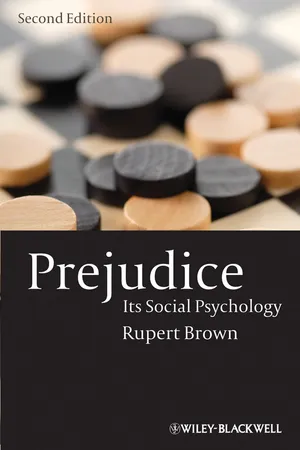
- Takes a social psychological perspective, analysing individual behavior as part of a pattern of intergroup processes
- Covers the major research, including classical personality accounts, developmental approaches, socio-cognitive research focussing on categorization and stereotyping, prejudice as an intergroup phenomenon, and ways to combat prejudice
- Illustrates concepts with examples of different kinds of prejudice drawn from everyday life
- Includes a new chapter on prejudice from the victim's perspective
- Fully updated throughout, with expansion of the notions of explicit and implicit manifestations of prejudice
- English
- ePUB (mobile friendly)
- Available on iOS & Android
eBook - ePub
About this book
This new edition of Prejudice provides a comprehensive treatment of the subject, introducing the major theoretical ideas as well as providing a critical analysis of recent developments.
Information
1
The Nature of Prejudice
In 1954 a Harvard social psychologist called Gordon Allport published a book from which this chapter takes its title (Allport, 1954). Brilliantly written and encyclopaedic in its scope, the book has rightly come to be regarded as point of departure for modern investigators into the nature of prejudice and into methods for its reduction. Allport provided not only an incisive analysis of the origins of intergroup discrimination, anticipating some discoveries in social cognition and group behaviour that have only recently been made (see Chapters 3–6), but also a series of influential policy recommendations for its elimination (see Chapter 9). Indeed, it is no exaggeration to say that most practical attempts to improve intergroup relations in over the past fifty years have had their basis in Allport’s theorizing.
It is thus entirely appropriate that in this first chapter we should take another look at some of the definitions and assumptions that guided Allport’s scholarship. After presenting a few contemporary illustrations of prejudice in action, I examine how the term ‘prejudice’ has traditionally been defined. Though finding much to agree with in these conventional accounts, I propose a simpler and more inclusive definition, which eschews any reference to the putative ‘falsity’ of a prejudiced thought, word or deed. After this terminological discussion, I outline in broad terms the perspective to be adopted in the remainder of the book – a perspective that simultaneously seeks to treat prejudice as a group process and as a phenomenon that nevertheless can be analysed at the level of individual perception, emotion and action. Finally, I relate this social psychological approach to the analyses offered by other disciplines – history, politics, economics, sociology and so on. I conclude that each of these various perspectives can independently offer valuable insights into the nature of prejudice without being subservient or reducible to some more fundamental level of analysis. At the same time, I recognize that ultimately – in some future social scientific utopia – each level of analysis will need to be consistent with the others and may well impose conceptual and empirical constraints on theorizing in those other domains.
What Is Prejudice?
It is 5 o’clock in the afternoon somewhere in Bristol, in the West of England, in the mid-1980s. Geoff Small, a black man in his twenties, has just been shown round a flat that is being offered to let by a white landlord.
SMALL: am i the first one to see it?
LANDLORD: …yes, you are actually but there are several other people coming round, you know. Well, another one in a moment – ten past – and some more at six.
SMALL: ah, right. Then what’s your criterion for allotting the place?
LANDLORD: well, i’m going to see the people who come along. Then, you know, give them a call and let them know …
Ten minutes later a second man, also in his twenties, calls round to the same flat. His name is Tim Marshall. He happens to be white. After being shown round, he asks how the landlord will decide on who will be the tenant.
MARSHALL: Is it on a first come, first served … that is, if I wanted it …?
LANDLORD: (hesitating) … er … yeah … well … yes … someone sort of suitable I would say yes, I would. But … otherwise I might say ‘I’ll let you know’ (embarrassed laugh).
MARSHALL: Ok, I do actually like it. But I have got …
LANDLORD: … got others to see, have you?
MARSHALL: Yes, two places. But I mean … have I got any competition? I mean, does anyone else want it?
LANDLORD: Well, the situation is that I came back at four o’clock. There’s a chap coming round at six o’clock – between six and seven – and … um … being a bit of a racist … but he was black – nice enough chap – but I thought he might create problems so I said look, I’d let him know.
MARSHALL: Would you not have a black …?
LANDLORD: No. He was a nice chap, you know. But on the other hand, he was a big bloke and he’d be a bit of a handful. But I thought he might create problems, you know.
MARSHALL: Damn. I don’t know what to say. I don’t want to lose it but I don’t want to say yes for sure.
LANDLORD: Well, I’ve got another room … which I let as well.
MARSHALL: Well, I’ll take my chances because you’re saying the black guy is not going to get it?
LANDLORD: That’s right.
On the way downstairs to show Marshall out, the landlord continues his justification for not wanting to let to the previous applicant, at one point describing him as ‘a bit arrogant’.
These two encounters were covertly filmed by the two prospective tenants, who were in reality making a television documentary (Black and White, BBC Television, 1987). Armed with hidden microphones and cameras, they went looking for accommodation, jobs and leisure entertainment. The documentary was, in fact, a televised replication of a well-known piece of research initiated by a committee appointed by the British Government in 1965 (Daniels, 1968). As in the television programme, one of the research techniques was to dispatch three interviewers, who purported to be genuine applicants, in search of housing, jobs and a variety of other services. In most respects the interviewers were similar – similar age, appearance, qualifications – but there were some crucial differences: the first applicant to any vacancy happened to have somewhat darker skin than the other two because he was West Indian or Asian; the second applicant’s skin was white, but he was from Hungary; and the third applicant was always white and English.
The results were dramatic: out of 60 landlords approached, the West Indian received identical treatment to the others on just 15 occasions (Daniels, 1968). On 38 of the 45 other occasions he was told that the flat had gone when both other applicants were told later that it was still vacant. When applying for jobs, an equally stark discrimination occurred: 40 firms were approached. On no less than 37 occasions, the West Indian or Asian applicants were told that there was no vacancy. The white English received only 10 such outright refusals, and the Hungarian 23. Direct offers of jobs or encouragement to apply showed a similar bias.
It is tempting to dismiss such findings on grounds of their antiquity. Surely, one might ask, it would be difficult to witness such overt discrimination today, after four decades of successive race relations and equal opportunities legislations? I would not be so sanguine about it. There was, after all, that television documentary, which revealed repeated instances of a differential treatment of black and white reporters. That such discrimination lingers is confirmed in some more recent reports. One was a study by Bertrand and Mullainathan (2004) in which 5,000 applications were sent out in response to various job advertisements in American newspapers. Half of the applicants purported to have typically white-sounding names like Allison or Greg, the remainder had typical African American names like Ebony or Leroy. Independently of the names at the top of the résumé, some applicants seemed to have more skills and experience relevant to the job, others less. Of course, the vast majority of these applications did not elicit a response from the employers. However, those with white-sounding names were about 50 per cent more likely to yield a reaction than those with the African American names: the response rates were 9.6 per cent and 6.4 per cent respectively. Even worse, for the applications from the ‘white’ candidates, the quality of the résumé made a noticeable difference to the likelihood of a response, whilst it had virtually no effect for the ‘black’ candidates. Similar evidence of job discrimination, simply on the basis of applicants’ names, has been found in Britain, where applicants with Asian names are less likely to be short-listed than those with white names (BBC, 2004; Department for Work and Pensions, 2009; Esmail and Everington, 1993). And in Chile, too, workers with high-status Castillean Spanish names are likely to earn around 10 per cent more than their colleagues with lower-class or indigenous names, even when holding constant (or, in technical terms, controlling for) their academic achievement level on graduating from university (Nunez and Gutierez, 2004). In the field of housing, it seems that people from ethnic minorities in Britain still face discrimination when they look for property to rent. According to the British Commission for Racial Equality, as many as 20 per cent of private accommodation agencies were still discriminating in the allocation of rented property in the late 1980s – a situation which still persists in some places, according to a recent report in a Belfast newspaper (CRE, 1990; Irish News, 30 October 2004).
Behind these statistics lies a grim reality of daily verbal abuse, harassment and threat of physical attack for many members of minority groups. Perhaps the following will serve as one last illustration that prejudice can sometimes – perhaps often – contain elements of overt hostility and violence. In 2009, the BBC sent two British Asian reporters, Tamann Rahman and Amil Khan, to live for two months on a working-class housing estate in Bristol (‘Panorama’, BBC 1 TV, 19 October 2009; see http://news.bbc.co.uk/panorama/hi/front_page/newsid_8303000/8303229.stm). Posing as a married couple, the two covertly filmed how they were received by their neighbours and other people in the community. Their treatment was truly shocking. They were frequently called names in the street – ‘Paki’, ‘Oi, you Taliban’, ‘Who’s got a bomb?’, ‘Iraq’s that way’ are some of the more printable insults that they received. They were physically assaulted, sometimes by quite young children. An 11-year-old boy tried to mug Ms Rahman, pretending to have a gun, then a knife, and finally actually producing a rock with which he threatened her until a passer-by intervened. She had rocks, bottles and cans of drink thrown at her. Mr Khan was similarly abused, and on one occasion he was punched on the side of his head, in a completely unprovoked attack. Such is life for some ethnic minorities living in parts of twenty-first-century Britain.
These are all instances of a particular kind of prejudice: prejudice towards members of ethnic minorities. There are, of course, many other common varieties of prejudice – against women, against gay people, against people with disabilities – as will become clear in the pages of this book. But what exactly do we mean by the word ‘prejudice’? It is conventional at this point to refer to a dictionary in which we can find prejudice typically defined as ‘a judgement or opinion formed beforehand or without due examination’ (Chambers English Dictionary, 1988).
Definitions like this one have led many social psychologists to emphasize features such as ‘incorrectness’ or ‘inaccuracy’ in their attempts to define prejudice. For example Allport wrote: ‘[e]thnic prejudice is an antipathy based upon a faulty and inflexible generalization. It may be felt or expressed. It may be directed toward a group as a whole or toward and individual because he is a member of that group’ (Allport, 1954, p. 10; my emphasis); or, more recently, Samson: ‘prejudice involves an unjustified, usually negative attitude towards others because of their social category or group membership’ (Samson, 1999, p. 4; my emphasis).
Such social psychological definitions have much to recommend them over more formal lexical accounts. In particular, they accurately convey one essential aspect of the phenomenon of prejudice – that it is a social orientation either towards whole groups of people or towards individuals because of their membership of a particular group. The other common factor between these definitions is that they stress the negative flavour of group prejudice. Of course, logically, prejudice can take both positive and negative forms. I, for example, am particularly favourably disposed towards all things Italian: I love Italian food, Italian cinema, and I lose no opportunity to try out my execrable Italian on anyone who will listen (much to the embarrassment of friends and family). However, such harmless infatuations hardly constitute a major social problem, worthy of much of our attention as social scientists. Rather, the kind of prejudice that besets so many societies in the world today and which so urgently requires our understanding is usually the negative variety: the wary, fearful, suspicious, derogatory, hostile or ultimately murderous treatment of one group of people by another. Thus, practically speaking, I think it is usually most useful to concern ourselves with what governs variations in these different forms of antipathy. Still, it will be necessary to revisit this question of ‘positive’ prejudice when I present my definition below.
However, I do not believe it is necessary to imply – as these definitions do – that prejudice must be regarded as a ‘false’ or ‘irrational’ set of beliefs, a ‘faulty’ generalization, or as an ‘unwarranted’ disposition to behave negatively towards another group. There are three reasons for taking issue with this point of view. First, to say that an attitude or belief is ‘faulty’ implies that we could have some way of establishing its ‘correctness’. In some rather special circumstances it might be possible to do this, but only if the belief in question refers to some objectively measurable criterion (Judd and Park, 1993; Lee et al., 1995; Oakes and Reynolds, 1997). But how often would this be possible? Prejudiced statements are typically couched in much more vague and ambiguous terms. Take the landlord quoted earlier in the chapter: how could we hope to establish the truth or falsity of his beliefs that blacks are likely ‘to create problems’? By devising some procedure to measure people’s scores on this index against some normative standard of ‘peaceableness’? Even to pose the question seems to me to highlight the insurmountable difficulties that would be encountered in trying to answer it. And, even if such a comparative test were possible and, let us suppose hypothetically, it did show a greater incidence of ‘problem creation’ among the black population, would this justify regarding that landlord’s statement as unprejudiced? There is a myriad of possible explanations for the hypothetical statistic – for example reactions to provocation by whites, response to unjust social deprivation, and so on – any one of which could suffice to refute the imputation of blacks’ supposed propensity ‘to create problems’. The fact remains that the sentiments expressed by that landlord – and their social consequences – would be no less negative (and prejudicial) for having some (alleged) basis in reality.
A second problem with including any ‘truth value’ element in a definition of prejudice stems from the peculiarly relativistic nature of intergroup perception. It has long been observed – and we shall see ample confirmations in later chapters – that, for groups even more than for individuals, ‘beauty is in the eye of the beholder’. In other words, one group may view very differently what another group finds to be ‘pleasant’, or ‘virtuous’, or even self-evidently ‘true’. So, if one group regards itself as ‘thrifty’, is that view more, or is it less, at variance with reality than the view of another group, who regards the former as ‘stingy’? Of course, it is impossible to say. The important distinction between the two views lies not in their relative ‘correctness’ but in their implied connotations of value.
A third point to make about some of these traditional definitions of prejudice is that they often seem to pre-empt the analysis of the origins and functions of prejudiced thinking. Thus, when Allport (1954) refers to an ‘inflexible generalization’, or when Ackerman and Jahoda (1950) talk of prejudice serving an ‘irrational function’, they are presupposing more in their definitions than it may be wise to allow. It may well be, as we shall see in subsequent chapters, that much prejudice does have an apparently immutable and dysfunctional quality to it. But equally, as these chapters will also reveal, to think of prejudice as being impervious to change, or as having no rational function for its adherents, is to fail to do justice to the variety and complexity of the forms it can take and to its surprisingly labile quality in many situations.
Let us now return to the restriction, encountered in traditional definitions, that prejudice should refer to a negative orientation. For many years this restriction was uncontroversial (Aboud, 1988; Jones, 1972; Sherif, 1966). Indeed in the first edition of this book I adopted it myself (Brown, 1995). However, some recent analyses have argued that social psychological definitions of prejudice should, after all, include some apparently positive beliefs, sentiments and actions. Thus Jones, in a revision of his earlier book, now defines prejudice as ‘a positive or negative attitude, judgement or feeling about a person that is generalized from attitudes or beliefs held about the group to which the person belongs’ (Jo...
Table of contents
- Cover
- Title page
- Copyright page
- Dedication
- Preface
- Acknowledgements
- List of Figures
- 1 The Nature of Prejudice
- 2 Prejudiced Individuals
- 3 Social Categorization and Prejudice
- 4 Stereotyping and Prejudice
- 5 The Development of Prejudice in Children
- 6 Prejudice and Intergroup Relations
- 7 Prejudice Old and New
- 8 Prejudice from the Recipients’ Point of View
- 9 Reducing Prejudice
- Glossary of Key Terms
- References
- Subject Index
- Author Index
Trusted by 375,005 students
Access to over 1.5 million titles for a fair monthly price.
Study more efficiently using our study tools.
Frequently asked questions
Yes, you can cancel anytime from the Subscription tab in your account settings on the Perlego website. Your subscription will stay active until the end of your current billing period. Learn how to cancel your subscription
No, books cannot be downloaded as external files, such as PDFs, for use outside of Perlego. However, you can download books within the Perlego app for offline reading on mobile or tablet. Learn how to download books offline
Perlego offers two plans: Essential and Complete
- Essential is ideal for learners and professionals who enjoy exploring a wide range of subjects. Access the Essential Library with 800,000+ trusted titles and best-sellers across business, personal growth, and the humanities. Includes unlimited reading time and Standard Read Aloud voice.
- Complete: Perfect for advanced learners and researchers needing full, unrestricted access. Unlock 1.5M+ books across hundreds of subjects, including academic and specialized titles. The Complete Plan also includes advanced features like Premium Read Aloud and Research Assistant.
We are an online textbook subscription service, where you can get access to an entire online library for less than the price of a single book per month. With over 1.5 million books across 990+ topics, we’ve got you covered! Learn about our mission
Look out for the read-aloud symbol on your next book to see if you can listen to it. The read-aloud tool reads text aloud for you, highlighting the text as it is being read. You can pause it, speed it up and slow it down. Learn more about Read Aloud
Yes! You can use the Perlego app on both iOS and Android devices to read anytime, anywhere — even offline. Perfect for commutes or when you’re on the go.
Please note we cannot support devices running on iOS 13 and Android 7 or earlier. Learn more about using the app
Please note we cannot support devices running on iOS 13 and Android 7 or earlier. Learn more about using the app
Yes, you can access Prejudice by Rupert Brown in PDF and/or ePUB format, as well as other popular books in Psychology & Social Psychology. We have over 1.5 million books available in our catalogue for you to explore.