- English
- ePUB (mobile friendly)
- Available on iOS & Android
eBook - ePub
Qualitative Spatial and Temporal Reasoning
About this book
Starting with an updated description of Allen's calculus, the book proceeds with a description of the main qualitative calculi which have been developed over the last two decades. It describes the connection of complexity issues to geometric properties. Models of the formalisms are described using the algebraic notion of weak representations of the associated algebras. The book also includes a presentation of fuzzy extensions of qualitative calculi, and a description of the study of complexity in terms of clones of operations.
Tools to learn more effectively

Saving Books

Keyword Search

Annotating Text

Listen to it instead
Information
Chapter 1
Allen's Calculus
1.1. Introduction
The story of qualitative temporal and spatial reasoning begins with the publication of Allen's 1983 paper [ALL 83]. In this chapter and the following one, we give an introduction to Allen's calculus, and take stock of the current state of knowledge on the subject. The past 25 years have witnessed a steady development of results and techniques for reasoning about time and space in a qualitative way. For a view of the state of knowledge on this subject by the late 1980s, the reader can refer to [BBS 89b].
1.1.1. “The mystery of the dark room”
In [ALL 83], Allen introduces his calculus by using the following anecdote:
1) John was not in the room when I touched the switch to turn on the light;
2) But John was in the room later while the light went out.
1.1.1.1. Representation
These two sentences refer to three events, which in turn correspond to three time intervals: Let S (for “switch”) be a short time interval during which the switch was pressed, an interval L (for “light”) corresponding to the period when the light was on, and an interval R (for “room”) during which John was present in the room. Moreover, the two sentences provide qualitative (qualitative, i.e. not involving measurements) information about the relationships between the three time intervals I, L, and J.
What indeed can we deduce from these sentences?
Figure 1.1. When I pressed the switch …
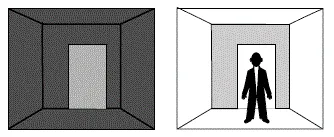
According to sentence 1, there is no overlapping of the time intervals S and R. Moreover, our common sense informs us that the light was on in the room at a time soon after I started to press the switch and also not later than the time when I released the pressure on the switch.
If we consider all possible relations between two intervals based only on the relative orderings of their starting and ending points, we get the 13 relations represented in Figure 1.2. These 13 relations are called Allen's basic relations.
Figure 1.2. Allen's 13 basic relations between interval x (in gray) and interval y (in white)
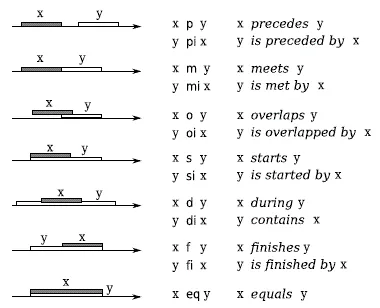
The information obtained from sentence 1 of Allen's example is not sufficiently precise to be expressed in terms of Allen's basic relations, but only in terms of disjunctions between these relations. These disjunctions are noted as subsets of the basic relations. For example, from sentence 1, we can deduce that the relationship between S and R corresponds to the set {p, m, pi, mi} (expressing the fact that I and J are disjoint), and that the relationship between S and L corresponds to the set {o, m}.
In a similar manner, from sentence 2, we can deduce that the relationship between L and R corresponds to the set {o, s, d}.
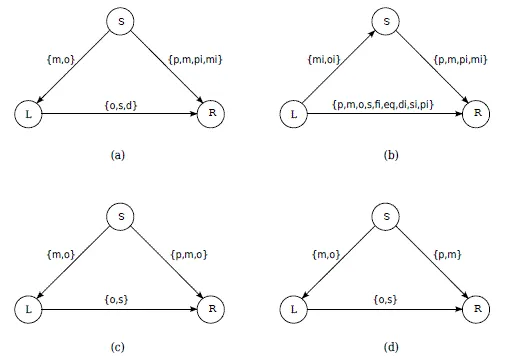
More precisely, we will express our knowledge about the existing relations in terms of constraint networks. In our case, we will consider a network with three nodes representing the time intervals S, L, and R, and arcs labeled by subsets of Allen's basic relations to express the constraints between these intervals. Hence we get the following labels:
– on the arc (S, R), the constraint {p, m, pi, mi};
– on the arc (S, L), the constraint {m, o};
– on the arc (L, R), the constraint {o, s, d}.
Figure 1.3 (a) represents the network thus obtained.
Figure 1.3. The dark room: initial constraints between the three intervals S, L, and R (a); constraint on the arc (L, R) by composition (b); after intersection, the constraint on (L, R) is {o, s}; by composition, {p, m, o} on (S, R) is obtained (c); after intersection with the initial constraint on (S, R) (d)
1.1.1.2. Reasoning: constraint propagation
In a manner similar to what we discussed for the time point calculus in the Introduction, two natural operations are possible for Allen's relations: the inversion operation and the composition operation. For example, by inverting the constraint {m, o} on the arc (S, L), tlie constraint {mi, oi} on the arc (L, S) can be deduced. We now have a set of possible basic relations between L and S, and another set of possible basic relationships between S and R. The operation of composition will allow us to infer a set of possible relations between L and R from this knowledge. The results of the composition of two basic relations can be tabulated, resulting in a table called the composition table of Allen's calculus (originally called table of transitivity by Allen). Using the composition table, we get the constraint {p, m, o, s, fi, eq, di, si, pi} on the arc...
Table of contents
- Cover
- Title Page
- Copyright
- Introduction: Qualitative Reasoning
- Chapter 1: Allen‘s Calculus
- Chapter 2: Polynomial Subclasses of Allen‘s Algebra
- Chapter 3: Generalized Intervals
- Chapter 4: Binary Qualitative Formalisms
- Chapter 5: Qualitative Formalisms of Arity Greater than 2
- Chapter 6: Quantitative Formalisms, Hybrids, and Granularity
- Chapter 7: Fuzzy Reasoning
- Chapter 8: The Geometrical Approach and Conceptual Spaces
- Chapter 9: Weak Representations
- Chapter 10: Models of RCC-8
- Chapter 11: A Categorical Approach of Qualitative Reasoning
- Chapter 12: Complexity of Constraint Languages
- Chapter 13: Spatial Reasoning and Modal Logic
- Chapter 14: Applications and Software Tools
- Chapter 15: Conclusion and Prospects
- Appendix A: Elements of Topology
- Appendix B: Elements of Universal Algebra
- Appendix C: Disjunctive Linear Relations
- Bibliography
- Index
Frequently asked questions
Yes, you can cancel anytime from the Subscription tab in your account settings on the Perlego website. Your subscription will stay active until the end of your current billing period. Learn how to cancel your subscription
No, books cannot be downloaded as external files, such as PDFs, for use outside of Perlego. However, you can download books within the Perlego app for offline reading on mobile or tablet. Learn how to download books offline
Perlego offers two plans: Essential and Complete
- Essential is ideal for learners and professionals who enjoy exploring a wide range of subjects. Access the Essential Library with 800,000+ trusted titles and best-sellers across business, personal growth, and the humanities. Includes unlimited reading time and Standard Read Aloud voice.
- Complete: Perfect for advanced learners and researchers needing full, unrestricted access. Unlock 1.4M+ books across hundreds of subjects, including academic and specialized titles. The Complete Plan also includes advanced features like Premium Read Aloud and Research Assistant.
We are an online textbook subscription service, where you can get access to an entire online library for less than the price of a single book per month. With over 1 million books across 990+ topics, we’ve got you covered! Learn about our mission
Look out for the read-aloud symbol on your next book to see if you can listen to it. The read-aloud tool reads text aloud for you, highlighting the text as it is being read. You can pause it, speed it up and slow it down. Learn more about Read Aloud
Yes! You can use the Perlego app on both iOS and Android devices to read anytime, anywhere — even offline. Perfect for commutes or when you’re on the go.
Please note we cannot support devices running on iOS 13 and Android 7 or earlier. Learn more about using the app
Please note we cannot support devices running on iOS 13 and Android 7 or earlier. Learn more about using the app
Yes, you can access Qualitative Spatial and Temporal Reasoning by Gérard Ligozat in PDF and/or ePUB format, as well as other popular books in Computer Science & Computer Science General. We have over one million books available in our catalogue for you to explore.