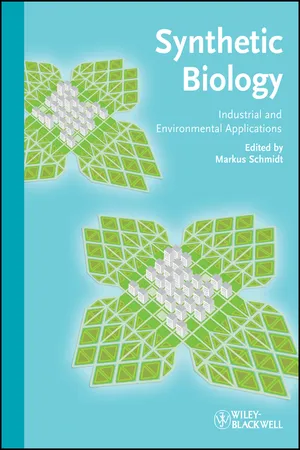
This is the only book to focus on industrial and environmental applications of synthetic biology, covering 17 of the most promising uses in the areas of biofuel, bioremediation and biomaterials. The contributions are written by experts from academia, non-profit organizations and industry, outlining not only the scientific basics but also the economic, environmental and ethical impact of the new technologies.
This makes it not only suitable as supplementary material for students but also the perfect companion for policy makers and funding agencies, if they are to make informed decisions about synthetic biology.
Largely coordinated by Markus Schmidt, a policy adviser, and the only European to testify in front of the bioethics commission of the Obama administration.
- English
- ePUB (mobile friendly)
- Available on iOS & Android
eBook - ePub
About this book
Trusted by 375,005 students
Access to over 1.5 million titles for a fair monthly price.
Study more efficiently using our study tools.
Information
1
Biofuels
1.1 Biofuels in General
1.1.1 Introduction
In 1973, over 86% of the world’s total primary energy supply came from fossil fuels. While the energy supply has increased since then (from about 6 Gtoe1) in the 1970s to 12 Gtoe in 2007), the share of fossil fuels remains high. In 2007, still over 81% came from fossil fuels (gas: 20.9%; oil: 34%; coal: 26.5%; IEA, 2009). The European Community (EC) is strongly dependent on fossil fuels for its transport needs and is a net importer of crude oil (EC, 2010). Numerous experts predict that oil production will reach a ceiling by 2020, while the demand will continue to grow, pulled by China and India. Facing this demand calls for finding alternatives in petroleum products. At the same time, concerns are increasing about climate change and the potential economic and political impact of limited oil and gas resources. To address these issues and reduce our dependency on fossil fuels the EC has adopted measures2) to encourage the production and use of sustainable biofuels (e.g., achieve 5.75% of biofuels among total fuel in the EC). Interestingly, the agricultural policy in Europe or in the United States is also probably the most important driver for the biofuel production. From 2000 to 2008, biofuel production in the United States has increased 82% even though that market accounts for less than 5% of total fuel consumption. Nevertheless, current biofuel production is based only on the exploitation of the storage organs of agricultural plants (sugars or oils). Research and development efforts are necessary to diversify the feedstock available, to limit the impact on food markets, and to produce more efficient molecules as biofuels. This new SB application is probably one of the success keys, as suggested by new petroleum investments (Exxon’s investment in Craig Venter’s synthetic genomics start up, BP invested in Qteros, French Total invested in Gevo, Amyris and Coskata).
Biofuels from biomass (e.g., plant stalks, trunks, stems, leaves) are designed to significantly reduce dependence on imported oil and decrease the environmental impacts of energy use. Biotech research is critical for accelerating the deconstruction of (cellulosic) biomass into sugars that can be converted to biofuels. Woodchips, grasses, cornstalks, and other ligno-cellulosic biomass are abundant but more difficult to break down into sugars than cereals (corn, wheat, etc.), a principal source of fuel ethanol production today. Cellulosic ethanol is therefore one of the proposed cornerstones for our energy needs. There are, however, other alternatives both in terms of feedstock and end product (e.g., butanol). Butanol is assumed to hold great promise. Aquatic biomass, such as algae, does not compete with arable land for food production. Algae can be used for the production of a variety of products, including biodiesel and hydrogen. In a long-term perspective, producing hydrogen or even electricity directly from solar energy and water by means of artificial photosynthesis would provide an almost unlimited source of energy (Thomassen et al., 2008).
Biotechnology and especially synthetic biology can play a key role in increasing production and promoting the use of sustainable bioenergy through:
- Development of next-generation biofuel feedstocks,
- Advanced sunlight to biomass to bioenergy conversion,
- By considering socio-economic and environmental challenges when designing technological solutions.
Table 1.1 provides an overview of different biofuels and the technology and feedstock needed to produce them.
Table 1.1 Overview of different generations of biofuels (UNEP, 2009).
| Traditional biofuels | Basic technology | Feedstocks |
| Solid biofuelsa) | Traditional use of dried biomass for energy | Fuel wood, dried manure |
| First-generation biofuels (conventional biofuels) | ||
| Plant oilsb) | As transport fuel: either adaptation of motors for the use of plant oils; or modification of plant oils to be used in conventional motors | Rapeseed oil, sunflower, other oil plants, waste vegetable oil |
| For the generation of electricity and heat in decentralized power or CHP stations | Rapeseed oil, palm oil, jatropha, other oil plants | |
| Biodiesel | Transesterification of oil and fats to provide fatty acid methyl ester (FAME) and use as transport fuel | Europe: rapeseed, sunflower, soya |
| United States: soya, sunflower | ||
| Canada: soya, rapeseed (canola) | ||
| South and Central America: soya, palm, jatropha, castor | ||
| Africa: palm, soya, sunflower, jatropha | ||
| Asia: palm, soya, rapeseed, sunflower, jatropha | ||
| Bioethanol | Fermentation (sugar); hydrolysis and fermentation (starch); use as transport fuel | United States: corn |
| Brazil: sugar cane | ||
| Other South and Central American countries: sugar cane, cassava | ||
| Europe: cereals, sugar beets | ||
| Canada: maize, cereals | ||
| Asia: sugar cane, cassava | ||
| Africa: sugar cane, maize | ||
| Biogas (CH4, CO2, H2) | Fermentation of biomass used either in decentralized systems or via supply into the gas pipeline system (as purified biomethane): | Energy crops (e.g., maize, miscanthus, short rotation wood, multiple cropping systems); biodegradable waste materials, including animal sewage |
| (1) To generate electricity and heat in power or CHP stations | ||
| (2) As transport fuel, either 100% biogas fuel or blending with natural gas used as fuel | ||
| Solid biofuels | Densification of biomass by torrefaction or carbonization (charcoal) | Wood, grass cuttings, switchgrass; grains; charcoal, domestic refuse, dried manure |
| Residuals and waste for generation of electricity and heat (e.g., industrial wastes in CHP) | ||
| Second-generation biofuels (advanced biofuels) | ||
| Bioethanol | Breakdown of cellulosic biomass in several steps including hydrolysis and finally fermentation to bioethanol | Ligno-cellulosic biomass like stalks of wheat, corn stover and wood; “special energy or biomass” crops (e.g., Miscanthus); sugar cane bagasse |
| Biodiesel and “designer”-biofuels such as bio-hydrogen, bio-methanol, DMFc), bio-DMEd), mixed alcohols | Gasification of low-moisture biomass (<20% water content) provides “syngas” (with CO, H2, CH4, hydrocarbons) from which liquid fuels and base chemicals are derived | Ligno-cellulosic biomass like wood, straw, secondary raw materials like waste plastics |
| Third-generation biofuels (advanced biofuels) | ||
| Biodiesel, aviation fuels, bioethanol, biobutanol | Bioreactors for ethanol (production can be linked to sequestering carbon dioxide from power plants); transesterification and pyrolysis for biodiesel; other pyrolysis for biodiesel; other future technologies | Marine macro-algae or micro-algae in ponds or bioreactors |
a) Traditional use of biomass included for complete overview.
b) Also known as straight vegetable oil. Plant oil used as direct fuel in transport is common in German agriculture with about 838 000 tonnes, mostly rapeseed oil, in 2007, representing 1.4% of total fuel consumption in transport.
c) 2,5-Dimenthylfuran.
d) Dimethyl ether.
1.1.2 Economic Potential
The European Union and the United States have already created an artificial market through energy policies that specify the required rate of incorporation of biofuels in petroleum products. They also support this path through important tax rebates. However, with the arrival of the oil production ceiling and thus the increase in oil prices, a real market will be created and these sectors are likely to be profitable. According to the IEA, 45 million barrels per day could be supplied by biofuels in 2030, making up the deficit in petrol production (see Table 1.2).
Table 1.2 Optimistic scenario of alternative fuel introduction until 2020 in the European Union (Biofuels Platform, 2010).

World ethanol production for transport fuel tripled between 2000 and 2007 from 17 billion to more than 52 billion liters, while biodiesel expanded 11-fold from less than 1 billion to almost 11 billion liters. Altogether, biofuels provided 1.8% of the world’s transport fuel. Recent estimates indicate a continued high growth. From 2007 to 2008, the share of ethanol in global gasoline-type fuel use was estimated to increase from 3.7 to 5.4%, and the share of biodiesel in global diesel-type fuel use from 0.9 to 1.5%. Currently, the main suppliers for transport biofuels are the United States, Brazil and the European Union. Production in the United States consists mostly of ethanol from corn starch, in Brazil of ethanol from sugar cane, and in the European Union mostly of biodiesel from rapeseed. Investment into biofuel production capacity probably exceeded $ 4 billion wo...
Table of contents
- Cover
- Related Titles
- Title page
- Copyright page
- List of Contributors
- Short CV of Contributors
- Preface
- Acknowledgments
- Executive Summary
- Introduction
- 1 Biofuels
- 2 Bioremediation
- 3 Biomaterials
- 4 Other Developments in Synthetic Biology
- 5 Regulatory Frameworks for Synthetic Biology
- Annex A: List of Biofuel Companies
- Annex B: List of Bioremediation Companies
- Index
Frequently asked questions
Yes, you can cancel anytime from the Subscription tab in your account settings on the Perlego website. Your subscription will stay active until the end of your current billing period. Learn how to cancel your subscription
No, books cannot be downloaded as external files, such as PDFs, for use outside of Perlego. However, you can download books within the Perlego app for offline reading on mobile or tablet. Learn how to download books offline
Perlego offers two plans: Essential and Complete
- Essential is ideal for learners and professionals who enjoy exploring a wide range of subjects. Access the Essential Library with 800,000+ trusted titles and best-sellers across business, personal growth, and the humanities. Includes unlimited reading time and Standard Read Aloud voice.
- Complete: Perfect for advanced learners and researchers needing full, unrestricted access. Unlock 1.5M+ books across hundreds of subjects, including academic and specialized titles. The Complete Plan also includes advanced features like Premium Read Aloud and Research Assistant.
We are an online textbook subscription service, where you can get access to an entire online library for less than the price of a single book per month. With over 1.5 million books across 990+ topics, we’ve got you covered! Learn about our mission
Look out for the read-aloud symbol on your next book to see if you can listen to it. The read-aloud tool reads text aloud for you, highlighting the text as it is being read. You can pause it, speed it up and slow it down. Learn more about Read Aloud
Yes! You can use the Perlego app on both iOS and Android devices to read anytime, anywhere — even offline. Perfect for commutes or when you’re on the go.
Please note we cannot support devices running on iOS 13 and Android 7 or earlier. Learn more about using the app
Please note we cannot support devices running on iOS 13 and Android 7 or earlier. Learn more about using the app
Yes, you can access Synthetic Biology by Markus Schmidt in PDF and/or ePUB format, as well as other popular books in Biological Sciences & Biotechnology. We have over 1.5 million books available in our catalogue for you to explore.