![]()
1
The place of genetics in medicine
The case for genetics
In recent years medicine has been in a state of transformation, created by the convergence of two major aspects of technological advance. The first is the explosion in information technology and the second, the rapidly expanding science of genetics. The likely outcome is that within the foreseeable future we will see the establishment of a new kind of medicine, individualized medicine, tailored uniquely to the personal needs of each patient. Some diseases, such as hypertension, have many causes for which a variety of treatments may be possible. Identification of a specific cause allows clinicians to give personal guidance on the avoidance of adverse stimuli and enable precise targeting of the disease with personally appropriate medications.
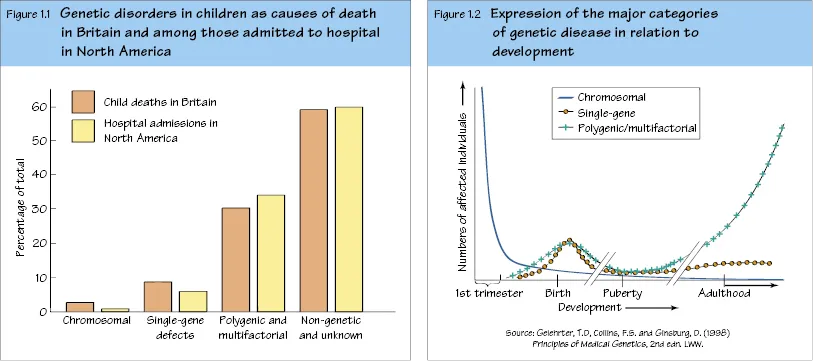
One survey of over a million consecutive births showed that at least one in 20 people under the age of 25 develops a serious disease with a major genetic component. Studies of the causes of death of more than 1200 British children suggest that about 40% died as a result of a genetic condition, while genetic factors are important in 50% of the admissions to paediatric hospitals in North America. Through variation in immune responsiveness and other host defences, genetic factors even play a role in infectious diseases.
Genetics underpins and potentially overlaps all other clinical topics, but is especially relevant to reproduction, paediatrics, epidemiology, therapeutics, internal medicine and nursing. It offers unprecedented opportunities for prevention and avoidance of disease because genetic disorders can often be predicted long before the onset of symptoms. This is known as predictive or presymptomatic genetics. Currently healthy families can be screened for persons with a particular genotype that might cause later trouble for them or their children.
‘Gene therapy’ is the ambitious goal of correcting errors associated with inherited deficiencies by introduction of ‘normal’ versions of genes into their cells. Progress along those lines has been slower than anticipated, but has now moved powerfully into related areas. Some individuals are hypersensitive to standard doses of commonly prescribed drugs, while others respond poorly. Pharmacogenetics is the study of differential responses to unusual biochemicals and the insights it provides guide physicians in the correct prescription of doses.
Genes in development
Genes do not just cause disease, they define normality and every feature of our bodies receives input from them. Typically every one of our cells contains a pair of each of our 20 000–25 000 genes and these are controlled and expressed in molecular terms at the level of the cell. During embryonic development the cells in different parts of the body become exposed to different influences and acquire divergent properties as they begin to express different combinations of the genes they each contain. Some of these genes define structural components, but most define the amino acid sequences of enzymes that catalyse biochemical processes.
Genes are in fact coded messages written within enormously long molecules of DNA distributed between 23 pairs of chromosomes. The means by which the information contained in the DNA is interpreted is so central to our understanding that the phrase: ‘DNA makes RNA makes protein’; or more correctly: ‘DNA makes heterogeneous nuclear RNA, which makes messenger RNA, which makes polypeptide, which makes protein’; has become accepted as the ‘central dogma’ of molecular biology.
During the production of the gametes the 23 pairs of chromosomes are divided into 23 single sets per ovum or sperm, the normal number being restored in the zygote by fertilization. The zygote proliferates to become a hollow ball that implants in the maternal uterus. Prenatal development then ensues until birth, normally at around 38 weeks, but all the body organs are present in miniature by 6–8 weeks. Thereafter embryogenesis mainly involves growth and differentiation of cell types. At puberty development of the organs of reproduction is re-stimulated and the individual attains physical maturity. The period of 38 weeks is popularly considered to be 9 months, traditionally interpreted as three ‘trimesters’. The term ‘mid-trimester’ refers to the period covering the 4th, 5th and 6th months of gestation.
Genotype and phenotype
Genotype is the word geneticists use for the genetic endowment a person has inherited. Phenotype is our word for the anatomical, physiological and psychological complex we recognize as an individual. People have diverse phenotypes partly because they inherited different genotypes, but an equally important factor is what we can loosely describe as ‘environment’. A valuable concept is summarized in the equation:
It is very important to remember that practically every aspect of phenotype has both genetic and environmental components. Diagnosis of high liability toward ‘genetic disease’ is therefore not necessarily an irrevocable condemnation to ill health. In some cases optimal health can be maintained by avoidance of genotype-specific environmental hazards.
Genetics in medicine
The foundation of the science of genetics is a set of principles of heredity, discovered in the mid-19th century by an Augustinian monk called Gregor Mendel. These give rise to characteristic patterns of inheritance of variant versions of genes, called alleles, depending on whether the unusual allele is dominant or recessive to the common, or ‘wild type’ one. Any one gene may be represented in the population by many different alleles, only some of which may cause disease. Recognition of the pattern of inheritance of a disease allele is central to prediction of the risk of a couple producing an affected child. Their initial contact with the clinician therefore usually involves construction of a ‘family tree’ or pedigree diagram.
For many reasons genes are expressed differently in the sexes, but from the genetic point of view the most important relates to possession by males of only a single X-chromosome. Most sex-related inherited disease involves expression in males of recessive alleles carried on the X-chromosome.
Genetic diseases can be classed in three major categories: monogenic, chromosomal and multifactorial. Most monogenic defects reveal their presence after birth and are responsible for 6–9% of early morbidity and mortality. At the beginning of the 20th century, Sir Archibald Garrod coined the term ‘inborn errors of metabolism’ to describe inherited disorders of physiology. Although individually most are rare, the 350 known inborn errors of metabolism account for 10% of all known single-gene disorders.
Because chromosomes on average carry about 1000 genes, too many or too few chromosomes cause gross abnormalities, most of which are incompatible with survival. Chromosomal defects can create major physiological disruption and most are incompatible with even prenatal survival. These are responsible for more than 50% of deaths in the first trimester of pregnancy and about 2.5% of childhood deaths.
‘Multifactorial traits’ are due to the combined action of several genes as well as environmental factors. These are of immense importance as they include most of the common disorders of adult life. They account for about 30% of childhood illness and in middle-to-late adult life play a major role in the common illnesses from which most of us will die.
The application of genetics
If genes reside side-by-side on the same chromosome they are ‘genetically linked’. If one is a disease gene, but cannot easily be detected, whereas its neighbour can, then alleles of the latter can be used as markers for the disease allele. This allows prenatal assessment, informing decisions about pregnancy, selection of embryos fertilized in vitro and presymptomatic diagnosis.
Genetically based disease varies between ethnic groups, but the term ‘polymorphism’ refers to genetic variants like blood groups that occur commonly in the population, with no major health connotations. The concept of polymorphism is especially important in blood transfusion and organ transplantation.
Mutation of DNA involves a variety of changes which can be caused for example by exposure to X-rays. Repair mechanisms correct some kinds of change, but new alleles are sometimes created in the germ cells, which can be passed on to offspring. Damage that occurs to the DNA of somatic cells can result in cancer, when a cell starts to proliferate out of control. Some families have an inherited tendency toward cancer and must be given special care.
A healthy immune system eliminates possibly many thousands of potential cancer cells every day, in addition to disposing of infectious organisms. Maturation of the immune system is associated with unique rearrangements of genetic material, the study of which comes under the heading of immunogenetics.
The study of chromosomes is known as cytogenetics. This provides a broad overview of a patient's genome and depends on microscopic examination of cells. By contrast molecular genetic tests are each specifically for just one or a few disease alleles. The molecular approach received an enormous boost around the turn of the millennium by the detailed mapping of the human genome.
The modern application of genetics to human health is therefore complex. Because it focuses on reproduction it can impinge on deeply held ethical, religious and social convictions, which are often culture variant. At all times therefore, clinicians dealing with genetic matters must be acutely aware of the real possibility of causing personal offence and take steps to avoid that outcome.
![]()
2
Pedigree drawing
Overview
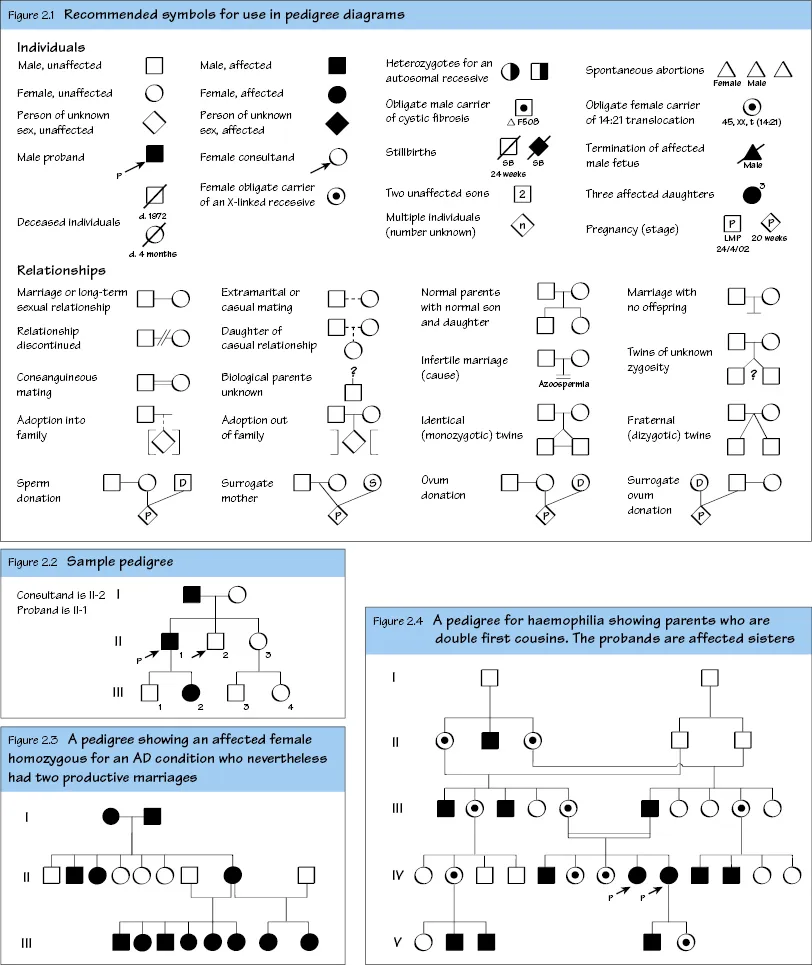
The collection of information about a family is the first and most important step taken by doctors, nurses or genetic counsellors when providing genetic counselling. A clear and unambiguous pedigree diagram, or ‘family tree’, provides a permanent record of the most pertinent information and is the best aid to clear thinking about family relationships.
Information is usually collected initially from the consultand, that is the person requesting genetic advice. If other family members need to be approached it is wise to advise them in advance of the information required. Information should be collected from both sides of the family.
The affected individual who caused the consultand(s) to seek advice is called the propositus (male), proposita (female), proband or index case. This is frequently a child or more distant relative, or the consultand may also be the proband. A standard medical history is required for the proband and all other affected family members.
The medical history
In compiling a medical history it is normal practice to carry out a systems review broadly along the follow...