- Focuses on the current schema mode model, within which cases can be more easily conceptualized and emotional interventions more smoothly introduced
- Extends the practice of schema therapy beyond borderline personality disorder to other personality disorders and Axis I disorders such as anxiety, depression and OCD
- Presented by authors who are world-respected as leaders in the schema therapy field, and have pioneered the development of the schema mode approach
eBook - ePub
Schema Therapy in Practice
An Introductory Guide to the Schema Mode Approach
- English
- ePUB (mobile friendly)
- Available on iOS & Android
eBook - ePub
Schema Therapy in Practice
An Introductory Guide to the Schema Mode Approach
About this book
Schema Therapy in Practice presents a comprehensive introduction to schema therapy for non-specialist practitioners wishing to incorporate it into their clinical practice.
Information
II
TREATMENT
4
Treatment Overview
As a first step in treatment, the mode concept is discussed with the patient. The patient’s mode model summarizes the main problems, symptoms, and interaction patterns and should be reasonable and plausible for both the patient and the therapist. In the treatment that follows, each type of mode is linked with specific treatment goals (see Figure 4.1). The combination of treatment elements and the relative importance of different treatment techniques, as well as the balance between interventions treating specific symptoms and interventions treating personality symptoms, have to be adapted to the individual case.
4.1 Treatment Goals for Individual Modes
4.1.1 Vulnerable child modes
The basic goal of schema therapy with regard to vulnerable child modes is to help patients to care better for their own needs. They should develop a stronger focus on their own needs. They should establish or strengthen activities which fulfill important emotional and social requirements. A main task of the therapist in treating vulnerable child modes is validating, soothing, and helping to process abuse and other negative experiences. Thus the therapist offers a model for caring for vulnerable child parts (and for self-care in general).
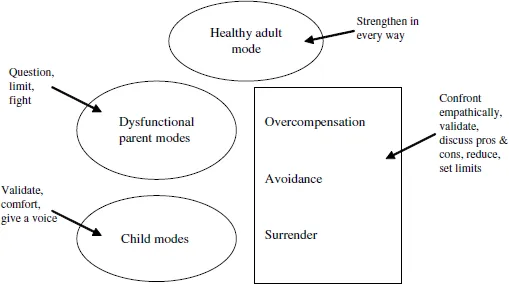
Figure 4.1 Treatment overview
4.1.2 Angry/enraged child modes
These modes should be aired in therapy. Patients are encouraged to experience and articulate anger. Anger comes up when their own needs are hurt; it is therefore regarded as an important feeling. The associated needs are validated and accepted. However, the patient has to learn more adequate ways of communicating these needs.
4.1.3 Impulsive/undisciplined child modes
As with angry child modes, the general needs behind impulsive or undisciplined child modes should be validated and accepted. However, these modes express needs in an exaggerated way. Thus it may be important to set limits to these modes and to help the patient find more realistic expectations regarding the needs associated with these modes. Furthermore, a patient with these modes should be taught discipline and frustration tolerance.
4.1.4 Dysfunctional parent modes
The main goal with these modes is to weaken them. Dysfunctional parent modes should be questioned, limited, or even fought. The therapist must help the patient reduce the extremely high standards and self-devaluations associated with these modes.
4.1.5 Dysfunctional coping modes
Patients should first be empathically confronted with these modes. The reasons these parts were important for the patient during childhood, and how protective they were at that time, should be discussed. At the same time, the negative consequences of these modes must be addressed. The influence of these modes has to be reduced in order to enable the patient to react more flexibly and more adequately to stressful situations. When dysfunctional coping modes constrain the course of the therapy, clear limits must be set.
4.1.6 Happy child mode and healthy adult mode
These modes should generally be strengthened and reinforced in therapy, and their intensity and frequency of activation increased.
4.2 Treatment Techniques
Schema therapy combines cognitive, emotion-focused, and behavioral interventions.
4.2.1 Cognitive interventions
Cognitive interventions (Figure 4.2) are used to test the validity and “truth” of schemas or modes by means of pro-and-con discussions. With cognitive reframing techniques, different “proofs of a schema or schema mode” are explained in turn. All cognitive interventions can be used. For example, a therapist might discuss with a patient why the woman at the supermarket cash desk did not say “hello” that morning. The patient might spontaneously interpret this in connection with a particular schema, and regard it as an indicator of rejection. Cognitive techniques may help this patient to get another perspective and adopt more functional interpretations. Similarly, schema-congruent errors in reasoning and the pros and cons of coping strategies are discussed. Psychoeducation plays an important role, too. Patients are informed about the normal needs of children, normal emotions, normal behavior patterns, and the differences between a healthy and normal childhood development and their own childhood.
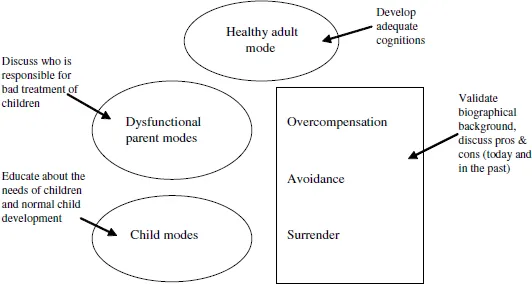
Figure 4.2 Cognitive treatment interventions
Cognitive interventions include all CBT methods, such as reframing, discussion of errors in reasoning, and the use of pro-and-con lists.
Child modes An important cognitive technique is psychoeducation about the normal needs of human beings. People with severe personality disorders in particular often have no clear and realistic idea of how they should actually have been treated as a child (even though many of these patients know quite well how children should be treated as far as other people—or their own children—are concerned).
Dysfunctional parent modes The main focus of cognitive interventions is on the discussion of guilt and the adequacy of parental behaviors in the patient’s childhood. Patients often feel that the way they were treated as a child was their own fault. Such misinterpretations have to be reattributed using cognitive treatment techniques. An important technique is to take an external perspective: “Would you still regard the child as responsible and guilty for the bad treatment if it was someone else, or if you were to imagine your own child in your place?”. Some patients say that they had a very complicated temperament or were in some way difficult as a child. Even if this is true, the patient should be told that the parents were wrong to have blamed the child for its temperament (the child didn’t choose its temperament) and that the parents were responsible for adequately adapting their care to the child’s temperament. Important topics that often need to be addressed with cognitive methods include: (1) when you are actually responsible, as distinct from “bad luck” (bad luck is a concept that is usually not incorporated in dysfunctional parent modes); (2) the fundamental right to make mistakes, and the necessity of making mistakes in order to learn new things; (3) the fundamental needs and rights of children (you may refer to the UN Declaration of the Rights of the Child: http://www.un.org/cyberschoolbus/humanrights/resources/child.asp).
Coping modes The important protective function of coping modes during childhood is first validated. The pros and cons of coping modes are then discussed, with regards to both the childhood situation and the current situation of the patient. Steps for reducing coping modes are explored, first within the therapeutic situation, then in the patient’s life outside therapy.
Cognitive work is embedded in emotion-focused interventions. For example, the adequacy of guilt can be addressed in chair dialogues between dysfunctional parent modes and the healthy adult mode. More explicit cognitive interventions in schema therapy include schema diaries or schema flash cards (Chapter 6), and pro-and-con lists for coping styles or schemas (Chapter 5).
4.2.2 Emotion-focused interventions
Emotion-focused interventions (Figure 4.3) are supposed to help the patient express sadness and rage. Experiencing and processing these emotions helps patients to focus more on their own needs and their own goals. They thus experience themselves as more important and finally as more positive and more valuable. Problematic emotions can be actively changed using emotion-focused techniques.
The main emotion-focused techniques in schema therapy are imagery exercises and so-called “chair work.”
Imagery exercises In imagery exercises, schemas or modes are activated by deepening current emotions and connecting them with biographical memories. The main intervention technique for (traumatic) childhood memories is “imagery rescripting.” In an imagery rescripting exercise, traumatic or difficult situations are changed in the imagination in such a way that the needs of the traumatized or badly treated child are fulfilled.
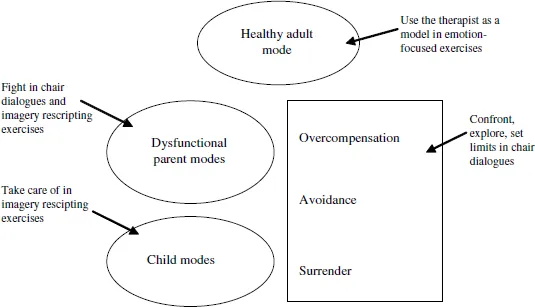
Figure 4.3 Emotion-focused interventions
This might mean stopping a violent or abusive perpetrator, taking the child out of the situation, and caring for it, for example. The use of imagery exercises is not restricted to the treatment of childhood memories. Imagery exercises can also be used to rescript later-life trauma or to prepare the patient for future situations (for a broad introduction, see Hackman et al., 2011). Imagery exercises are explained in more detail in Chapter 6.
Imagery rescripting exercises and other emotion-focused interventions support patients in experiencing feelings related to the fulfillment of needs, such as rage against punitive parent modes, or empathy with vulnerable child modes.
Chair work In chair-work exercises ...
Table of contents
- Cover
- Table of Contents
- Title
- Copyright
- About the Authors
- Acknowledgments
- Introduction
- I CASE CONCEPTUALIZATION
- II TREATMENT
- References
- Index
- End User License Agreement
Trusted by 375,005 students
Access to over 1.5 million titles for a fair monthly price.
Study more efficiently using our study tools.
Frequently asked questions
Yes, you can cancel anytime from the Subscription tab in your account settings on the Perlego website. Your subscription will stay active until the end of your current billing period. Learn how to cancel your subscription
No, books cannot be downloaded as external files, such as PDFs, for use outside of Perlego. However, you can download books within the Perlego app for offline reading on mobile or tablet. Learn how to download books offline
Perlego offers two plans: Essential and Complete
- Essential is ideal for learners and professionals who enjoy exploring a wide range of subjects. Access the Essential Library with 800,000+ trusted titles and best-sellers across business, personal growth, and the humanities. Includes unlimited reading time and Standard Read Aloud voice.
- Complete: Perfect for advanced learners and researchers needing full, unrestricted access. Unlock 1.5M+ books across hundreds of subjects, including academic and specialized titles. The Complete Plan also includes advanced features like Premium Read Aloud and Research Assistant.
We are an online textbook subscription service, where you can get access to an entire online library for less than the price of a single book per month. With over 1.5 million books across 990+ topics, we’ve got you covered! Learn about our mission
Look out for the read-aloud symbol on your next book to see if you can listen to it. The read-aloud tool reads text aloud for you, highlighting the text as it is being read. You can pause it, speed it up and slow it down. Learn more about Read Aloud
Yes! You can use the Perlego app on both iOS and Android devices to read anytime, anywhere — even offline. Perfect for commutes or when you’re on the go.
Please note we cannot support devices running on iOS 13 and Android 7 or earlier. Learn more about using the app
Please note we cannot support devices running on iOS 13 and Android 7 or earlier. Learn more about using the app
Yes, you can access Schema Therapy in Practice by Arnoud Arntz,Gitta Jacob in PDF and/or ePUB format, as well as other popular books in Psychology & Clinical Psychology. We have over 1.5 million books available in our catalogue for you to explore.