![]() PART 1
PART 1
Emerging Concepts![]()
Chapter 1
Joint Diversity and Beamforming for
Downlink Communications1
1.1. Introduction
Mobile communication systems must be able to cope with fading and multi-user interference. Since the introduction of GSM until today, these problems have been considered from different angles and several approaches have been proposed to mitigate impairments.
Digital processing of the signal coming from an array of antennas (called smart antenna techniques) [JAK 74, RAP 01, YAC 93] has played a very important role in the progress achieved in this area so far. Among the novel techniques in this area, we can cite beamforming, diversity and MIMO (multiple input multiple output) techniques as the most successful. Smart antenna techniques can be applied either at the base station or at the mobile, and on the downlink or uplink. For technological and economical reasons, it is often more advantageous to only have an array of antennas at the base station, and a single antenna at the mobile. For the sake of simplicity, but without loss of generality, in this chapter we will consider the downlink of a mobile system with an antenna array at the base station and a single antenna at the mobile.
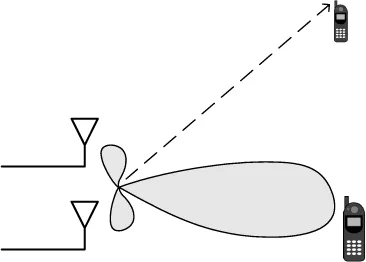
The main goal of beamforming is to increase the signal-to-noise ratio (SNR) at the desired mobile and to reduce the interference generated toward other mobiles present in the system. This is done by directing the radiated signal towards the receiver. The chosen direction does not necessarily match the geographical direction, but can correspond to the main path of the electromagnetic waves traveling from the base station to the receiver.
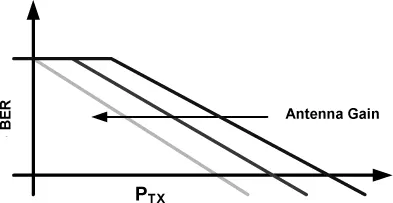
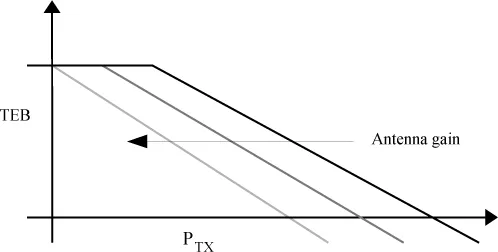
By forming a beam in the direction of the mobile, the transmit power (PTX) can thus be reduced in order to maintain the same bit-error rate (BER). The amount of transmit power saved in the process is called antenna gain. In fact, the effect of beamforming can be seen as a shift of the BER curve to the left.
The diversity approach treats the same problem from a different perspective. When looking closer at the propagation channel between the base station and the mobile receiver, we notice that this channel is generally formed by the sum of several smaller paths (called multipaths). Each multipath is characterized by its attenuation, delay and relative phase. These parameters vary in time due to the relative motion between the transmitter and receiver, but also due to the movement of all reflectors and obstacles present in the surroundings.
Hence, the overall propagation channel seen by the receiver is the result of the sum of all the multipaths, which translates into a time variation of the signal power at the receiver. This effect is the so-called fading. When the phases of the multipaths are such that they lead to a destructive combination (a strong attenuation of the transmit power), we talk about deep fading.
In practice, the performance of the mobile systems is highly degraded by the presence of deep fadings. The mitigation of these deep fadings is thus the main goal of the diversity techniques. The central idea is to exploit the fact that the channel shows a low correlation to send copies of the same signal, which will suffer uncorrelated attenuations. Thus, the probability that all these copies encounter a deep fading at the same time is very low. Therefore, by combining these copies at the receiver, we can drastically reduce the probability that the received signal is in deep fading and, even in the rare cases when it occurs, the duration of the fading is also diminished.
To best profit from diversity, the copies transmitted by uncorrelated multipaths should also be uncorrelated among them. In this manner, the receiver can combine these copies in such a way as to result in the addition of the multipaths’ powers, leading to the best use of the transmitted power at every time instant.
The different multipaths correspond to the diverse uncorrelated modes over which the signal can be transmitted, and the number of modes is called the diversity order of the channel. These modes are characterized in different domains, respectively in the spatial domain by the direction of arrival (DOA), in the temporal domain by the delay, and in the frequency domain by the selectivity. When the multipaths are uncorrelated in the temporal domain, we say that the channel provides time diversity. In the same way, when the multipaths are uncorrelated in the frequency domain, the channel provides frequency diversity. Instead, the use of an antenna array introduces a new processing domain and, therefore, a new kind of diversity that exploits the spatial decorrelation among multipaths, called space diversity. The use of the space diversity is of fundamental importance in mobile communication as it allows for an overall diversity order greater than 1, even when the channel is flat in frequency (no frequency diversity) and is time invariant (no temporal diversity).
The use of space diversity makes better use of the transmit power (PTX) in the probabilistic sense, leading to a reduction of PTX for the same BER. The slope of the BER curve becomes steeper with the diversity order of the channel. The relationship between the actual slope and the slope obtained without exploiting the channel diversity is called the diversity gain.
1.2. Space diversity versus beamforming
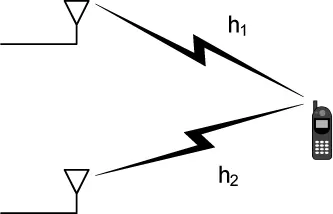
The assumptions behind beamforming and space diversity are contradictory. On the one hand, the best results for space diversity are obtained when the channels between each antenna and the mobile are uncorrelated. On the other hand, in order to best exploit the antenna gain provided by beamforming, these channels must have a minimum amount of correlation.
In practice, the physical channel between the base station and mobile user is never completely corre...