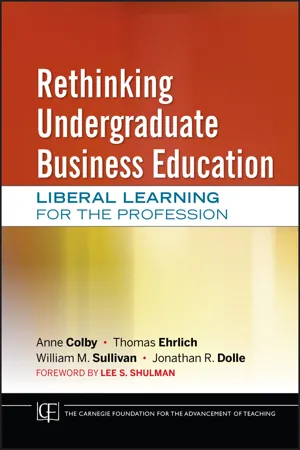
The Carnegie Foundation for the Advancement of Teaching's national study of undergraduate business education found that most undergraduate programs are too narrow, failing to challenge students to question assumptions, think creatively, or understand the place of business in larger institutional contexts. Rethinking Undergraduate Business Education examines these limitations and describes the efforts of a diverse set of institutions to address them by integrating the best elements of liberal arts learning with business curriculum to help students develop wise, ethically grounded professional judgment.
eBook - ePub
Rethinking Undergraduate Business Education
Liberal Learning for the Profession
- English
- ePUB (mobile friendly)
- Available on iOS & Android
eBook - ePub
Rethinking Undergraduate Business Education
Liberal Learning for the Profession
About this book
Business is the largest undergraduate major in the United States and still growing. This reality, along with the immense power of the business sector and its significance for national and global well-being, makes quality education critical not only for the students themselves but also for the public good.
Information
1
LIBERAL LEARNING FOR BUSINESS EDUCATION
AN INTEGRATIVE VISION
BUSINESS HAS NEVER MATTERED MORE. Most people now realize that the livelihood of citizens of Minneapolis is related in complicated ways to the skills and aspirations of the citizens of Guangzhou, Sao Paolo, and Mumbai as well as those of Mobile. The enormous economic expansion within some of the most populous nations of the world, especially China, Brazil, and India, has put competitive pressure on growing numbers of U.S. workers and firms, who compete with others in distant places, even as they also sometimes cooperate through complex networks of trade and investment.
Increasingly, this fragile interdependence is being managed by international business and, over the past several decades especially, by banking and financial sectors that have become tightly linked on a global scale. The “commanding heights” of the economic welfare of nations are no longer occupied by governments alone (Yergin & Stanislaw, 1998). Business in its multiple manifestations has become a prodigious governing force, shaping the destiny of people everywhere.
Business is also more important than ever in American higher education. In 2006–07, the most recent academic year for which national data were available, 21 percent of all undergraduates were business majors. This makes business the most popular field of undergraduate study. When business is combined with other vocational majors such as engineering, nursing, education, agriculture, security studies, and others, the total rises to 68 percent of all undergraduates (National Center for Educational Statistics, 2009).

At the same time, the prominence of business institutions in contemporary U.S. society has enhanced the prestige and authority of successful leaders in business, and business ways of thinking have now taken hold in wider sectors, including not only government but also the organization and leadership of the academy.
For higher education, these developments pose an important question. The American academy has been chartered for important public purposes, chiefly to educate citizens for democracy. The centrality of business in society, the great number of undergraduates who choose business as their field of study, and the even greater numbers who will be employed in business for their working lives demand that higher education do more than just help students acquire tools for advancing their personal careers in business, although that is an important goal. In order to ensure that its graduates develop the breadth of outlook and conceptual agility for living in a global century, higher education also needs to ensure that students understand the relation of business to the larger world and can act on that understanding as business professionals and as citizens. The question, then, is how best to do this? What should undergraduate business education provide for students?
The Bell Project
The answers proposed in this book reflect our work in the Business, Entrepreneurship, and Liberal Learning (BELL) project, an initiative of The Carnegie Foundation for the Advancement of Teaching. Simply put, we believe that undergraduate students who major in business should have the benefits of a strong liberal education. Business and liberal learning must be woven together to prepare students for their professional roles and work and also to prepare them for lives of social contribution and personal fulfillment. In this sense, we propose an integrative vision.
Accordingly, our research has focused on how liberal education interacts with business preparation in undergraduate programs, asking how well undergraduate business education has been able to take advantage of the contributions of liberal learning. We began our research with an understanding, which was subsequently reinforced by our observations, that business majors typically experience the liberal arts and sciences in ways that are weak or episodic. Many business students see liberal arts courses as largely irrelevant to their education. For all the reasons discussed previously—and elaborated in the pages that follow—we believe this is unsatisfactory. Therefore, we set out to examine programs that explicitly announced the intent to provide their undergraduate business majors with the benefits of liberal learning, looking both at common principles and concepts shaping their efforts and at the diverse strategies they have employed. These institutions’ efforts hold lessons for one another and for the larger field of business education, and we believe they also provide an opportunity for liberal arts disciplines to learn from business education, especially about strategies that help students practice and refine their knowledge in real-world circumstances (see, for instance, Shulman, 1997). Additionally, successful efforts at integration within business programs may be instructive for other professional and vocational programs that wish to do the same.
In this sense, we view business education as an instance of the larger phenomenon of vocational majors, fields of study that aim to prepare students directly for entry into the workforce. Due to the rising costs of higher education and the challenges of the employment market, students and their parents today consider preparation for work a top priority among the goals of higher education, and this preference is reflected in the large percentage of students choosing to major in professional or vocational fields. Because more undergraduate students major in business than in any other single field, it would seem there might be a distinctive character or identity to studying business at the college level. But we did not find this to be the case. Undergraduate business seems to be widely understood as a kind of simplified MBA program. In institutions that offer both MBA and undergraduate business degrees, the undergraduate program rarely has its own faculty or dean and its curriculum resembles that of the graduate program. A more distinctive identity for undergraduate business programs would acknowledge that this is their students’ college education as well as professional preparation. This means, in the American tradition of liberal education, that students need to be prepared for their futures as citizens and persons as well as entrants into the workforce.
Rethinking Undergraduate Business Education
To meet the needs of today’s increasingly complex context, undergraduate business programs should help their students develop intellectual perspectives that enable them to understand the role of the field within the larger social world. In keeping with this aim, business programs should uphold and cultivate among students a sense of professionalism grounded in loyalty to the mission of business to enhance public prosperity and well-being. To accomplish this, business education must be integrated with liberal learning.
We believe that undergraduate education of every kind should enable students to make sense of the world and their place in it, preparing them to use knowledge and skills as means toward responsible engagement with the world. In order to contribute to the larger life of society, students must be able to draw on varied bodies of knowledge. They need to gain fluency in looking at issues from multiple points of view, which requires the opportunity to explore with others different ways of posing problems and defining purposes. These are the traits that have historically defined a liberal education. In this sense, the question of what business education should provide for students is part of the more fundamental question of what a college education should provide.
Research on educational attainment provides abundant evidence that a college education produces significant lifelong effects. College is a prime moment for students, including many older students, to question and redefine their core sense of who they are. It offers the opportunity to expand their understanding of the world and to develop skills they will need to make their way in it. College education enables students to grow as whole persons as well as develop their minds and strengthen their working skills. It helps awaken their intellectual curiosity and self-reflection and can aid their evolution toward attaining a sense of responsibility for the common good.
Today’s educational challenge is to prepare students for a world in which ensuring the welfare of the human population must take place within a concern for planetary survival. In such a context, a college education needs more than ever to enable students to understand the world and find their place in it. Beyond that, higher education’s mission requires helping students develop so they can and will contribute to the life of their times. These are ideals long espoused by the tradition of liberal education and represented in the core commitments that define professional preparation. These aims have become especially important in the education of business undergraduates today because of the critical and pervasive role of business in contemporary life.
Narrowed Perspectives and Missed Connections
Business programs, like all forms of professional preparation, immerse students in the values and mind-sets that are peculiar to the field; in business this means, most prominently, the logic of the marketplace. This immersion holds the attendant danger that students will lose sight of the larger pluralism of institutional sectors and spheres of value within which business has to operate. This is not just a theoretical concern. Indeed, we found it distressingly common, even in high-quality programs, to hear students say that their business courses had taught them that “everything is business”—overlooking the different values represented by their families, religious congregations, and communities.
Like all undergraduates, business students need the ability to grasp the pluralism in ways of thinking and acting that is so salient a characteristic of the contemporary world. And it is especially important that business students learn to recognize and distinguish between the dominant logic of business and the marketplace, on the one hand, and, on the other, the very different values and ways of acting that hold sway in the family and the domestic sphere, the worlds of science and education, the arts, and within a democratic government. Business graduates will need facility in moving among these different spheres of value and logics of action. They will benefit from learning to see business and its logic from the outside as well as from within.
The need to grasp this pluralism of values and contexts is, we believe, a weak link in the current organization of undergraduate business programs. Most business programs require their students to take a substantial number of courses outside the business disciplines, in classic arts and sciences fields such as English composition, literature, history, the social sciences, science, and mathematics. However, the relation of these studies to students’ major courses in business is rarely well articulated or closely coordinated. The overall program as it stands now might be thought of as a curricular barbell: each end of the bar carries a significant weight of intellectual subject matter but the connection is slender. On the two ends of the barbell, students encounter courses taught by different groups of faculty, often from different schools or colleges, who have little contact with their colleagues on the other side of the curriculum. The linkages between the two ends of the barbell receive little explicit attention either in the way the curriculum is organized or in how courses are taught.
This arrangement is not the best way to support the high-quality, interconnected learning that today’s students need in order to understand the relation of business to the larger world. In recent decades, research on human learning has made it clear that effective learning depends significantly on learners’ intentions and motivation. With business students’ focus on career preparation as the most important outcome of college, the goals of liberal education are more achievable if they are explicitly related to students’ existing horizon of interest.
Liberal learning has the potential to broaden and reshape such initially narrow purposes but for this to occur students must come to see how and why the perspectives of the arts and sciences disciplines open up and provide insight into matters of concern to them. This requires a kind of teaching that systematically leads students to grasp and participate in making such connections (Kuh, 2008; National Research Council, 2000; Pascarella & Terenzini, 2005).
An Integrative Vision
Our aim in this book is to stimulate and contribute to a national discussion about business education and its future by focusing on approaches that work to integrate the two ends of the usual barbell curriculum. Rather than a barbell, we envision something more like a double helix. Borrowing from the famous DNA model developed by Watson and Crick, we propose the double helix as a metaphor for an undergraduate business curriculum that explicitly and continually links students’ learning of business to their use of various arts and sciences disciplines that provide a larger, complementary view of the world.
This is not simply an imagined possibility. As we will illustrate in the chapters that follow, we observed courses and entire programs that explicitly put the disciplinary insights and tools of the social sciences and humanities to use in this way. We first encountered the double helix metaphor at Santa Clara University. There, and in similar programs, we saw the liberal arts and sciences used to provide an understanding of the other institutional sectors that business depends on, such as effective public education systems organized by governments, and the ways in which business affects those other institutional contexts. Through these double helix approaches, faculty as well as students can develop facility in navigating the pluralism of values and operating logics that will mark their graduates’ actual lives as business professionals and as citizens.
In the absence of this kind of integrative consciousness, undergraduate business education is often narrow. By this we mean that it provides too little depth of understanding about or flexibility of perspective on the tools and concepts employed in business disciplines. This leads students to view these conceptual tools not as hypotheses to be employed for specific purposes but as simple and complete descriptions of reality. As we will try to show, this limits students’ development as thinkers. And, in doing so, it threatens to undermine the creative thinking that feeds innovation.
By contrast, when there is more intentional integration of liberal learning approaches with business—double helix style—faculty can help students achieve more advanced educational goals. They can also strengthen students’ sense of professional purpose by showing more effectively how business is interconnected with other dimensions of society and the environment. Implementing this integrative approach will require significant and sometimes difficult reform—that is the nature of innovation. But there is much to build on, historically and in current campus practice.
The Design of the Study
We began our study by surveying business programs broadly, by reading widely in the history of the field and in current business education literature, and by talking with those who have special expertise and experience to share. We also brought to our work a set of ideas and frameworks from Carnegie’s earlier studies of preparation in nursing, medicine, the clergy, engineering, and law (Benner, Sutphen, Leonard, & Day, 2009; Cooke, Irby, & O’Brien, 2010; Foster, Dahill, Golemon, & Tolentino, 2006; Sheppard, Macatangay, Colby, & Sullivan, 2009; Sullivan, Colby, Wegner, Bond, & Shulman, 2007).
With a broad sense of the field in view, we chose ten campuses for intensive site visits during the academic years 2007–08 and 2008–09. Our first criterion was to look for places that were committed to bringing liberal learning and business perspectives together in an intentionally integrated curriculum with appropriate pedagogies.
To ensure that we grasped the broad range of issues involved, we also wanted to be sure we visited a variety of program types. We went to several large university business schools. One of these was the Kelley School of Business at Indiana University (IU), as well as the Liberal Arts and Management Program housed in the IU College of Arts and Sciences. Three private university business schools figured in our rounds: the Wharton School of the University of Pennsylvania and the Stern School of New York University along with the Program in Management Science at Massachusetts Institute of Technology’s Sloan School of Management. We visited Babson College and Bentley University, institutions begun as business colleges that have evolved into full four-year institutions, as well as Morehouse College and Franklin & Marshall College among predominately liberal arts institutions. Our sites also included Santa Clara University, a Jesuit institution in California, and Portland State University, a public, urban university in Oregon (see ‘‘Site Visit Institutions’’).
Site Visit Institutions
Babson College
Bentley University
Franklin & Marshall College
Indiana University, Bloomington (Kelley)
Massachusetts Institute of Technology (Sloan)
Morehouse College
New York University (Stern)
Portland State University
Santa Clara University (Leavey)
University of Pennsylvania (Wharton)
Our campus visits lasted several days. During that time, we spoke with a variety of academic personnel and students. We talked with deans, faculty, and students in the business programs and the arts and sciences. We visited classes in the business disciplines and the arts and sciences courses frequented by business students, giving special attention to those educational experiences that brought the two areas of the curriculum together. We sought to understand the varying practices of teaching and learning employed in these areas of the business students’ curriculum, the kinds of intellectual and social skills that each emphasizes, how students are assessed, and the kinds of moral meaning and professional identity that faculty intend to convey and that students perceive as salient. We interviewed arts and sciences and business faculty individually and held focus groups with students from business and the arts and sciences.
Our aim in these conversations was to understand th...
Table of contents
- Cover
- Title page
- Copyright page
- The Carnegie Foundation for the Advancement of Teaching
- FOREWORD
- Dedication
- ACKNOWLEDGMENTS
- THE AUTHORS
- 1 LIBERAL LEARNING FOR BUSINESS EDUCATION
- 2 BUSINESS AND THE ACADEMY
- 3 ON THE GROUND
- 4 THE MEANING AND RELEVANCE OF LIBERAL EDUCATION
- 5 TEACHING FOR KEY DIMENSIONS OF LIBERAL LEARNING
- 6 PEDAGOGIES OF LIBERAL LEARNING IN BUSINESS EDUCATION
- 7 STRUCTURAL APPROACHES TO INTEGRATION
- 8 EMERGING AGENDAS
- 9 THE WAY FORWARD
- REFERENCES
- Index
Trusted by 375,005 students
Access to over 1.5 million titles for a fair monthly price.
Study more efficiently using our study tools.
Frequently asked questions
Yes, you can cancel anytime from the Subscription tab in your account settings on the Perlego website. Your subscription will stay active until the end of your current billing period. Learn how to cancel your subscription
No, books cannot be downloaded as external files, such as PDFs, for use outside of Perlego. However, you can download books within the Perlego app for offline reading on mobile or tablet. Learn how to download books offline
We are an online textbook subscription service, where you can get access to an entire online library for less than the price of a single book per month. With over 1.5 million books across 990+ topics, we’ve got you covered! Learn about our mission
Look out for the read-aloud symbol on your next book to see if you can listen to it. The read-aloud tool reads text aloud for you, highlighting the text as it is being read. You can pause it, speed it up and slow it down. Learn more about Read Aloud
Yes! You can use the Perlego app on both iOS and Android devices to read anytime, anywhere — even offline. Perfect for commutes or when you’re on the go.
Please note we cannot support devices running on iOS 13 and Android 7 or earlier. Learn more about using the app
Please note we cannot support devices running on iOS 13 and Android 7 or earlier. Learn more about using the app
Yes, you can access Rethinking Undergraduate Business Education by Anne Colby,Thomas Ehrlich,William M. Sullivan,Jonathan R. Dolle in PDF and/or ePUB format, as well as other popular books in Education & Higher Education. We have over 1.5 million books available in our catalogue for you to explore.