- Brings together contributions from a distinguished group of international scholars.
- Provides an overview of current thinking on the period.
- Traces the great political, social and economic upheavals of the time.
- Illuminates perennial themes, as well as new areas of enquiry.
- Takes a pan-European approach, highlighting similarities and differences across nations and regions.
- English
- ePUB (mobile friendly)
- Available on iOS & Android
eBook - ePub
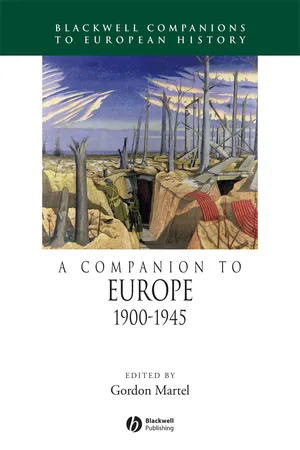
A Companion to Europe, 1900 - 1945
About this book
This volume brings together a distinguished group of international scholars to discuss the major debates in the study of early twentieth-century Europe.
Information
PART I
Continuity and Change; Forces and Movements
CHAPTER ONE
Urbanization, Poverty, and Crime
Thus on every side the strange and artificial growth of our cities confronts us … We cannot but observe the evil effects of the enforced severance from natural conditions of life. (C. F. G. Masterman, The Heart of the Empire, 1901)
It is relatively easy to construct a portrait of Europe during the first half of the twentieth century as intrinsically “modern.” After all, the “metropolis” – blazing with electric light, crowded with commuters, flanked by suburbs – was already an established feature of European society by World War I. The growth of fledgling welfare state initiatives across Europe revolutionized living conditions for many during the period. Paid holidays, slum clearances, town planning, and improving educational provision – all seem indicative of early “progress” towards the comfortable present of twenty-first century Europe. Similarly, the period can also be viewed as a “Golden Age” of policing in some countries. The lack of public legitimacy and problems with professional conduct which had beset crime control institutions for much of the nineteenth century were subsiding, and the advent of early forensic science and the development of international institutions such as Interpol (set up in 1923) again seem indicative of a Europe not dissimilar to our own. It is tempting, therefore, in looking back on the first half of the twentieth century, to discern in retrospect only our current Europe in its nascent form.
However, caution must be exercised. It is inadvisable to look back from the vantage point of twenty-first century Europe and perceive only its smooth genesis. Rather than a history of progress, even the most cursory study of the Europe of the first half of the twentieth century also throws up startling incongruities. In the first place, significant regional and temporal variations are apparent when any single vector of change is considered. For example, while more than half of all Britons had been classed as living in urban areas by the mid-nineteenth century, it took until the 1930s for this proportion to be reached just across the Channel in France. Equally, welfare provision and the amelioration of poverty varied widely across time and place. While Germany, Denmark, and Norway all pioneered the introduction of welfare legislation,as late as 1931 barely 40 percent of houses in Moscow had running water. In the field of crime and policing, too, while there is certainly some evidence of growing public acceptance of increasingly professional policing, a “revisionist” history of crime and policing might also be presented, which might highlight the London Metropolitan Police baton charging Hunger Marchers in 1932 or the disturbing uses to which the police were put in Nazi Germany (and, to a lesser extent, in Nazi-occupied nations).
Perhaps even more significantly, however, not only were there wide variations in social conditions across Europe, in patterns of urbanization, and in the nature of crime and policing, but there were also big divergences in the ways in which these topics were perceived by contemporaries. The nature of modern urban life and “the city” were often hotly debated. Some, like the German art critic August Endell, believed that the urban environment was “a marvel of beauty and poetry … a fairy tale, brighter, more colorful, more diverse than anything ever invented by a poet.”1 Others, however, believed that the city was primarily a degenerating, enervating, and unnatural environment, marked by a divisive “urban morality” which glorified the most egoistic, inconsiderate, and destructive traits of human nature. Similarly divergent views and fierce debates concerning poverty (or, more specifically, the poor) and criminality can also be identified. What is also particularly striking is how these three themes – the urban environment, poverty, and criminality – were continually intertwined. One of most obvious vehicles via which these conceptual links were made were the Eugenics movements which existed in most European countries during the period and which (despite postwar efforts to indicate the contrary in Britain and France) were a seriously considered response to the issues of poverty, welfare costs, and criminality.
Care must be taken, therefore, not to underplay either the extent of regional and temporal diversity in Europe in the period 1900–45, or the extent to which ways of thinking about urbanization, poverty, and crime may have differed from our own contemporary views. With this in mind, this chapter will provide an overview of these three themes – urbanization, poverty and welfare, and crime and policing – and will illustrate the diversity of developments across Europe during the period. In addition, it will highlight the range of intertwined perceptions, debates, and opinions which these issues aroused.
Urbanization and the “Metropolis”
While urbanization in Europe was a long process (most of the major cities we know today were founded before 1300), rapid urbanization is usually associated with the nineteenth century and with the rise of industrial societies. During the period 1800–1910, the urban population of Europe grew about six-fold, partly because of a growth in overall population sizes and partly because of a shift towards urban living. It might be assumed, therefore, that this process was largely tailing off by 1900. In fact, Europe as a whole remained more rural than urban up until 1914, and even until after World War II if the Soviet Union is included. This is because the trend towards urbanization before 1900 disguised considerable regional variations. Thus, while England had a predominantly urban population by 1871, Russia had barely begun to urbanize by World War I. While almost 80 percent of the Welsh population and57 percent of Belgians were classed as urban in 1920, this figure was only 46 percent for the French, and 30 percent for Swedes and Norwegians.2 Clearly, urbanization was neither an even process, nor largely complete by 1900. Variations between countries were marked, and even within individual nations processes of urbanization could vary considerably. London was by far the biggest city in Europe at the turn of the century – twice the size of Paris and almost five times as populous as Moscow. However, Paris in 1911 (together with its suburbs), dominated urban life in France to a greater extent than London did England, and had more inhabitants than all other French cities with more than 50,000 inhabitants put together. In Germany, the landscape of the west was dominated by the Ruhr conurbation. While described as a “city of cities,” this huge industrial sprawl in fact had no unified direction of any form until 1920.
Thus, diverse urban contexts could be found across Europe in the period before World War I. And yet, by 1950, almost all of the countries of Europe could be described as industrial and urban. The period 1900–45 was therefore certainly still one marked by the significant expansion of major towns and cities, often into suburban hinterlands. Unlike the factory industrialization of the nineteenth century, however, which had concentrated people near coalfields and water sources, the capitalism of the twentieth century favored large capital cities and commercial centers. Concerns generated by this continued urbanization led, in many countries, to the development of town planning – something relatively unknown during the chaotic first wave of nineteenth-century urbanization. While moves towards planning had begun around the turn of the century, interest (and indeed a new profession of “town planning”) grew rapidly. Authors like Patrick Geddes, the Scottish biologist and pioneer of town planning, argued that only a “new association of civic and social action with architectural and artistic effort” could counter slums and “the mean ugliness of our towns.”3 While some gains were made, the results of town planning were very mixed. Municipal planners sometimes struggled to cope with the rapid development of existing major cities and the infrastructure demands this created. An official report on Paris, for example, noted in 1908 that the suburbs were “not sufficiently prepared to receive such a large and a rapid addition of new inhabitants” and that “old villages, scattered here and there, have become in a few years large centers of population, which in an uninterrupted chain meet to form a disorderly mass like a single city.”4 The Parisian banlieue (suburbs) had few effective building regulations between the wars. Despite this, however, public funds contributed to 77,000 of the 320,000 dwellings built in Paris between 1920 and 1938 and similar successes can be found elsewhere. In Vienna, Social Democrats managed to house 1/8 of the population in Gemeindebauten and British local councils helped to demolish many slums and build 1.5 million out of 4 million new homes.
Centralized planning in regard to cities perhaps reached its peak under the communist and fascist regimes of the interwar period, yet even here results were mixed. In Russia, socialism had an immediate impact after the revolution, as it authorized the subdivision of large houses owned by the middle classes, and their occupation by workers. Thus, the pre-revolutionary spatial distinctions of class and income were swept away. However, low priority was given to housing in the early five-year plans from 1928 onwards, and the 1935 “General Plan for the Reconstruction of Moscow” was deprived of funding. This meant that urban conditions in many Russian citiesremained among the worst in Europe until the 1950s. In Germany the National Socialist approach to urban issues suffered from inherent contradictions. While fascist propaganda scorned the decadent morality of urban populations, the Nazis also invested heavily in grandiose urban redevelopment schemes during the period before World War II, particularly in Berlin.
The impact of the two world wars themselves should also not be neglected when considering the major factors influencing urban development during the first half of the century. World War I had a considerable impact on the urban infrastructure (housing stock, transport networks, municipal services) of most of Europe. Lack of investment during the war created complications for planners throughout the 1920s and 1930s. However, the destruction wrought by World War II was of another magnitude altogether. Aerial bombardment quickly became the weapon of choice for strategists. This had grave implications for the cities of most combatant nations and for Germany in particular. Fifty percent of the built-up areas of German cities with more than 100,000 inhabitants in 1939 had been destroyed by 1945. Equally, conflict on the ground could have similarly grave consequences for cities, as in the case of Stalingrad. Destruction wrought by retreating troops also reduced parts of many cities (including much of Rotterdam and a staggering 80 percent of Warsaw) to rubble.
The spread and nature of urbanization thus varied greatly across Europe during the period 1900–45. However, there is no doubt that this period saw the rise of the “metropolis,” in the modern sense of the word. Indeed, it was at the start of the century that statisticians first began to distinguish between normal cities, big cities (grandes villes or Grossstädte), and metropolises (Weltstädte). In 1900 there were only eight cities in Europe with over a million inhabitants. By 1950 this number had risen to 22. These vast new agglomerations were closely linked to modernity and the notion of progress, and in many senses this faith was justified. Paris, London, Berlin, and Moscow were all early pioneers of the futuristic novelty of underground train systems. All major cities were associated with the excitement generated by electric light, seen as one of the crucial attributes of modern metropolitan life. In October 1928, for example, the “Berlin in the Light” festival celebrated just this – the practical aspects of electric lighting (in terms of safer travel and leisure) as well as its symbolic relationship with progress and modernity. However, as was the case with urbanization in general, contrasts and incongruities abound where metropolitan life is considered. In Moscow between the wars, for example, a metropolis of well over a million inhabitants, overcrowding was such that an average small apartment was home to nine individuals. Water was in such short supply that it was frequently rationed, and diseases such as cholera remained widespread. This was hardly an exemplar of modernity and progress. Even in London, Paris, and Berlin, the “success stories” of urban development, the veneer of modernity was often perilously thin. Stepping away from the renovated central districts, visitors still encountered slum conditions of the worst sort. Even the prized features of electricity and electric light could initially only be found in certain central districts. A visitor to Berlin in 1930 remarked that “a step into the side streets, and you felt set back by centuries.”5 In London before World War I, competition between boroughs meant that there were 65 electricity suppliers, 49 different supply systems, 10 frequencies, and 24 voltage levels. And, presumably, frequent interruptions to supply.
While inevitably impressionistic, these examples indicate that, while the period 1900–40 was marked by continued urbanization and the growth of large cities, experiences of these processes varied widely due to geography and social status. In other words, who and where you were determined your impressions of urban life. Hence it is perhaps unsurprising that a great diversity of opinion (and often heated debate) existed concerning urbanization and urban life. Specific debates about “urban man” and a specifically “urban” mode of living were already becoming entrenched in the social sciences by the turn of the century. Theorists such as Emile Durkheim and Max Weber came to posit a distinction between urban life (characterized by formal, rationalized, social organizations which nonetheless give the individual great freedom of action) and rural life (which they saw as dominated by spontaneous, informal social organizations founded upon tradition and kinship). Such notions were further elaborated on. Georg Simmel, for example, sought to delineate in more detail a specifically “metropolitan type of man.” He admitted that variants of this type existed, but felt that the basic distinction between city and rural life would eventually produce a new type of human. As he noted: “With each crossing of the street, with the tempo and multiplicity of economic, occupational and social life, the city sets up a deep contrast with small town and rural life with reference to the sensory foundations of psychic life.”6 The work on these issues of American sociologists of the Chicago School, such as Robert Parks and Louis Wirth, was also widely debated in Europe.
Obviously, the concept of a specifically “urban” way of life also generated discussion well beyond the academic sphere. Most commentators had mixed views, but among some, in the artistic field for example, primarily positive views prevailed. Avant-garde artists in particular were captivated before World War I by the modernity which the city represented. The Italian futurist Filippo Tommaso Marinetti aimed at an art that would “sing of the great crowds in the excitement of labor, pleasure, and rebellion, of the multi-colored and polyphonic surf of revolutions in modern capital cities; of the nocturnal vibrations of arsenals and workshops beneath their violent electrical moons.”7 The author Ford Madox Hueffer (later Ford Madox Ford) similarly praised the diversity and freedom which the big city represented, writing of London that it had “as it were on show … the best products of the cook, of the painter, of the flower-gardener, of the engineer, of the religious and of the scientists.”8
Inevitably, there were plenty who disagreed, and who viewed urbanization and city life in a much more sinister light. Adverse critiques often tended to focus on the putative problematic attributes of city dwellers (both physical and moral). C. F. G. Masterman, for example, writing in the context of England,...
Table of contents
- Cover
- Half Title Page
- Series Page
- Title Page
- Copyright Page
- Contributors
- Preface
- Introduction Europe in Agony, 1900–1945
- Part I: Continuity and Change; Forces and Movements
- Part II: Before the Deluge
- Part III: World War I
- Part IV: The Aftermath of War
- Part V: The New Age
- Part VI: World War II
- Bibliography
- Index
Trusted by 375,005 students
Access to over 1.5 million titles for a fair monthly price.
Study more efficiently using our study tools.
Frequently asked questions
Yes, you can cancel anytime from the Subscription tab in your account settings on the Perlego website. Your subscription will stay active until the end of your current billing period. Learn how to cancel your subscription
No, books cannot be downloaded as external files, such as PDFs, for use outside of Perlego. However, you can download books within the Perlego app for offline reading on mobile or tablet. Learn how to download books offline
Perlego offers two plans: Essential and Complete
- Essential is ideal for learners and professionals who enjoy exploring a wide range of subjects. Access the Essential Library with 800,000+ trusted titles and best-sellers across business, personal growth, and the humanities. Includes unlimited reading time and Standard Read Aloud voice.
- Complete: Perfect for advanced learners and researchers needing full, unrestricted access. Unlock 1.5M+ books across hundreds of subjects, including academic and specialized titles. The Complete Plan also includes advanced features like Premium Read Aloud and Research Assistant.
We are an online textbook subscription service, where you can get access to an entire online library for less than the price of a single book per month. With over 1.5 million books across 990+ topics, we’ve got you covered! Learn about our mission
Look out for the read-aloud symbol on your next book to see if you can listen to it. The read-aloud tool reads text aloud for you, highlighting the text as it is being read. You can pause it, speed it up and slow it down. Learn more about Read Aloud
Yes! You can use the Perlego app on both iOS and Android devices to read anytime, anywhere — even offline. Perfect for commutes or when you’re on the go.
Please note we cannot support devices running on iOS 13 and Android 7 or earlier. Learn more about using the app
Please note we cannot support devices running on iOS 13 and Android 7 or earlier. Learn more about using the app
Yes, you can access A Companion to Europe, 1900 - 1945 by Gordon Martel in PDF and/or ePUB format, as well as other popular books in History & 20th Century History. We have over 1.5 million books available in our catalogue for you to explore.