One of the main challenges facing the chemical industry is the transition to sustainable operations. Industries are taking initiatives to reduce resource intensities or footprints, and by adopting safer materials and processes. Such efforts need to be supported by techniques that can quantify the broad economic and environmental implications of industrial operations, retrofi t options and provide new design alternatives.
This contemporary overview focuses on cradle-to-grave life cycle assessments of existing or conceptual processes for producing valueadded fuels, chemicals, and/or materials from renewable agricultural residues, plant-derived starches and oils, lignocellulosic biomass, and plant-based industrial processing wastes.
It presents the key concepts, systems, and technologies, with an emphasis on new feedstocks for the chemical industry. Each chapter uses common themes of specifi c raw materials, thus forming a natural progression throughout the book. The result is coverage from a wide range of perspectives, emphasizing not only the technical issues but also considering the market place and socio-economic aspects.
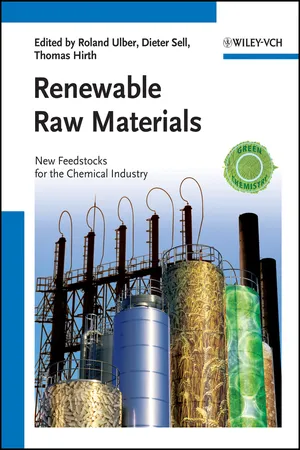
eBook - ePub
Renewable Raw Materials
New Feedstocks for the Chemical Industry
- English
- ePUB (mobile friendly)
- Available on iOS & Android
eBook - ePub
Renewable Raw Materials
New Feedstocks for the Chemical Industry
About this book
Trusted by 375,005 students
Access to over 1.5 million titles for a fair monthly price.
Study more efficiently using our study tools.
Information
1
Introduction to Renewable Resources in the Chemical Industry
Processes in the chemical industry are historically based on fossil resources. During industrial revolution, energy sources like peat and such renewable biomasses as wood were substituted by coal and later on by natural gas and petroleum oil. The latter has been, until now, the main resource for raw materials and the energy supply for the private sector. Due to its very beneficial properties in terms of chemical synthesis processes, only a minor proportion of approximately 10% of this plentiful resource is used for such purposes, whereas 90% is utilized for energy and transport. With regard to the increasing population and energy demand and oil consumption of developing countries, the limited availability of crude oil, and financially motivated trading operations, the price of oil rises steadily and reached a peak of nearly 150 USD per barrel in 2008. It is assumed that most of the known so-called supergiant oil-fields cross the oil-peak, which comes along with a decrease in the discovery of novel oil springs. Therefore, alternatives have to be introduced to reduce the dependency on these transient fossil fuels. But one has to keep in mind that alternative fuels and resources for chemical building blocks have to compete against classical fossil compounds.
Currently, the prices of most bulk and specialty chemicals are too low for biotechnological routes to compete. It is estimated that competition begins at feedstock prices above $2 per kilogram. Nevertheless, the share of biotechnologically produced chemicals is expected to increase from approximately 5% to 20% in the year 2010. The greatest impact is expected in the segment of fine and specialty chemicals with up to 60% of the products based on biotechnological processes. Interfacing with green biotechnology for enhanced crop properties and increased plant breeding can be expected. More attention is paid to the lignocellulose feedstock, which is extensively discussed and examined to be used as a sustainable raw material for ethanol production. In addition, a few current trends focus on C1 carbonic compounds such as methanol and methane, fatty acids and glycerol from plant oil, and whey-based substrates that can be used as input compounds for a chemical refinery.
If one has a closer look to current activities of oil companies, it is obvious that the time is changing. Several efforts to utilize sustainable biomass feedstocks for recovering fuel substitutes were carried out by these companies. But the exploitation and utilization of the biomass feedstock have to be implemented very carefully to avoid such an already occurred competition of energy crops with food production, if first-generation biomass fuels were considered. However, the complete substitution of fossil resources by biobased fuels and raw materials within the near future is quite improbable, considering the current process operation’s dependency on large amount of biomass feedstock. Therefore, socioeconomic trends must focus on a holistic approach, where fossil as well as biological resources have to be used in a complementary way. At least at the laboratory scale, for 6 of the 10 best sellers of the chemical industry alternative biotechnological production processes are under development (ethylene, ethylene oxide, dichloroethane, propylene, formaldehyde, and propylene oxide). In Western Europe alone, the annual demand for ethylene and propylene is 40.5 million tonnes. World production of the basic building blocks of the chemical industry, including polymers, exceeds 500 million tonnes. This fact clearly shows that large quantities of renewable raw materials must be made available for the production of bulk chemicals. Despite the 5.6 million hectares of arable land currently lying fallow in the EU, this cannot be limited to the provision of sugar or starch. On the contrary, what is required is the holistic utilization of diverse renewable resources. Nature provides around 170 billion tonnes of plant biomass, of which hitherto only approximately 3–4% have been commercially exploited. The crux of the matter is how much can, and indeed may, be used of the remaining 96% in a sustainable way? And how much energy will this entail?
If one considers the biomass feedstock, the number of different categories is enormous and includes grains, sugar crops, oilseed crops, agricultural wastes, food-processing wastes (liquid and solid), wood, wood chips, bark, mill residues, forest residues, pulping liquors, manures, and algae. With regard to an increasing utilization of crops in the material and energy sector, the prices for comestible goods also increase and a couple of social problems arise. Therefore, the exploitation of forest residues or special planted wood-based biomass is – based on our current knowledge – accompanied only by insignificant social problems. Especially for European countries, prosperous predictions for utilization of such materials do exist. Owing to a declining population, the need for agricultural crop lands for food supply will decrease and could be used for industrial plantations. As a positive consequence, new collaborations between producers (farmers) and chemical manufacturers will be established in analogy to the already existing collaborations between the starch-processing companies and manufacturers.
One potential starting point is the development of the lignocellulose biorefinery. However, the sustainable development of the biorefinery depends on the extensive process integration. A concept devised solely for the production of basic and fine chemicals may well fail to achieve its target. More importantly, the materials applied should be used both for energy (in the form of heat and power) and for the production of chemicals and materials. All planning must allow for the fact that the renewable resources in question should not only be allocated to biotechnology but also in fact in the area of energy supply where there is a tendency to draw increasingly on biomass. Hütermann and Metzger, for example, state that “… global energy provision on the basis of biomass is feasible without detriment to food production. …” According to their calculations, a biobased economy would require 22.3 billion tonnes of bio-oil from pyrolysis. This corresponds to approximately 35 billion tonnes of biomass solely for conversion into energy. In the construction materials sector, too, there is a growing trend to utilize renewable resources. To quote the “Informationsknoten nachwachsende Rohstoffe” (Renewable Resources Information Centre), “… nature provides a huge range of plant and animal raw materials that are suitable for a variety of applications. The challenge for the future is to exploit this inexhaustible raw materials potential without detriment either to man or to the environment and without impairing the standard of living of the population. …”. Only the concerted efforts of all interest groups in the field of renewable resources can pave the way for a meaningful development. In the following chapters, the options for the biotechnological and chemical industries will be examined in more detail. In view of the raw materials figures initially mentioned, one of the priorities will be (ligno)cellulose as, with around 95%, it accounts for the bulk of renewable raw materials. A further priority will be the more intensive utilization of methane and methanol from both fossil and renewable sources.
Assuming an estimated annual biomass production of 170 billion tonnes by biosynthesis, of which 75% are carbohydrates mainly in the form of cellulose, chitin, starch, and sucrose, 20% lignin, and only 5% other natural products such as fats (oils), proteins, and diverse ingredients, the prime concern should be efficient access to carbohydrates and processing them into chemical mass products and finished products. This will not take place overnight since the relevant technologies first have to be developed; moreover a shift from fossil to sustainable processes can only be implemented if it is seen to be economically viable. The substitution of fossil resources by renewable resources can, therefore, only proceed in stages. To combine the markets for fossil and renewable resources would only make a prognosis of the most favorable time for the change more difficult.
Raw materials on the basis of biomass cannot simply be converted into conventional plants like naphtha crackers; hence it is postulated that new processes for the conversion of biomass first need to be developed. If used intelligently, chemical reaction technology, including catalysis and process engineering together with biotechnology, may provide economic solutions to this technological problem. The following strategies are, in principle, possible:
- utilization of the chemical structures produced by nature without any chemical modification;
- one-step modification of these structures;
- multistep chemical modification;
- total degradation to C-1 fragments (e.g., synthesis gas or methane) and controlled synthesis to obtain the desired molecules.
The chemical industry owes its success to the principle of unit construction: from simple basic substances, like ethylene, carbon monoxide, or hydrogen, more complex precursors can be produced under controlled conditions by chemical reactions; due to the variety of combination options, the latter can in turn be converted into inconceivable quantities of derivatives and end products. Chemistry learned how to produce chemically pure basic substances from oil that are simple to handle and exactly defined; this is performed highly efficiently in refineries. This was the key to its success. Without exact knowledge of this functional principle, the triumphant success of plastics would have been just as impossible as the production of thousands of other chemical products that today make our lives safe and comfortable.
Within the following chapters, this book tries to answer some of the important questions to establish biorefineries within the existing chemical industry. What should be the impact from plant breeding for new biorefineries? Is it possible to design new and better plants which fulfill most of the requirements (high contents of fermentable raw materials, less by-products, easy to hydrolyze)? Initially the chemical industry considered fermentation of plant carbohydrates as the only viable solution. But now, with the increasing success of globally grown genetically modified plants, plant enzymes, cell cultures, and whole plants have been taken seriously for chemical production processes. Pharmaceutical proteins, SMDs, and fine chemicals have been the first choice for production. But with ever-rising prices of fossil resources, chemical commodities such as platform chemicals (e.g., succinate, itaconic acid), intermediates, or polymers are now considered as economically viable (see Chapter 2). However, is the world agro capacity big enough to deliver all raw materials needed? The primary purpose of agriculture is food production and has been so throughout human history. During the last decade, environmental and economic concerns have led to growing interest in fuel and energy crop production. Therefore, the production of renewable chemicals from agricultural raw materials will be in direct competition with both food and fuel production for space, resources, labor, and funds. Although the high value of chemical products may make them economically viable, they may have an undesirable competitive effect on food production. However, food, fuel, and chemical production are not necessarily mutually exclusive. The biorefinery concept aims to make best use of whole crop plants by producing numerous products from a single resource (discussed in Chapter 3). In comparison to their fossil counterparts, process chains based on renewable raw materials differ in many aspects. Operations for cultivation, harvesting, and provision of renewable raw materials take place in a natural environment. The raw materials accrue spatially distributed on large areas. Amount and characteristics of the resources underlie seasonal variances and restrictions. As a rule, the abilities and capabilities for storage are limited. Long-distance transports are disadvantageous because of comparable high water content and low calorific values. Thus, Chapter 4 explains the essential adjustments for the logistics of renewable raw materials. Looking at the existing value chain of industrial biotechnology, all fermentation processes which have been commercialized in the last decades for the production of one of the building blocks such as ethanol or amino acids presently rely on carbohydrates as feedstock. Moreover, the majority of fermentation processes, which recently are in the feasibility stage, also start from these feedstocks at the moment. Chapter 5 gives an overview about the existing value chains and the products already produced in the so-called type-one biorefineries, whereas future biorefineries are described in Chapter 6. The establishment of new industrial firms, such as a biorefinery, in a rural area can be seen as an opportunity to revitalize the local economy, and to revert the negative demographic trend, which very often characterizes those areas. However, apart from the scarce density of capital and human resources locally existing, the development of a biorefinery in those places strictly depends on the acceptance level of the local communities which, in assessing the socioeconomic and environmental implications, take into account a series of concerns particularly related to understand how their quality of life may change as a result of the industrial project implementation. These economic and social implications of the industrial use of renewable raw materials are discussed in Chapter 7. Potential markets for bioproducts are wide ranging, including polymers, lubricants, solvents, adhesives, herbicides, and pharmaceuticals. While bioproducts have already penetrated most of these markets to some extent, new products and technologies are emerging with the potential to further enhance performance, cost competitiveness, and market share. The market needs and opportunities for products produced by the existing and proposed new types of biorefineries are explained in Chapter 8. One major reason for the interest in biobased products is their potential contribution to the mitigation of climate change since biobased products are made from renewable resources which, during their growth, take up the same amount of CO2 as is released by biological degradation or energetic conversion in the end of the product’s life. This is a generic advantage compared to the use of fossil resources, which release the inventory of carbon accumulated and stored in the ground millions years before. However, is this true for all biobased products? Chapter 9 tries to answer this by discussing the life cycle analysis of biobased products.
The aim of this book is to highlight all areas which have to be regarded in order to realize the vision of a “biobased economy” as a sustainable industrial future based on renewable resources is often termed. The choice of the chapters is inspired by the scientific framework and the business conditions with an influence on the development of a biobased economy. How do the different authors as specialists in their fields appraise the application of renewable raw materials? Where do they see chances, where do they see need of action? “May you live in interesting times” stated Wim Soetaert in regard to the progress of biorefineries (see Soetaert, W. [2009] May you live in interesting times! Biofuels, Bioprod. Biorefin., 3, 491–492, DOI: 10.1002/bbb.173). We hope that you will have interesting time while reading this book!
2
Plants as Bioreactors: Production and Use of Plant-Derived Secondary Metabolites, Enzymes, and Pharmaceutical Proteins
2.1 Introduction
The organic chemical industry is largely based on materials derived from photosynthetically active organisms: plants (coal) and algae (petrol). In addition to these fossil sources, the chemical industry in Germany obtains 10% of its raw material from renewable resources, with more than 90% of these from plants. Due to dwindling fossil reserves, the focus of research has shifted to replace petrochemically derived chemicals by renewable plant-derived material. Initially the chemical industry considered fermentation of plant carbohydrates as the only viable solution. But now, with the increasing success of globally grown genetically modified (GM) plants, plant enzymes, cell cultures, and whole plants have been taken seriously for chemical production processes. Pharmaceutical proteins, small molecule drugs (SMDs) [1], and fine chemicals have been the first choice for production. But with ever-rising prices for fossil resources, chemical commodities such as platform chemicals (e.g., succinate, itaconic acid), intermediates, or polymers [2] are now considered as economically viable.
This chapter will remind the reader that for all these new developments there are already examples of established production processes where plants, plant cell cultures, plant enzymes, or plant (secondary) metabolites play a major role. It will give examples where genetic modification of plants and the use of plant enzymes and ingredients have increased the economical and ecological potential of plants as renewable resources for a sustainable chemistry.
2.2 Renewable Resources in the Chemical Industry
The chemical industry is a raw material- and energy-intensive industry. Due to the scarcity of fossil resources, steadily increasing oil prices, and a need to reduce greenhouse gases, renewable resources from plants will be an increasingly important issue for the industry over the coming years. Germany, fourth in the world in chemical production, will take a leading role in these efforts as manifested by high investments of the German chemical industry in industrial biotechnology R&D.
Presently, around 10% of basic material for the chemical industry stems from renewable resources, mainly plant materials. The sustainability of chemical processes can be increased by the use of fermentation processes or direct biocatalytic steps. Unlike most chemical reactions, biocatalytically driven reactions are highly stereo-selective for the substrate and the resulting product due to the intrinsic properties of the enzyme activities, resulting in particularly high specificities for substrates and reactions. In addition, natural enzyme-based processes operate at lower temperatures and atmospheric pressure, and they produce less toxic waste than conventional chemical processes. As an example, the conversion of elemental nitrogen to ammonium demands high pressures and temperatures, and the use of metal catalysts in the Haber–Bosch process. In contrast, bacterial nitrogen fixation occurs at room temperature and normal pressure. Nitrogen fixation by free-living bacteria is widespread, but the rate of fixation is relatively low (15 kg/ha/year) as it is limited by the available energy. In contrast, nitrogen fixation rates from 75 to 300 kg of N/ha/year are common in various combinations of legume–rhizobia [3].
The production of aromatics in a sustainable fermentation process is a challenging future task where interdisciplinary skills and close cooperation of microbiologists and plant specialists will be necessary. The plant shikimate pathway, synthesizing anthranilate out of erythrose, serves as a prime example that is waiting to be converted into a fermentation process or a whole plant production via an interdisciplinary approach. Currently, however, it may be easier to use a waste compound from the forest industry to be converted by a simple chemical reaction into an aromatic compound (Figure 2.1).
Figure 2.1 Example of a waste product from forest industry being converted in a simple one-step chemical reaction into an aromatic compound (α-pinen into cymol;
drawing by Dr. Frank Kastenholz, Phytowe...
Table of contents
- Cover
- Related Titles
- Title page
- Copyright page
- List of Contributors
- 1 Introduction to Renewable Resources in the Chemical Industry
- 2 Plants as Bioreactors: Production and Use of Plant-Derived Secondary Metabolites, Enzymes, and Pharmaceutical Proteins
- 3 World Agricultural Capacity
- 4 Logistics of Renewable Raw Materials
- 5 Existing Value Chains
- 6 Future Biorefineries
- 7 Economic and Social Implications of the Industrial Use of Renewable Raw Materials
- 8 Biobased Products – Market Needs and Opportunities
- 9 Life-Cycle Analysis of Biobased Products
- 10 Conclusion
- Index
Frequently asked questions
Yes, you can cancel anytime from the Subscription tab in your account settings on the Perlego website. Your subscription will stay active until the end of your current billing period. Learn how to cancel your subscription
No, books cannot be downloaded as external files, such as PDFs, for use outside of Perlego. However, you can download books within the Perlego app for offline reading on mobile or tablet. Learn how to download books offline
Perlego offers two plans: Essential and Complete
- Essential is ideal for learners and professionals who enjoy exploring a wide range of subjects. Access the Essential Library with 800,000+ trusted titles and best-sellers across business, personal growth, and the humanities. Includes unlimited reading time and Standard Read Aloud voice.
- Complete: Perfect for advanced learners and researchers needing full, unrestricted access. Unlock 1.5M+ books across hundreds of subjects, including academic and specialized titles. The Complete Plan also includes advanced features like Premium Read Aloud and Research Assistant.
We are an online textbook subscription service, where you can get access to an entire online library for less than the price of a single book per month. With over 1.5 million books across 990+ topics, we’ve got you covered! Learn about our mission
Look out for the read-aloud symbol on your next book to see if you can listen to it. The read-aloud tool reads text aloud for you, highlighting the text as it is being read. You can pause it, speed it up and slow it down. Learn more about Read Aloud
Yes! You can use the Perlego app on both iOS and Android devices to read anytime, anywhere — even offline. Perfect for commutes or when you’re on the go.
Please note we cannot support devices running on iOS 13 and Android 7 or earlier. Learn more about using the app
Please note we cannot support devices running on iOS 13 and Android 7 or earlier. Learn more about using the app
Yes, you can access Renewable Raw Materials by Roland Ulber,Dieter Sell,Thomas Hirth in PDF and/or ePUB format, as well as other popular books in Physical Sciences & Industrial & Technical Chemistry. We have over 1.5 million books available in our catalogue for you to explore.