- Revitalizes and internationalizes scholarship on this most popular and highly-rated American president
- Covers many aspects of Roosevelt's personality and his policies, domestic and foreign, to create a complete picture of the man
- Provides scholarship from both sides of the Atlantic, from established Roosevelt specialists, respected scholars, and a new generation of historians
- A new and fresh historiographical exploration of Roosevelt's life and ideas, political career and achievements, and his legacies
- English
- ePUB (mobile friendly)
- Available on iOS & Android
eBook - ePub
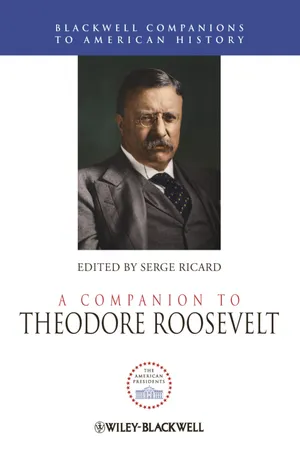
A Companion to Theodore Roosevelt
About this book
A Companion to Theodore Roosevelt is the first comprehensive anthology to encompass Roosevelt as whole, highlighting both his personality and his skilled diplomacy.
Trusted by 375,005 students
Access to over 1.5 million titles for a fair monthly price.
Study more efficiently using our study tools.
Information
Chapter One
THE EDUCATION OF THEODORE ROOSEVELT
In his recent biographical study, The Wilderness Warrior: Theodore Roosevelt and the Crusade for America, historian Douglas Brinkley argues that, during his formative years, the future 26th president of the United States became a devoted Darwinian naturalist. As a child and then as an adolescent living in a fashionable neighborhood of New York City, young TR immersed himself in the wonders of nature and the mysteries of life on earth. Whether collecting many specimens of birds and small mammals, even harboring live mice and garden snakes in his upstairs bedroom of the family home at 28 East 20th Street, or marveling at richly illustrated books depicting wild and exotic animals in far-away places, he cultivated a lifelong interest in what was then termed “natural history.” Perhaps it was altogether fitting, therefore, that TR came into the world shortly before the appearance of Charles Darwin’s seminal study, On the Origin of Species (1859), and that he grew to maturity in what might be aptly termed the Age of Darwin (Brinkley 2009, 23–24).
TR also came of age at a time when the industrial revolution and the growth of great cities were fast transforming America, ensuring the transition of an agrarian nation into a manufacturing giant with economic interests stretching around the globe. To understand the mind and motives of the impressionable young man who became President Theodore Roosevelt, the student of history must first consider his meandering journey through both worlds – the new and changing urban-industrial world of the future, and the fast-receding world of the wilderness, which reigning scientific thought now concluded was the product of evolutionary change. A glimpse into the formative years that shaped the personal values and intellectual worldview of a future American leader reveals that the attitudes, ideals and principles – so identifiable in the makeup of the trust-busting, big stick-wielding president known to history – were all forged from the experience, trial, and adversity of his youth.
It all began in New York City on October 27, 1858, when Theodore and Martha Bulloch Roosevelt welcomed their second child and first son into the world. The elder Roosevelt, tall, handsome and stoic in appearance, had earned his reputation as a successful New York City banker, importer, and philanthropist; his beautiful young wife, a genteel Southern lady with a kind manner and fun-loving spirit, was known for her charm and wit. In so many ways, their eldest son’s childhood seemed typical, at least for his patrician class and privileged station in New York society. Like most scions of the Eastern aristocracy, young Theodore (or “Teedie to his parents and siblings) enjoyed the best education that his family’s fortune could provide. Precocious and curious beyond his years, the boy benefited from the best private tutors his parents could employ. In summers he enjoyed his time in the country at the Roosevelts’ estate at Oyster Bay. Near the spacious, two-story home, known appropriately as Tranquility, the child passed countless hours in the outdoors, scrambling along hillsides, playing in the sands, and wading into the surf of Long Island Sound (McCullough 1981, 19–20, 36–37, 39–42, 141–43).
Despite the appearance of a normal childhood, Teedie faced extraordinary challenges. A frail and wheezing asthmatic, the boy suffered frequent attacks of spasmodic coughing and respiratory convulsions that sometimes left him limp and listless. So severe were these gasping spells, so frightening the effects of the “asmer,” as the child pronounced it, that his father would often drive him through the dingy, gas-lit streets of New York City in the family’s carriage, hoping that the damp evening air might allow his lungs to expand. Worse yet, Teedie’s parents learned that their oldest son was diagnosed with a heart murmur, which seemed serious enough that his family physician wondered aloud if the sickly child would ever be able to enjoy a normal life, or if he would even live to see adulthood. If these maladies were not enough, by the age of thirteen the boy’s poor eyesight forced him to be fitted with spectacles so thick as to give him a somewhat peculiar, owl-eyed appearance (McCullough 1981, 36, 44, 59, 81–82, 89–108, 110, 113; Morris 1979, 34, 38–57).
Little wonder that the sickly child spent so much of his early years indoors, reading, studying and mostly dreaming. Understandably, the elder Theodore Roosevelt worried about his son, whose pale skin and thin, reedy voice only confirmed that he suffered from chronically poor health. Theodore’s sister Corinne recalled the day when their father challenged Teedie to prepare himself for manhood. “Theodore, you have the mind but not the body, and without the body the mind cannot go as far as it should,” the father urged. “You must make your body.” So the boy looked up and vowed defiantly, “I’ll make my body.” To encourage him to increase his physical strength and stamina, Theodore, Sr. purchased barbells and other exercise equipment and converted the roof of the home into a private gymnasium (Robinson 1921, 34, 36, 39, 50; Roosevelt 1926a, 7, 12, 27; Morison, Blum, and Chandler 1951–1954, 1: 10–11; Roosevelt 1926b, 237, 243, 246–58).
Not surprisingly, in the eyes of his son, the elder Roosevelt stood as a paragon of strength and courage. “He was the most wise and loving father that ever lived. I owe everything to him,” the younger Roosevelt remembered fondly. “My father was the best man I ever knew,” he later recalled in his autobiography, “the only man of whom I was ever really afraid.” “He was a big, powerful man, with a leonine face” but a “heart filled with gentleness for those who needed help or protection.” Aside from instilling in the child an understanding of civic responsibility, Theodore, Sr. also imparted to him an abiding reverence for nature as well as an almost romantic sense of adventure. During summer vacations on the family’s leased country estate in New Jersey, at Oyster Bay, and on camping trips to upstate New York, the elder Theodore led his children on “tramping” expeditions into the woods. In the evening he read aloud from the timeless Leatherstocking Tales of James Fenimore Cooper. Around a nightly campfire, or during story times beside the family hearth, he also regaled the children with the exploits of such legendary frontiersmen as Daniel Boone and David Crockett (Harbaugh 1978, 16–17; Theodore Roosevelt Papers, Library of Congress, series 7, reel 429, February 15, March 29, 1878; Roosevelt 1926a, 7).
During these summer sojourns into the woods Theodore learned to listen to the voices of the wilderness. No longer were the deer, elk and bear mere images depicted on the pages of books, or silent trophy heads on the walls of museums. No more were the smallest of mammals and wild birds petrified specimens that stank of formaldehyde. In the dark forests of the Adirondacks they all came to life before his very eyes, the eyes that squinted behind glasses as the boy struggled to observe them in all the richness of their bright colors and brilliant hues. Intently, with an innate curiosity and a keen eye for detail, he learned to identify literally hundreds of different species of birds simply by their movements in flight, their distinct plumage, and their identifiable songs. In all, his early experiences in the woods kindled a reverence for nature, one that would remain with him all of his days (Brinkley 2009, 22–23).
In contrast to Theodore, Sr., whose Dutch patroon heritage instilled in the Roosevelt children a practical, common sense approach to life, Martha (“Mittie”) remained the romantic, and in many ways the center of that love and devotion that bonded together a most remarkable family. “My mother … was a sweet, gracious, beautiful Southern woman, a delightful companion and beloved by everybody,” the future president recalled with affection. Her Southern charm and genteel manner reminded the children, and indeed everyone she met, of her Georgia roots. As for her wit and warmth, they seemed always of the greatest comfort to the children, especially the delicate and sickly son whose future well-being seemed so uncertain (Roosevelt 1926a, 11).
In the spring of 1869, at the age of ten, Teedie accompanied his parents and siblings on a Grand Tour of Europe and the Mediterranean. Voyaging first to London and Edinburgh, then on to Antwerp, Cologne, Paris and Vienna, the boy viewed the Old World with polite indifference. “I do not think I gained anything from this particular trip,” he remembered years later. “I cordially hated it, as did my younger brother and sister.” Indeed, while the eldest child Anna, or “Bamie,” tolerated the trip well enough, little “Thee,” Elliot (or “Ellie”) and Corinne (“Conie”) longed for home. “Our one desire was to get back to America,” Theodore recalled (Roosevelt 1926a, 13).
When Theodore and Martha Roosevelt returned to Europe with their children in the winter of 1872–1873, the results would be different for their oldest son. Old enough to enjoy this trip, and to learn and benefit from the experience, the 14-year-old Theodore toured Rome, viewing with interest the ancient ruins and historic sites of the Eternal City. From there it was on to Egypt. With awe and wonder, he gazed upon the Pyramids of Giza, then sailed up the eternal Nile to witness the great Temple at Karnak, journeying on from there to the Holy Land and the sacred city of Jerusalem, and finally Constantinople and Greece. After traveling back to Western Europe again, he enrolled in a private school in Dresden to study the German language and culture. When the family sailed back to New York in late 1873, therefore, Teddie had already gained a global perspective that few of his generation would ever possess (Pringle 1931, 13–23; Roosevelt 1926a, 19–21; Roosevelt 1926b, 229–37, 277–90).
Back home amid the bustle and clamor of New York City, young Theodore often retreated into his bedroom, losing himself in the pages of the many books that filled the downstairs family library. Among his favorites were the adventure novels of an Irish-American schoolmaster-turned soldier of fortune, Captain Mayne Reid, whose stories seemed to carry Teedie into the remote wilds of the trans-Mississippi West. With the turning of every page, the boy traveled through his imagination with the fictional characters of The Scalp Hunters (1851) and The Boy Hunters (1853). No doubt, Reid’s romantic and stirring narrations would serve as TR’s literary model in years to come. Surely too, the indelible images of adventuresome young men stalking wild animals and fighting menacing “savages” on the borderlands remained as real to young Roosevelt as those of any chronicles of history that his tutors assigned. Just as fascinating to Teddie were the works of the great John J. Audubon, who opened the boy’s eyes to the skies filled with flying creatures as diverse as those on land and in the sea (Roosevelt 1926a, 14).
At the age of 15, Theodore – by now his bouts with asthma less severe and more infrequent – began serious preparation to enter Harvard. Under the tutelage of schoolmaster Arthur Cutler, he threw himself into his studies with the unceasing energy that was to become his trademark. “I could not go to school because I knew so much less than most boys of my age in some subjects and so much more in others.” Steeped in the sciences, letters, and history, he nevertheless remained woefully lacking in Latin and mathematics (Roosevelt 1926a, 21).
Without doubt, while TR’s years at Harvard were ones of intellectual ferment, they also proved to be something of a disappointment. Although he excelled in his studies and attempted to fit in socially, joining in most every extracurricular activity available, he found most of the faculty to be distant and aloof, and the student body divided into two castes, the patrician scions of the Boston Brahmin and everyone else – in other words the haves and have mores. Despite the fact that he attempted to burnish his image with expensive clothes and family connections, most evidence suggests that Theodore would be remembered by classmates and mentors – if remembered at all – as an awkward, bookish young man with a shrill, piping voice, a peculiar “bundle of eccentricities” as William Roscoe Thayer recalled. Or as friend John Woodbury put it, he seemed oddly out of place and “some thought he was crazy.” Pursuing with a passion the sciences, earning high marks on exams, the budding ornithologist and field naturalist felt confined, even stifled in laboratories surrounded by microscopes and Petri dishes. In the end, he left Harvard unceremoniously, seemingly believing that he had not learned much more there than he could have learned back home in New York City. As he penned in his autobiography 33 years later, “I thoroughly enjoyed Harvard, and I am sure it did me good, but only in the general effect, for there was very little in my actual studies which helped me [later] in … life.” Instead of extending the horizons of his mind, his professors had mostly confirmed the reigning ideologies of the day, particularly the dual dogmas of laissez faire and Social Darwinism. In future years, TR spoke little of his college experiences, other than his pride at being a “Harvard man” (Thayer 1919, 21; Roosevelt 1926a, 22–26; McCullough 1981, 195–208).
The education of TR continued well beyond the halls of academe and far from the Ivy-covered walls surrounding Harvard Yard. In September 1878, and again in the winter of 1879, the robust young Roosevelt, accompanied by cousins Emlen and James West Roosevelt, ventured into the woods of Northern Maine to commune with nature. These two trips proved to be among the most significant formative experiences of TR’s youth. Vanishing into the primeval forests of the Aroostook country on the borders of New Brunswick, he gloried in the fresh air of the wilderness, where his lungs could breathe freely among the spectacular evergreens and white rivers of this remote region.
Just as important, on his first trek into the wilds of the Aroostook country, some ninety miles north of Bangor, Theodore forged a friendship with two Maine woodsmen who would come to influence his perception of the manly world that awaited beyond the borders of settlement. For three weeks in September of 1878, TR and his cousins stayed at the Island Falls hunting lodge of William “Bill” Sewall, a bearded, Bible-toting Yankee who seemed to know as much about Norse mythology or the poetry of Longfellow and Keats as any Harvard scholar. For eighteen days the stoic woodsman and his quiet, boyish-looking nephew Wilmot Dow guided the three Roosevelts deep into the dark forests of the North Country. Although Sewall found young Roosevelt to be “a different fellow to guide than any I had ever seen,” he liked and even admired him, as did young Dow. In fact, when their charismatic friend invited both men to join him in the Dakota Badlands six years later as his partners in the cattle business, neither hesitated. None realized it at the time, but their bond would last a lifetime (Sewall 1919, 5; Roosevelt 1926a, 30–31; Brinkley 2009, 111–20).
The experience of tramping through the backwoods of Northern Maine proved to be everything that Theodore could have hoped for. Whether canoeing down the rushing waters of the Mattawamkeag, observing the habits of the moose and caribou, studying the behavior of the bears and bats, marveling at the many birds soaring overhead, or just stretching out around a campfire and swapping stories under the stars, TR had found his niche. And he may have also found a faith in his own physical stamina, a confidence that had eluded him for the first two decades of his life.
Back at Harvard for his junior year, the brilliant though contentious TR seemed energized as he continued to apply himself with tremendous vigor. Suddenly, however, tragedy struck, interrupting not only his studies but also changing his life. On February 9, 1878, word came that his beloved father, “Thee” as Martha called him, was dying. The elder Roosevelt – at the age of 46 – had succumbed after a lengthy battle with stomach cancer. He died in the family’s new home at 6 West 57th Street, just hours before his oldest son reached his bedside. Young Theodore recorded that it was the “blackest day of my life.” His father’s funeral and burial in Brooklyn’s Greenwood Cemetery seemed to him a “hideous dream.” As he confided to classmate Henry Davis Minot, “it seems that part of my life had been taken away.” The pain and grief seemed overwhelming, even unbearable. ”When I heard the sound of the first clod dropping on the coffin holding the one I loved dearest on earth,” Theodore recorded in his diary, “I felt that I should almost perish” (Theodore Roosevelt Papers, Library of Congress, series 7, reel 429, February 9, 12, 13, March 9, 21, 1878; Morison, Blum, and Chandler 1951–1954, 1: 31).
As his father wished, young Roosevelt returned to Harvard to finish what he had started. Grieving the loss and insisting that “no one will ever be able to take his place,” he looked forward to his senior year, to graduation, and a future yet uncertain. What Theodore never planned was a chance meeting with an angelic, blue-eyed beauty from Boston’s Chestnut Hill. While visiting the home of classmate Richard Saltonstall on October 18, 1878, he was introduced to 17-year-old Alice Hathaway Lee, daughter of prominent banker George Cabot Lee. Statuesque, with soft features and a pretty smile, she not only caught the eye of the restive Mr. Roosevelt but also quickly captured his affection. After a courtship lasting more than a year, they married at the Unitarian Church in nearby Brookline, Massachusetts, on October 27, 1880 – Theodore’s 22nd birthday (Theodore Roosevelt Papers, Library of Congress, series 7, reel 429, March 9, 21, 1878; McCullough 1981, 218–30).
In the meantime, TR had graduated from Harvard the previous June. His honor...
Table of contents
- Cover
- Series page
- Title page
- Copyright page
- Dedication
- List of Figures
- Notes on Contributors
- INTRODUCTION: AN ALL-TIME HISTORIAN’S FAVORITE
- Chapter One: THE EDUCATION OF THEODORE ROOSEVELT
- Chapter Two: THEODORE ROOSEVELT’S EARLY POLITICAL CAREER: THE MAKING OF AN INDEPENDENT REPUBLICAN AND URBAN PROGRESSIVE
- Chapter Three: THE ASSISTANT SECRETARY OF THE NAVY AND THE SPANISH-AMERICAN WAR HERO
- Chapter Four: THE ROUGH RIDER AS SUPER-POLITICIAN: THEODORE ROOSEVELT’S ASCENDANCY ON THE NATIONAL POLITICAL STAGE
- Chapter Five: PREPAREDNESS AND DEFENSE: THE ORIGINS OF THEODORE ROOSEVELT’S STRATEGY FOR THE UNITED STATES ON THE INTERNATIONAL STAGE
- Chapter Six: ROOSEVELT’S REPUBLIC
- Chapter Seven: SEX AND GENDER IN ROOSEVELT’S AMERICA
- Chapter Eight: “A SERIOUS ART AND LITERATURE OF OUR OWN”: EXPLORING THEODORE ROOSEVELT’S ART WORLD
- Chapter Nine: THEODORE ROOSEVELT, PRESIDENTIAL POWER AND THE REGULATION OF THE MARKET
- Chapter Ten: THE QUALITY OF THEODORE ROOSEVELT’S ENVIRONMENTALISM
- Chapter Eleven: THEODORE ROOSEVELT AND THE INDIANS
- Chapter Twelve: “HALF A SOUTHERNER”: PRESIDENT ROOSEVELT, AFRICAN AMERICANS AND THE SOUTH
- Chapter Thirteen: THEODORE ROOSEVELT AND THE PRESS
- Chapter Fourteen: THEODORE ROOSEVELT AND THE JOYS OF FAMILY LIFE
- Chapter Fifteen: THE GLOBAL STRATEGIST: THE NAVY AS THE NATION’S BIG STICK
- Chapter Sixteen: THEODORE ROOSEVELT, THE PANAMA CANAL, AND THE ROOSEVELT COROLLARY: SPHERE OF INFLUENCE DIPLOMACY
- Chapter Seventeen: THEODORE ROOSEVELT AND CANADA: ALASKA, THE “BIG STICK” AND THE NORTH ATLANTIC TRIANGLE, 1901–1909
- Chapter Eighteen: ANGLO-AMERICAN PARTNERSHIP: THE FOUNDATION OF THEODORE ROOSEVELT’S FOREIGN POLICY
- Chapter Nineteen: THEODORE ROOSEVELT AND THE “SPECIAL RELATIONSHIP” WITH FRANCE
- Chapter Twenty: AMERICA’S FIRST INTERVENTION IN EUROPEAN POLITICS: THEODORE ROOSEVELT AND THE EUROPEAN CRISIS OF 1905–1906
- Chapter Twenty-One: THE END OF AN ERA: THEODORE ROOSEVELT AND THE TREATY OF PORTSMOUTH
- Chapter Twenty-Two: JAPANESE-AMERICAN RELATIONS: THE 1906 CALIFORNIA CRISIS, THE GENTLEMEN’S AGREEMENT, AND THE WORLD CRUISE
- Chapter Twenty-Three: “UPLIFTING THE BARBARIAN”
- Chapter Twenty-Four: ROOSEVELT IN AFRICA
- Chapter Twenty-Five: THE NEW NATIONALISM AND PROGRESSIVE ISSUES: THE BREAK WITH TAFT AND THE 1912 CAMPAIGN
- Chapter Twenty-Six: THE GREAT WAR, AMERICANISM REVISITED, AND THE ANTI-WILSON CRUSADE
- Chapter Twenty-Seven: THEODORE ROOSEVELT’S CONTRADICTORY LEGACIES: FROM IMPERIALIST NATIONALISM TO ADVOCACY OF A PROGRESSIVE WELFARE STATE
- Chapter Twenty-Eight: THE MEMORY OF THEODORE ROOSEVELT THROUGH MOTION PICTURES
- CONCLUSION: A ROOSEVELTIAN CENTURY?
- BIBLIOGRAPHY
- INDEX
Frequently asked questions
Yes, you can cancel anytime from the Subscription tab in your account settings on the Perlego website. Your subscription will stay active until the end of your current billing period. Learn how to cancel your subscription
No, books cannot be downloaded as external files, such as PDFs, for use outside of Perlego. However, you can download books within the Perlego app for offline reading on mobile or tablet. Learn how to download books offline
Perlego offers two plans: Essential and Complete
- Essential is ideal for learners and professionals who enjoy exploring a wide range of subjects. Access the Essential Library with 800,000+ trusted titles and best-sellers across business, personal growth, and the humanities. Includes unlimited reading time and Standard Read Aloud voice.
- Complete: Perfect for advanced learners and researchers needing full, unrestricted access. Unlock 1.5M+ books across hundreds of subjects, including academic and specialized titles. The Complete Plan also includes advanced features like Premium Read Aloud and Research Assistant.
We are an online textbook subscription service, where you can get access to an entire online library for less than the price of a single book per month. With over 1.5 million books across 990+ topics, we’ve got you covered! Learn about our mission
Look out for the read-aloud symbol on your next book to see if you can listen to it. The read-aloud tool reads text aloud for you, highlighting the text as it is being read. You can pause it, speed it up and slow it down. Learn more about Read Aloud
Yes! You can use the Perlego app on both iOS and Android devices to read anytime, anywhere — even offline. Perfect for commutes or when you’re on the go.
Please note we cannot support devices running on iOS 13 and Android 7 or earlier. Learn more about using the app
Please note we cannot support devices running on iOS 13 and Android 7 or earlier. Learn more about using the app
Yes, you can access A Companion to Theodore Roosevelt by Serge Ricard in PDF and/or ePUB format, as well as other popular books in History & 20th Century History. We have over 1.5 million books available in our catalogue for you to explore.