- Offers a definition of "misuse" and "addiction" and the factors that influence the nature of misuse or addiction
- Reviews extensively the nature and impact of parental substance misuse on children and families using the latest evidence
- Explores how research and theories might help inform professionals or non-professionals assessing families affected by parents who misuse drugs or alcohol
- Provides an in-depth discussion of Motivational Interviewing, including a critical discussion of the challenges and limitations involved in using it in child and family settings
- Considers the wider implications of the findings for practice and policy and argues that these responses can be used across the field of work with vulnerable children and their families
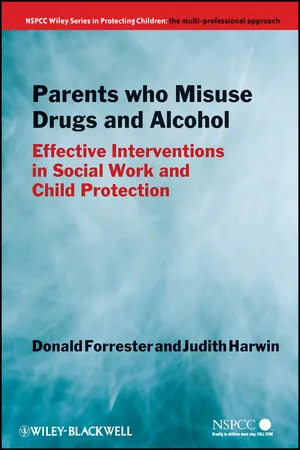
eBook - ePub
Parents Who Misuse Drugs and Alcohol
Effective Interventions in Social Work and Child Protection
- English
- ePUB (mobile friendly)
- Available on iOS & Android
eBook - ePub
Parents Who Misuse Drugs and Alcohol
Effective Interventions in Social Work and Child Protection
About this book
This book presents original research outlining the key elements in responding to parental misuse of drugs and alcohol.
Information
Part 1
Introduction
This is a book about children affected by a parent’s drug or alcohol problem. It is written to help professionals to develop best practice, but we hope that the book will also be of interest to policy-makers and researchers with an interest in this area, and to non-professionals affected by misuse of drugs or alcohol by a parent.
Until recently the numbers of children living with parental substance misuse was not clear. Indeed, there was very little British research in this area until the late 1990s and no reliable estimates of the extent of the problem. Based on more recent evidence it seems likely that between 1 in 10 and 1 in 14 children are affected (Advisory Council on the Misuse of Drugs, 2003; Brisby et al., 1997). Looked at another way, in the average classroom two or three children go home to a parent with a drink or drug problem. Recent estimates suggest that the numbers may be even higher. Manning et al. (2009) estimate even higher numbers of children living with parents who binge-drink. This highlights that parental substance misuse is not a small-scale problem that can be left to specialists (Department for Children Schools and Families, 2010); it is a common issue which every professional working with children or their families encounters on a regular basis. It affects every school and every youth club, every hospital and every community centre. Every social worker, health visitor, Children’s Centre worker, police officer or other professional working with people comes into contact with families in which there is parental misuse of drugs or alcohol frequently – whether they are aware of it or not. There is also a host of non-professional adults affected by the drug or alcohol problems of parents. This includes non-misusing parents, aunts and uncles, neighbours and grandparents, who often become very involved either in supporting the family or caring for children who can no longer live with the parent with the drug or alcohol problem.
We have learnt far more in recent years about the impact that a mother’s or father’s drink or drug problem can have on children. Most of these studies have emphasized the serious harm that it can have on children’s welfare. Children are more likely to be neglected or emotionally, physically and even sexually abused when a parent has a substance misuse problem. They are also at increased risk of a host of negative outcomes, including coming into care, becoming homeless, low educational attainment, emotional difficulties, behavioural problems, involvement in crime and developing an addiction themselves. Yet this is not always so. Many children survive and some thrive despite the adversity they grew up with, and we now have a clearer picture of the factors that make this more likely and the interventions that help children to achieve it. Later in the book we discuss in detail these areas. However, we start by considering the approach we take to the book at a more general level.
The most important general point we would stress is that throughout we attempt to focus on the needs of both the child and the parent. From the inquiry into the death of Maria Colwell in 1974, through a series of inquiries into tragic deaths through the 1970s, 1980s and 1990s right up to the report into the death of Victoria Climbié in 2000, the danger of being ‘family-focused’ has been highlighted (Brent, 1985; Department of Health et al., 1991; Greenwich, 1987; Laming, 2003; Secretary of State for Social Services, 1974). Supporting ‘families’ can lead to the voices of the less powerful individuals within the family, usually children or women experiencing violence, not being heard and to their abuse becoming invisible. From the 1990s onwards this has led many to argue that child welfare professionals, and particularly social workers, should be ‘child-centred’. Indeed, this is now the accepted approach within child and family social work.
We believe that for both pragmatic and ethical reasons this is not helpful. Pragmatically, achieving positive change for children generally involves working effectively with parents. This does not and should not mean collusion with parents at the expense of children’s needs, or a failure to raise and discuss difficult issues or focus on children’s needs. However, it does mean that effective work requires the worker to be aware of the needs of both the child and the adult, and that workers need to be sensitive to the parents’ views and needs even when their primary concern is for the child. Reflecting on the findings of research looking at how social workers talk to parents, Forrester et al. (2008a) have characterized this as being ‘child-focused plus’ and suggested that it is an approach most likely to engage parents and thus to achieve positive outcomes for children. We explore further these issues in Chapters 7 and 8.
Yet this is not just the approach that is most likely to work, it is also important for ethical reasons. Working with families in which parents misuse drugs or alcohol involves working with two sets of vulnerable people – the children and their parents. Individuals with drug or alcohol problems tend to have serious psychological and social problems, many have experienced abuse themselves and most are deeply unhappy people. In any caring profession, workers have a duty to recognize this and to work sensitively with such individuals. We have a ‘duty of care’ that extends beyond the legal definition of the term to include a more general professional responsibility in the way we work with vulnerable individuals. While it may be tempting to simplify one’s role and focus on just the adult or only the child we believe that this is not only ineffective but that it is against the ethos of all the caring professions. We should be sensitive in working with vulnerable people, because that is the right thing to do. Indeed, we believe that the ability to focus on both parent and child is one of the hallmarks of good quality practice and policy-making.
One of the key implications of this belief is that we spend a considerable proportion of the book discussing parental issues, despite the fact that the book is about children. Thus, the nature of addiction and problem substance use, issues in assessment and methods for intervention all borrow heavily from the literature relating to adults. We see this as an example of being ‘child-focused plus’ in that we are learning all we can about how to work effectively with these vulnerable parents in order to help not only them but also their children in the most effective way possible. A particular contribution of this book is that we spend much of it considering theoretically and in practice how effective interventions with adults might be adapted to be used by child welfare professionals. With that in mind it seems appropriate to consider the structure and content of the book.
STRUCTURE AND CONTENT
This book reviews the literature on parental substance misuse and presents findings from our own work in this area. In particular it considers a study, funded by the Nuffield Foundation and undertaken by the authors, of 100 families allocated a social worker and follows up what happened to the children over the next two years. Our initial idea for the book was that we would review the existing evidence, present our findings and then draw out their contribution to understanding issues in such families. With the benefit of hindsight we recognize that this approach was naïve. Our research does not provide ‘answers’. It describes what happened to the children in these families and identifies some indications of factors associated with ‘good’ or ‘poor’ outcomes for children. We present our findings in Chapters 3, 4 and 5. This may be useful for informing assessments and developing policy. However, for us the research posed more questions than answers. In particular the social workers we interviewed were struggling with profoundly difficult dilemmas that they did not know the answer to. The descriptive nature of the research meant that we developed a good idea of the challenges they were working with, but could not state with certainty the best way of dealing with them.
Some examples of issues that emerged repeatedly included:
- When does the worker decide that enough is enough – that the risks to the child are too great to continue in the current way?
- How should professionals talk with and engage parents? In particular, how can they understand and work with the denial and minimization that is so common in these cases? And how can they raise difficult issues around drugs and alcohol in ways that are most effective?
- How can workers assess the impact of the substance misuse on the child? And how can they assess the future pattern of substance misuse? Indeed, how can they move from assessing the current situation to looking at what might happen in the future?
Our research does not provide answers to these questions. Indeed, there may be no ‘answer’ to some of these dilemmas, and the best we may reasonably aim for is well-informed and wise decision-making. Yet providing professionals and non-professionals involved with such families with the information they need to understand and work effectively with these dilemmas seems crucial. That is in part why we wrote this book.
A further change that arose as we were writing was a realization that many of the challenges that we were describing were structural and therefore required policy-level responses. Thus the book attempts not only to outline the nature of best practice, but also to consider the policies required to nurture and support such practice.
In order to address these areas the book is set out in three parts. In Part 1, we provide an introduction to substance misuse and its impact on children. Specifically, in Chapter 1 we look at what ‘misuse’ and ‘addiction’ are, and at the factors that influence the nature of misuse or addiction. This chapter attempts to bring together the many different issues that affect the nature of addictive and problem behaviour into a coherent framework. With this in mind, we structure the discussion around Jim Orford’s theory of ‘excessive appetites’ (Orford, 2001). In Chapter 2, we consider at some length the nature of parental misuse, its impact on children and factors that increase or reduce the harm it may cause. We highlight in both chapters the complexities that researchers struggle with in these areas, for instance in defining terms or unpicking complex and interrelated patterns of causation, as we believe that these are issues that professionals are often struggling with in practice. One of the key issues arising from the literature is that we know very little about the extent or nature of parental substance misuse in the work of Children’s Services. For instance, while many studies identify a high proportion of families affected by substance misuse, very few follow up what happens to the children and the interrelationship between the substance misuse and other factors in shaping outcomes for children.
In Part 2 we address this gap through a description of a research study that we undertook. In Chapter 3, we review the limited evidence on the extent and nature of parental substance misuse within child welfare work and then outline the issues in a sample of 100 families affected by parental substance misuse who were allocated a social worker in Children’s Services. Chapter 4 presents the views of social workers on the families, with a focus on how they carried out their assessments. Chapter 5 describes what happened to the children two years after their referral to Children’s Services, in particular, where they were living and how they were progressing developmentally. At the end of the chapter the key findings from the research, plus the questions and issues arising from them are set out. We are particularly keen to identify the difficulties and dilemmas that social workers and others had in working with these families. These inform the content and structure of Part 3.
With this in mind, Part 3 considers research and theories that might help inform professionals or non-professionals assessing families affected by parent/s who misuse drugs or alcohol. Chapter 6 draws on the literature to consider what is known about assessing the impact of parental substance misuse on children. It builds on the evidence reviewed in Chapter 2. A particular focus of this chapter is the issue of assessing risk of harm in the future. Chapter 7 looks at evidence about what is effective in working with parents who misuse. It presents evidence from recent research by one of the authors (Forrester et al., 2008a) and provides practical suggestions for engaging and working with parents with drink or drug problems. Chapter 8 reviews the evidence about what works in treating problem drinkers or drug-takers. It addresses how research studies produce the positive impacts that they often do and the policy implications for normal services. In particular Motivational Interviewing is identified as a particularly promising approach for use in child welfare settings. Chapter 9 discusses Motivational Interviewing in some depth, including a critical discussion of the challenges and limitations involved in using it in child and family settings. Chapter 10 focuses on the limited number of services focused specifically on parental substance misuse where there are serious concerns about children’s welfare.
The book concludes by reviewing the key findings of the preceding chapters. In doing so we consider the wider implications of the findings for practice and policy, and argue that parental substance misuse is essentially synonymous with good practice in the field of child welfare. This is not because parental substance misuse is such a common issue that it is difficult to imagine a competent practitioner not being able to work with it (though this is true). Rather, it is because the issues – of client resistance and child risk, of evidence-based practice and professional discretion, of communication around difficult issues and assessment in an uncertain world – apply to almost all the work that child and family social workers and related professionals undertake. As a result, learning lessons about what works with parents who misuse substances provides the opportunity to improve practice and policy responses across the field of work with vulnerable children and their families. In light of this belief we hope that you find this book to be of help in working with parental substance misuse, but that the lessons from it also apply across the range of work that you may be involved with.
1
What is ‘Substance Misuse’?
INTRODUCTION
Even a cursory reading of the literature on misuse of drugs and alcohol reveals a bewildering array of ways of talking about excessive use of substances. Some authors write of ‘drug addicts’ and ‘alcoholics’; others of ‘substance misuse’ or ‘alcohol problems’; a few mention ‘use’ of substances. Behind these different terminologies lie different views about the nature of excessive use of drugs or alcohol. Understanding these different views is important for two reasons. First, it provides an important introduction to key issues within the field of addiction and problem substance use. Indeed, without an appreciation of the reasons for and significance of these different terminologies it is difficult to understand many studies in this area. Second, the terminologies involve different sets of assumptions, beliefs and values about excessive substance use. They therefore provide an important starting point for considering our own values and assumptions. For instance, a professional who calls someone an ‘alcoholic’ is – whether they are aware of it or not – making different assumptions from one who says the same individual has an ‘alcohol problem’. Informed practice therefore starts with a consideration of the words we use and the models they relate to.
We have noted elsewhere the differences between some of the common words used in this field (Forrester and Harwin, 2004). Some key definitions are:
- Drug or alcohol use: This term simply describes use of a substance. It does not imply that drug-taking or drinking is wrong and is therefore useful if one wants to avoid being judgemental. However, it also fails to differentiate between problematic use and non-problematic use, or between use that the individual feels is out of control and use that is occasional and that the individual can control.
- Drug or alcohol abuse or misuse: These terms imply that the use is harmful. They refer to use of a substance that is associated with problematic or harmful behaviour, i.e. harm is caused to the user or others, such as children, as a result of their use. This might range from liver damage to the family having no money for food because it was all spent on alcohol. These terms make a judgement about harm, but they do not imply addiction or dependence.
- Problem drinking or problem drug-taking: These terms are similar to ‘misuse’ or ‘abuse’. It is important to note that the problem can come and go over time.
- Addiction, addict or alcoholic: These terms imply that the individual cannot easily control their drinking – they feel a sense of compulsion about their substance use. Addiction is a controversial term, with some authors feeling that it should not be used and is unhelpful because it has been associated with approaches that characterize alcohol or drug problems as an illness. This is discussed further below.
In general we refer to parental substance ‘misuse’ in this book, as the parent’s use of substances appears to be contributing to problems for their children – and therefore seems to be more than ‘use’ – but is not necessarily a physical dependency or psychological addiction, although in this chapter we often talk of ‘addiction’, as much of the literature relates to this concept. We use ‘addict’ or ‘alcoholic’ to refer to individuals who feel that they have difficulty in controlling or abstaining from use of drugs or alcohol. Yet these terms, and the theories underlying them, require further unpacking if we are to have an appreciation of their potential significance in our work with families affected by substance misuse.
WHAT IS ADDICTION?
There are many definitions of ‘alcoholism’ or similar conditions (such as being addicted to a particular drug or drugs). Historically, the term referred to continued use of alcohol despite it causing the user health or other difficulties. More recently, medical definitions have sometimes referred to alcoholism or addiction as if it were an illness. Thus the American Medical Association defines alcoholism as:
a primary, chronic disease characterized by impaired control over drinking, preoccupation with the drug alcohol, use of alcohol despite adverse consequences, and distortions in thinking.
(Morse and Flavin, 1992)
Such definitions should not lull us into believing either that diagnosing ‘addiction’ is straightforward or that there is widespread agreement about the nature of ‘addiction’ or ‘alcoholism’. ‘Addiction’ is in fact a hotly contested term, with some academics denying that it is a useful label, while others see it as central to misuse of substances. Indeed, the ICD-10 (a manual defining medical conditions) has no entry for ‘alcoholism’, but instead defines ‘dependence syndrome’. This refers to behavioural, cognitive and physiological phenomena that may develop after repeated substance use. Typically, these include:
- a strong desire to take the drug;
- impaired control over its use;
- persistent use despite its harmful consequences;
- a higher priority given to drug use than to other activities and obligations;
- increased tolerance;
- a physical withdrawal reaction when drug use is discontinued.
In ICD-I0, the diagnosis of dependence syndrome is made if three or more of these have been experienced within a year. The syndrome may relate to a specific substance (e.g. heroin or alcohol), a class of substances (e.g. opioids) or a wider range of pharmacologically different substances (World Health Organization, 2007a and b). However, it is worth noting that even this medical definition does not rely primarily on physical symptoms.
Gifford and Humphrey (2007), in a recent review of the evidence on alcoholism, highlight the contested and uncertain nature of add...
Table of contents
- Cover
- Half title page
- Series page
- Title page
- Copyright page
- Dedication
- About the Authors
- Acknowledgements
- Part 1
- Part 2
- Part 3
- Conclusion
- References
- Index
Trusted by 375,005 students
Access to over 1.5 million titles for a fair monthly price.
Study more efficiently using our study tools.
Frequently asked questions
Yes, you can cancel anytime from the Subscription tab in your account settings on the Perlego website. Your subscription will stay active until the end of your current billing period. Learn how to cancel your subscription
No, books cannot be downloaded as external files, such as PDFs, for use outside of Perlego. However, you can download books within the Perlego app for offline reading on mobile or tablet. Learn how to download books offline
Perlego offers two plans: Essential and Complete
- Essential is ideal for learners and professionals who enjoy exploring a wide range of subjects. Access the Essential Library with 800,000+ trusted titles and best-sellers across business, personal growth, and the humanities. Includes unlimited reading time and Standard Read Aloud voice.
- Complete: Perfect for advanced learners and researchers needing full, unrestricted access. Unlock 1.5M+ books across hundreds of subjects, including academic and specialized titles. The Complete Plan also includes advanced features like Premium Read Aloud and Research Assistant.
We are an online textbook subscription service, where you can get access to an entire online library for less than the price of a single book per month. With over 1.5 million books across 990+ topics, we’ve got you covered! Learn about our mission
Look out for the read-aloud symbol on your next book to see if you can listen to it. The read-aloud tool reads text aloud for you, highlighting the text as it is being read. You can pause it, speed it up and slow it down. Learn more about Read Aloud
Yes! You can use the Perlego app on both iOS and Android devices to read anytime, anywhere — even offline. Perfect for commutes or when you’re on the go.
Please note we cannot support devices running on iOS 13 and Android 7 or earlier. Learn more about using the app
Please note we cannot support devices running on iOS 13 and Android 7 or earlier. Learn more about using the app
Yes, you can access Parents Who Misuse Drugs and Alcohol by Donald Forrester,Judith Harwin in PDF and/or ePUB format, as well as other popular books in Politics & International Relations & Social Policy. We have over 1.5 million books available in our catalogue for you to explore.