Combining an up-to-date insight into mass-spectrometric polymer analysis beyond MALDI with application details of the instrumentation, this is a balanced and thorough presentation of the most important and widely used mass-spectrometric methods.
Written by the world's most proficient experts in the field, the book focuses on the latest developments, covering such technologies and applications as ionization protocols, tandem and liquid chromatography mass spectrometry, gas-phase ion-separation techniques and automated data processing. Chapters on sample preparation, polymer degradation and the usage of mass-spectrometric tools on an industrial scale round off the book.
As a result, both entrants to the field and experienced researchers are able to choose the appropriate methods and instrumentations -- and to assess their respective strengths and limitations -- for the characterization of polymer compounds.
eBook - ePub
Mass Spectrometry in Polymer Chemistry
- English
- ePUB (mobile friendly)
- Available on iOS & Android
eBook - ePub
Mass Spectrometry in Polymer Chemistry
About this book
Information
Chapter 1
Mass Analysis
1.1 Introduction
Modern day mass analyzer technologies have, together with soft ionization techniques, opened powerful new avenues by which insights can be gained into polymer systems using mass spectrometry (MS). Recent years have seen important advances in mass analyzer design, and a suite of effective mass analysis options are currently available to the polymer chemist. In assessing the suitability of different mass analyzers toward the examination of a given polymer sample, a range of factors, ultimately driven by the scientific questions being pursued, must be taken into account. It is the aim of the current chapter to provide a reference point for making such assessments.
The chapter will open with a summary of the measures of mass analyzer performance most pertinent to polymer chemists (Section 1.2). How these measures of performance are defined and how they commonly relate to the outcomes of polymer analyses will be presented. Following this, the various mass analyzer technologies of most relevance to contemporary MS will be discussed (Section 1.3); basic operating principles will be introduced, and the measures of performance described in Section 1.2 will be summarized for each of these technologies. Finally, an instrument's tandem and multiple-stage MS (MS/MS and MSn, respectively) capabilities can play a significant role in its applicability to a given polymer system. The capabilities of different mass analyzers and hybrid mass spectrometers in relation to these different modes of analysis will be summarized in Section 1.4.
1.2 Measures of Performance
When judging the suitability of a given mass analyzer toward the investigation of a polymer system, the relevant performance characteristics will depend on the scientific motivations driving the study. In most instances, knowledge of the following measures of mass analyzer performance will allow a reliable assessment to be made: mass resolving power, mass accuracy, mass range, linear dynamic range, and abundance sensitivity. How these different performance characteristics are defined, and how they relate to the data collected from polymer samples is expanded upon in the sections below.
1.2.1 Mass Resolving Power
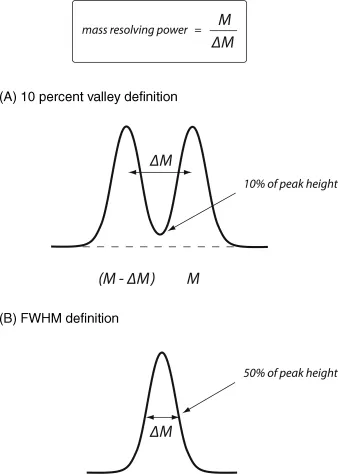
Mass analyzers separate gas-phase ions based on their mass-to-charge ratios (m/z); how well these separations can be performed and measured is defined by the instrument's mass resolving power. IUPAC recommendations allow for two definitions of mass resolving power [1]. The “10% valley definition” states that, for two singly charged ion signals of equal height in a mass spectrum at masses M and (M − ΔM) separated by a valley which, at its lowest point, is 10% of the height of either peak, mass resolving power is defined as M/ΔM. This definition of mass resolving power is illustrated in portion A of Figure 1.1. The “peak width definition” also defines mass resolving power as M/ΔM; in this definition, M refers to the mass of singly charged ions that make up a single peak, and ΔM refers to the width of this peak at a height which is a specified fraction of the maximum peak height. It is recommended that one of three specified fractions should always be used: 50%, 5%, or 0.5%. In practice, the value of 50% is frequently utilized; this common standard, illustrated in portion B of Figure 1.1, is termed the “full width at half maximum height” (FWHM) definition. The mass resolving power values quoted for the mass analyzers described in this chapter use the FWHM criterion.
Figure 1.1 Methods of calculating mass resolving power. Portion (A) illustrates calculation via the 10% valley definition. Portion (B) illustrates calculation via the FWHM definition.
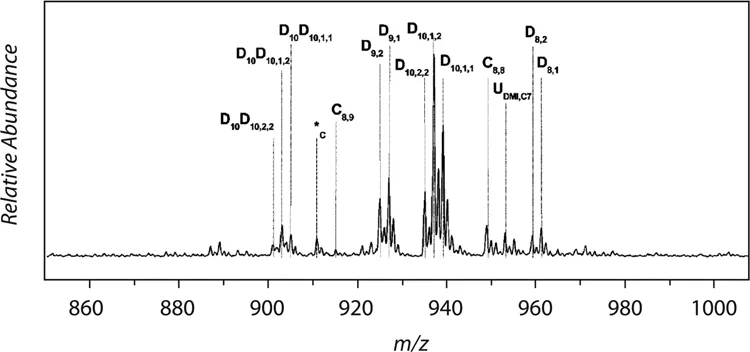
In the context of polymer analysis, the mass resolving power is important when characterizing different analyte ions of similar but nonidentical masses. These different ions may contain separate vital pieces of information. An example of this would be if the analytes of interest contain different chain end group functionalities; characterization of these distinct end groups would allow separate insights to be gained into polymer formation processes. Whether or not this information can be extracted from the mass spectrum depends on the resolving power of the mass analyzer. The importance of mass resolving power in this context has been illustrated in Figure 1.2 using data taken from a study conducted by Szablan et al., who were interested in the reactivities of primary and secondary radicals derived from various photoinitiators [2]. Through the use of a 3D ion trap mass analyzer, these authors were able to identify at least 14 different polymer end group combinations within a m/z window of 65. This allowed various different initiating radical fragments to be identified, and insights to be gained into the modes of termination that were taking place in these polymerization systems. It can be seen that the mass resolving power of the 3D ion trap allowed polymer structures differing in mass by 2 Da to be comfortably distinguished from one another.
Figure 1.2 A 3D ion trap-derived mass spectrum of the polymer obtained from an Irgacure 819-initiated pulsed laser polymerization of dimethyl itaconate, adapted from Figure 12 of Szablan et al. [2].
1.2.2 Mass Accuracy
Mass accuracy refers to the m/z measurement error – that is, the difference between the true m/z and the measured m/z of a given ion – divided by the true m/z of the ion, and is usually quoted in terms of parts per million (ppm). For a single reading, the term “mass measurement error” may be used [3]. It is usual for mass accuracy to increase with mass resolving power, and a higher mass accuracy increases the degree of confidence in which peak assignments can be made based upon the m/z. This lies in the fact that increases in mass accuracy will result in an increased likelihood of uniquely identifying the elemental compositions of observed ions.
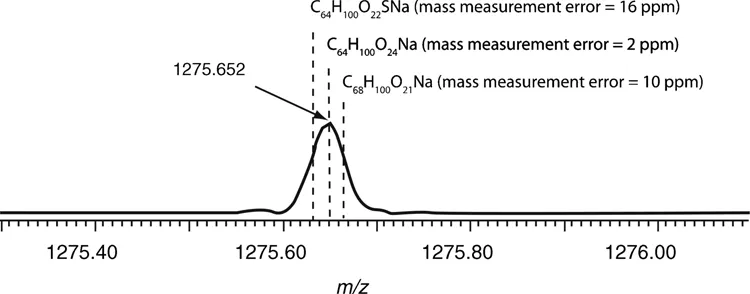
When attempting to identify peaks in mass spectra obtained from a polymer sample, it is common for different feasible analyte ions to have similar but nonisobaric masses. If the theoretical m/z's of these potential ion assignments differ by an amount lower than the expected mass accuracy of the mass analyzer, an ion assignment cannot be made based on m/z alone. Ideally such a scenario would be resolved through complementary experiments using, for example, MS/MS or alternate analytical techniques, in which one potential ion assignment is confirmed and the others are rejected. However if such methods are not practical, the use of a mass analyzer capable of greater mass accuracy may be necessary. An example of the use of ultrahigh mass accuracy data for this purpose can be found in research conducted by Gruendling et al., who were investigating the degradation of reversible addition-fragmentation chain transfer (RAFT) agent-derived polymer end groups [4]. These authors initially used a 3D ion trap instrument to identify a peak at m/z 1275.6 for which three possible degradation products could be assigned. To resolve this issue, the same sample was analyzed using a Fourier transform ion cyclotron resonance (FT-ICR) mass analyzer. As illustrated in Figure 1.3, the ultrahigh mass accuracy obtained using FT-ICR allowed two of the potential ion assignments to be ruled out based on higher than expected mass measurement errors; the mass measurement error of the third ion was reasonable, allowing a specific degradation product to be confirmed.
Figure 1.3 An FT-ICR-derived signal from the degradation product of a RAFT end group containing polymer chain. The gray chemical formulas describe potential ion assignments ruled out based on higher than expected mass measurement errors. The black chemical formula describes the ion assignment confirmed via an acceptable mass measurement error. Image adapted from Figure 2 of Gruendling et al. [4].
1.2.3 Mass Range
The mass range is the range of m/z's over which a mass analyzer can operate to record a mass spectrum. When quoting mass ranges, it is conventional to only state an upper limit; it is, however, important to note that for many mass analyzers, increasing the m/z's amenable to analysis will often compromise lower m/z measurements. As such, the mass ranges quoted for the mass analyzers described in this chapter do not necessarily reflect an absolute maximum; they instead provide an indication of the upper limits that may be achieved in standard instrumentation before performance is severely compromised.
The mass range is frequently of central importance when assessing the suitability of a given mass analyzer toward a polymer sample. For many mass analyzers, there is often a high likelihood that the polymer chains of interest are of a mass beyond the mass range; this places a severe limitation on the ability of the mass spectrometer to generate useful data. Because mass analyzers separate ions based on their m/z's, the generation of multiply charged ions may alleviate this issue. Relatively high mass resolving powers are, however, required to separate multiply charged analyte ions, and efficient and controlled multiple charging of polymer samples is generally difficult to achieve. As such, the generation of multiply charged ions is not a reliable method for overcoming mass range limitations, and for many studies, mass range capabilities will ultimately dictate a mass analyzer's suitabili...
Table of contents
- Cover
- Related Titles
- Title Page
- Copyright
- List of Contributors
- Introduction
- Chapter 1: Mass Analysis
- Chapter 2: Ionization Techniques for Polymer Mass Spectrometry
- Chapter 3: Tandem Mass Spectrometry Analysis of Polymer Structures and Architectures
- Chapter 4: Matrix-Assisted Inlet Ionization and Solvent-Free Gas-Phase Separation Using Ion Mobility Spectrometry for Imaging and Electron Transfer Dissociation Mass Spectrometry of Polymers
- Chapter 5: Polymer MALDI Sample Preparation
- Chapter 6: Surface Analysis and Imaging Techniques
- Chapter 7: Hyphenated Techniques
- Chapter 8: Automated Data Processing and Quantification in Polymer Mass Spectrometry
- Chapter 9: Comprehensive Copolymer Characterization
- Chapter 10: Elucidation of Reaction Mechanisms: Conventional Radical Polymerization
- Chapter 11: Elucidation of Reaction Mechanisms and Polymer Structure: Living/Controlled Radical Polymerization
- Chapter 12: Elucidation of Reaction Mechanisms: Other Polymerization Mechanisms
- Chapter 13: Polymer Degradation
- Chapter 14: Outlook
- Index
Trusted by 375,005 students
Access to over 1.5 million titles for a fair monthly price.
Study more efficiently using our study tools.
Frequently asked questions
Yes, you can cancel anytime from the Subscription tab in your account settings on the Perlego website. Your subscription will stay active until the end of your current billing period. Learn how to cancel your subscription
No, books cannot be downloaded as external files, such as PDFs, for use outside of Perlego. However, you can download books within the Perlego app for offline reading on mobile or tablet. Learn how to download books offline
Perlego offers two plans: Essential and Complete
- Essential is ideal for learners and professionals who enjoy exploring a wide range of subjects. Access the Essential Library with 800,000+ trusted titles and best-sellers across business, personal growth, and the humanities. Includes unlimited reading time and Standard Read Aloud voice.
- Complete: Perfect for advanced learners and researchers needing full, unrestricted access. Unlock 1.5M+ books across hundreds of subjects, including academic and specialized titles. The Complete Plan also includes advanced features like Premium Read Aloud and Research Assistant.
We are an online textbook subscription service, where you can get access to an entire online library for less than the price of a single book per month. With over 1.5 million books across 990+ topics, we’ve got you covered! Learn about our mission
Look out for the read-aloud symbol on your next book to see if you can listen to it. The read-aloud tool reads text aloud for you, highlighting the text as it is being read. You can pause it, speed it up and slow it down. Learn more about Read Aloud
Yes! You can use the Perlego app on both iOS and Android devices to read anytime, anywhere — even offline. Perfect for commutes or when you’re on the go.
Please note we cannot support devices running on iOS 13 and Android 7 or earlier. Learn more about using the app
Please note we cannot support devices running on iOS 13 and Android 7 or earlier. Learn more about using the app
Yes, you can access Mass Spectrometry in Polymer Chemistry by Christopher Barner-Kowollik, Till Gruendling, Jana Falkenhagen, Steffen Weidner, Christopher Barner-Kowollik,Till Gruendling,Jana Falkenhagen,Steffen Weidner in PDF and/or ePUB format, as well as other popular books in Sciences physiques & Spectroscopie et analyse du spectre. We have over 1.5 million books available in our catalogue for you to explore.